
Opening your dashboard
Class 10 Chemistry Chapter 8 Study of Compounds – Hydrogen Chloride: Previous Year Questions
27 questions on Chapter 8, each solved step by step. Class 10 Chemistry, ICSE 2026-27.
27 questions with solutions
1–5 marks · Mixed difficulty
- 11 mark
Question 1
The aim of the Fountain Experiment is to prove that:
Solve with AIAnswer
(A) HCl turns blue litmus red
(B) HCl is denser than air
- Correct
(C) HCl is highly soluble in water
(D) HCl fumes in moist air.
Answer: (C) HCl is highly soluble in water
Concept: Hydrogen chloride is extremely soluble in water: one volume of water dissolves about 450 volumes of the gas. When a little water dissolves a large amount of gas inside a closed flask, the pressure inside the flask falls sharply, and the air pressure outside pushes liquid in.
Step 1 — Recall the set-up.
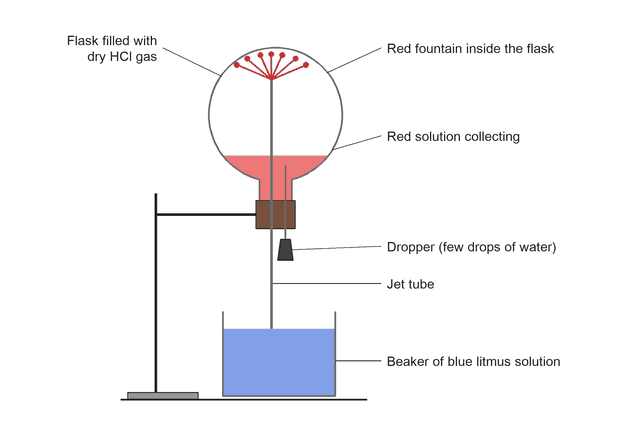
A dry round-bottom flask is filled with dry hydrogen chloride and clamped upside down. A long jet tube runs from inside the flask down into a beaker of blue litmus solution, and a dropper holding a few drops of water passes through the stopper.
Step 2 — Follow what happens when the dropper is pressed.
The few drops of water dissolve a very large volume of hydrogen chloride. So much gas disappears that the pressure inside the flask becomes much lower than the air pressure outside.
Step 3 — Explain the fountain.
The higher air pressure outside pushes the litmus solution up the jet tube, and it sprays into the flask as a fountain. A fountain can only form if the gas dissolves very fast and in very large amounts, so the experiment proves that hydrogen chloride is highly soluble in water. The fountain is red because the dissolved gas forms hydrochloric acid.
Watch out: The red colour of the fountain is a second observation (the solution is acidic); it is not the aim of the experiment.
Why the other options are wrong:
- (A) HCl turns blue litmus red: the fountain does turn red, so the solution is acidic, but that is only a side observation. The fountain itself forms because the gas dissolves so readily.
- (B) HCl is denser than air: that HCl is denser than air is shown by collecting it by upward displacement of air, not by the fountain experiment.
- (D) HCl fumes in moist air: fuming in moist air is seen at the mouth of a jar of the gas; the fountain experiment is not set up to show it.
Therefore, the fountain experiment proves that HCl is highly soluble in water, option (C).
- 25 marks
Question 2
State your observations when:
(i) Dilute Hydrochloric acid is added to Lead nitrate solution and the mixture is heated.
(ii) Barium chloride solution is mixed with Sodium Sulphate Solution.
(iii) Concentrated Sulphuric acid is added to Sugar Crystals.
(iv) Dilute Hydrochloric acid is added to Copper carbonate.
(v) Dilute Hydrochloric acid is added to Sodium thiosulphate.
Solve with AIWritten solution
Solution:
Concept: Each observation comes from the product that forms: a precipitate (and its colour), a gas (and its smell or test), or a change in colour. For each mixture we name the product first, then say what is seen.
Step 1 — (i) Dilute hydrochloric acid with lead nitrate solution, then heated.
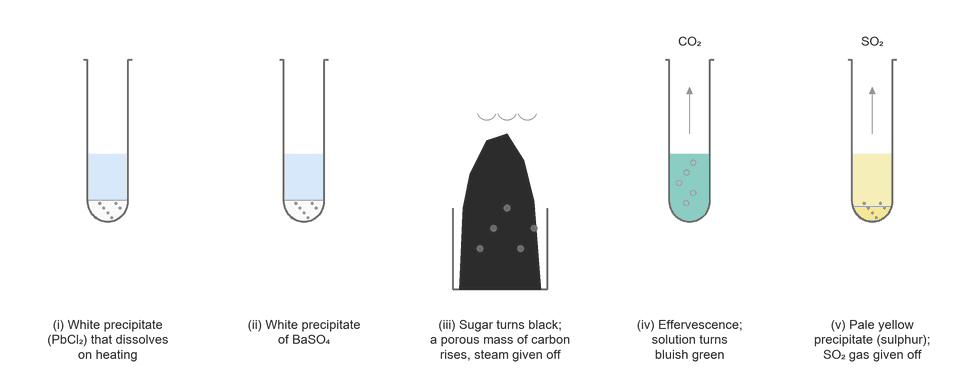
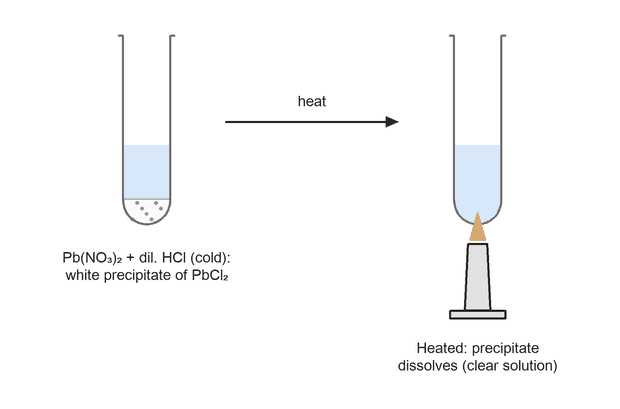
Hydrochloric acid gives lead chloride, which is insoluble in cold water, so a white precipitate forms. Lead chloride is soluble in hot water, so the precipitate dissolves on heating to give a clear solution (it comes back as crystals when the solution cools).
Step 2 — (ii) Barium chloride solution with sodium sulphate solution.
Barium ions and sulphate ions form barium sulphate, which is insoluble in water, so a white precipitate forms. It does not dissolve in dilute hydrochloric or nitric acid.
Step 3 — (iii) Concentrated sulphuric acid added to sugar crystals.
Concentrated sulphuric acid is a strong dehydrating agent: it removes the elements of water (hydrogen and oxygen in the ratio 2 : 1) from sugar. The white sugar turns yellow, then brown and finally black, and a black, spongy (porous) mass of carbon rises up. The mixture becomes very hot and steam is given off.
Step 4 — (iv) Dilute hydrochloric acid added to copper carbonate.
An acid decomposes a carbonate and gives carbon dioxide, so there is brisk effervescence of a colourless, odourless gas that turns lime water milky. The green copper carbonate dissolves and the solution turns bluish green because copper (II) chloride forms.
Step 5 — (v) Dilute hydrochloric acid added to sodium thiosulphate.
The acid decomposes thiosulphate into sulphur and sulphur dioxide. A pale yellow precipitate of sulphur appears (the solution turns cloudy yellow), and a colourless gas with the smell of burning sulphur (sulphur dioxide) is given off.
Watch out: In (i) the precipitate dissolves only when the mixture is HOT; in (v) the yellow colour comes from sulphur particles, not from the gas.
Therefore, (i) a white precipitate that dissolves on heating; (ii) a white precipitate (BaSO₄); (iii) sugar chars to a black porous mass of carbon, with heat and steam; (iv) brisk effervescence of CO₂ and a bluish-green solution; (v) a pale yellow precipitate of sulphur and SO₂ gas with the smell of burning sulphur.
- 31 mark
Question 3
Fill in the blanks from the choices given in brackets:
Potassium sulphite on reacting with hydrochloric acid releases .............. gas. (, , )
Solve with AIWritten solution
Solution:
Concept: Dilute hydrochloric acid decomposes the salts of weaker, unstable acids. A sulphite gives sulphur dioxide, a sulphide gives hydrogen sulphide and a carbonate gives carbon dioxide.
Step 1 — Identify the salt.
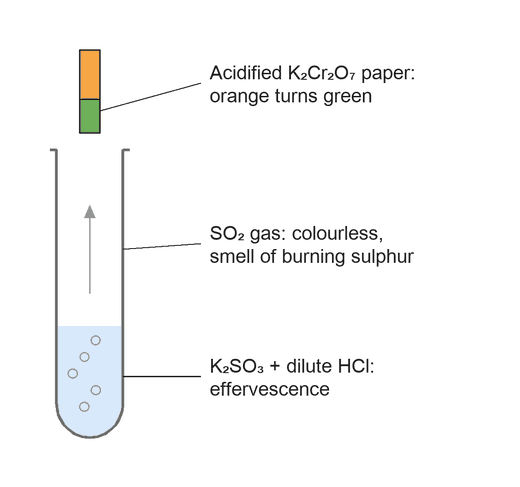
Potassium sulphite, , is a sulphite, so with hydrochloric acid it gives sulphur dioxide, water and potassium chloride.
Step 2 — Rule out the other two gases.
Chlorine forms only when hydrochloric acid is oxidised by an oxidising agent such as manganese dioxide; a sulphite does not do this. Hydrogen sulphide comes from a sulphide (S²⁻), not from a sulphite (SO₃²⁻).
Step 3 — Confirm the gas.
Sulphur dioxide is colourless, smells of burning sulphur and turns acidified potassium dichromate paper from orange to green.
Watch out: Sulphite (SO₃²⁻) gives SO₂, while sulphide (S²⁻) gives H₂S; read the name of the salt carefully.
Therefore, potassium sulphite on reacting with hydrochloric acid releases SO₂ (sulphur dioxide) gas.
- 41 mark
Question 4
State one relevant observation for each of the following reactions:
Action of dilute Hydrochloric acid on iron (II) sulphide.
Solve with AIWritten solution
Solution:
Concept: Dilute hydrochloric acid decomposes a metal sulphide and gives the metal chloride and hydrogen sulphide gas, which has the smell of rotten eggs.
Step 1 — Write the reaction.
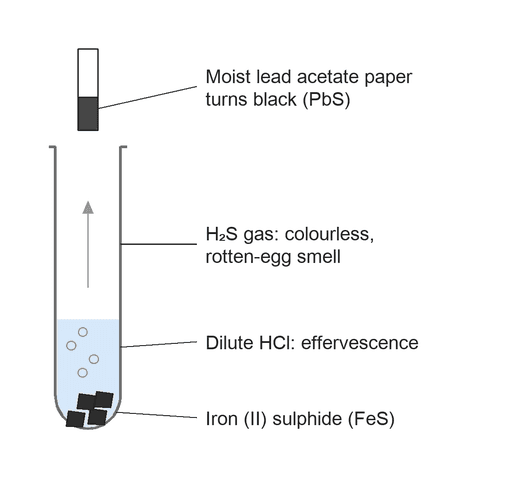
Iron (II) sulphide reacts with dilute hydrochloric acid to give iron (II) chloride and hydrogen sulphide.
Step 2 — State what is seen.
There is effervescence, and a colourless gas with the smell of rotten eggs is given off.
Step 3 — Confirm the gas.
The gas turns moist lead acetate paper black, because black lead sulphide forms on the paper.
Watch out: The gas itself is colourless; the black colour appears only on the lead acetate paper.
Therefore, a colourless gas with the smell of rotten eggs (H₂S) is given off with effervescence; it turns moist lead acetate paper black.
- 51 mark
Question 5
State one relevant observation for each of the following:
Lead nitrate solution is mixed with dilute hydrochloric acid and heated.
Solve with AIWritten solution
Solution:
Concept: Lead chloride is insoluble in cold water but soluble in hot water. So it precipitates when the solutions are mixed and dissolves again when the mixture is heated.
Step 1 — Mix the solutions.
Hydrochloric acid gives lead chloride with lead nitrate. Lead chloride does not dissolve in cold water, so a white precipitate forms.
Step 2 — Heat the mixture.
Lead chloride dissolves in hot water, so on heating the white precipitate dissolves and a clear, colourless solution is left. On cooling, lead chloride separates out again as white crystals.
Watch out: The observation asked for includes the heating; 'white precipitate' alone is only half the answer.
Therefore, a white precipitate of lead chloride forms, and it dissolves on heating to give a clear, colourless solution.
- 61 mark
Question 6
Name the gas that is produced in each of the following cases:
Action of dilute hydrochloric acid on sodium sulphide.
Solve with AIWritten solution
Solution:
Concept: Dilute hydrochloric acid decomposes sulphides and sets free hydrogen sulphide gas.
Step 1 — Write the reaction.
Sodium sulphide reacts with dilute hydrochloric acid to give sodium chloride and hydrogen sulphide.
Step 2 — Describe the gas.
Hydrogen sulphide is a colourless gas with the smell of rotten eggs. It turns moist lead acetate paper black, because black lead sulphide forms.
Therefore, the gas produced is hydrogen sulphide (H₂S).
- 71 mark
Question 7
Fill up the blanks with the correct choice given in brackets.
Dry hydrogen chloride gas can be collected by............... displacement of air. (downward / upward)
Solve with AIWritten solution
Solution:
Concept: A gas that is heavier than air is collected in a gas jar kept mouth upward: the gas sinks to the bottom and pushes the air out at the top. This is called upward displacement of air.
Step 1 — Compare hydrogen chloride with air.
We compare vapour densities. The vapour density of a gas is half its molar mass, and for air it is 14.4.
So hydrogen chloride is about 1.27 times as heavy as air.
Step 2 — Choose the method.
Because the gas is heavier than air, it collects at the bottom of an upright jar and the air is pushed up and out. Hydrogen chloride is not collected over water because it is highly soluble in water.
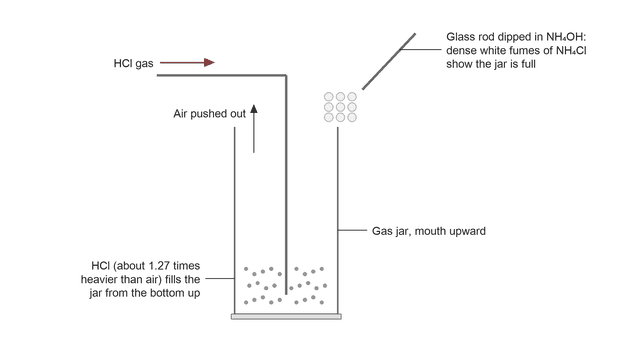
Watch out: The gas goes in at the bottom (downward delivery), but the AIR moves upward, so the method is named 'upward displacement of air'.
Therefore, dry hydrogen chloride gas can be collected by upward displacement of air.
- 83 marks
Question 8
(i) Name the acid used for the preparation of hydrogen chloride gas in the laboratory. Why is this particular acid preferred to other acids?
(ii) Write the balanced chemical equation for the laboratory preparation of hydrogen chloride gas.
Solve with AIWritten solution
Solution:
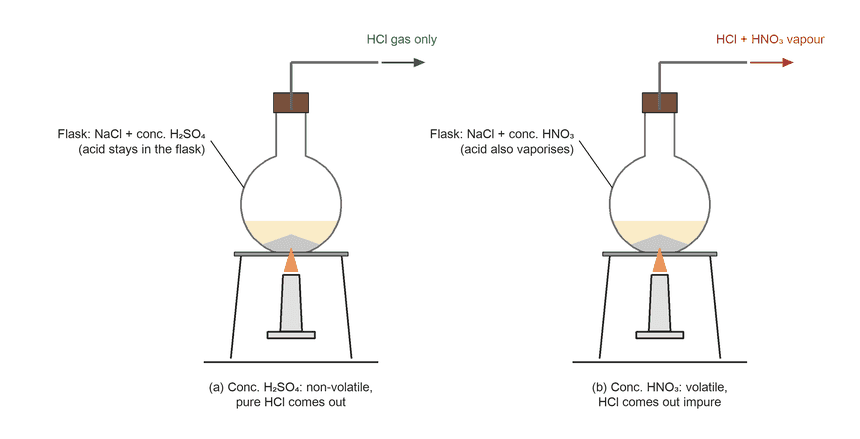
Concept: Hydrogen chloride is volatile (it boils easily). When a chloride is heated with a non-volatile acid, the volatile hydrogen chloride is driven out as a gas while the non-volatile acid stays behind.
Step 1 — (i) Name the acid.
The acid used is concentrated sulphuric acid, heated with sodium chloride.
Step 2 — (i) Say why it is preferred.
Concentrated sulphuric acid is non-volatile (it has a high boiling point, about 338 °C). On heating, the hydrogen chloride escapes while the sulphuric acid stays in the flask, so the gas comes off free from acid vapour. A volatile acid such as concentrated nitric acid would vaporise and come out with the hydrogen chloride, making the gas impure.
Step 3 — (ii) Write the balanced equation.
Sodium chloride is heated gently with concentrated sulphuric acid, keeping the temperature below 200 °C, so the reaction stops at sodium hydrogen sulphate.
The hydrogen chloride keeps escaping as a gas, so the reaction goes on until the salt is used up.
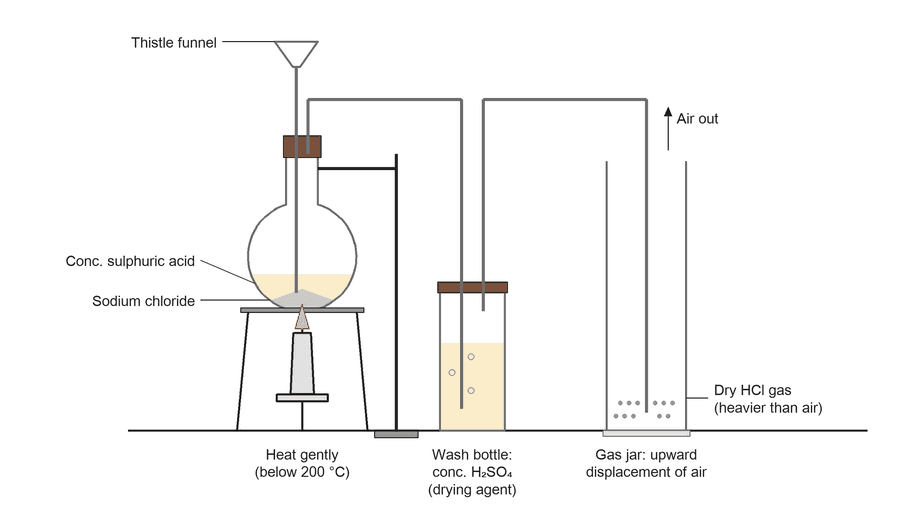
Watch out: The reason is that sulphuric acid is non-volatile, not that it is a drying agent; its drying action is used later, in the wash bottle.
Therefore, (i) concentrated sulphuric acid is used because it is non-volatile, so the volatile HCl escapes free from acid vapour; (ii) NaCl + H₂SO₄ → NaHSO₄ + HCl (below 200 °C).
- 92 marks
Question 9
For the preparation of hydrochloric acid in the laboratory:
(i) Why is direct absorption of hydrogen chloride gas in water not feasible?
(ii) What arrangement is done to dissolve hydrogen chloride gas in water?
Solve with AIWritten solution
Solution:
Concept: Hydrogen chloride dissolves in water extremely fast and in very large amounts (about 450 volumes in one volume of water). If the gas is led straight into water, the pressure in the apparatus falls and water is sucked back.
Step 1 — (i) Explain what goes wrong with a delivery tube dipping into water.
The gas dissolves so quickly that the pressure in the delivery tube and the generating flask falls below the air pressure outside. The outside air pressure then forces water back up the tube into the hot flask. This is called back suction.
Step 2 — (i) Say why back suction is dangerous.
The water meets hot concentrated sulphuric acid in the flask. A lot of heat is given out at once, so the acid can spurt and the flask can crack; the preparation is also spoilt.
Step 3 — (ii) Describe the arrangement.
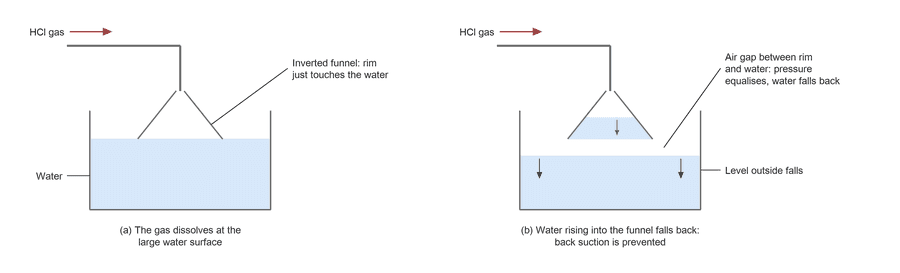
The delivery tube is joined to an inverted funnel whose rim just touches the water in a beaker or trough.
Step 4 — (ii) Explain how the funnel stops back suction.
When the gas dissolves fast, water rises into the wide funnel. This lowers the water level outside, so the rim comes out of the water and an air gap forms. Air enters, the pressure inside becomes equal to the pressure outside, and the water in the funnel falls back. This repeats until the water is saturated with the gas and becomes hydrochloric acid.
Step 5 — (ii) Note the second advantage.
The wide mouth of the funnel also gives a large surface area of water, so the gas is absorbed quickly. For extra safety, an empty flask can be placed between the generating flask and the funnel, so that any water sucked back collects there.
Watch out: The funnel's rim should only touch the water; if the funnel is pushed deep under the water, the air gap cannot form and back suction is not prevented.
Therefore, (i) direct absorption is not feasible because HCl is so soluble that water is sucked back into the generating flask (back suction); (ii) the gas is led through an inverted funnel whose rim just touches the water, which prevents back suction and gives a large surface for absorption.
- 101 mark
Question 10
The drying agent used to dry HCl gas is:
Solve with AIAnswer
- Correct
(A) Conc.
(B) ZnO
(C)
(D) CaO
Answer: (A) Conc.
Concept: A drying agent must remove water vapour from a gas without reacting with the gas itself. Hydrogen chloride is an acidic gas, so a basic or amphoteric oxide cannot be used to dry it.
Step 1 — Pick the drying agent that leaves HCl unchanged.
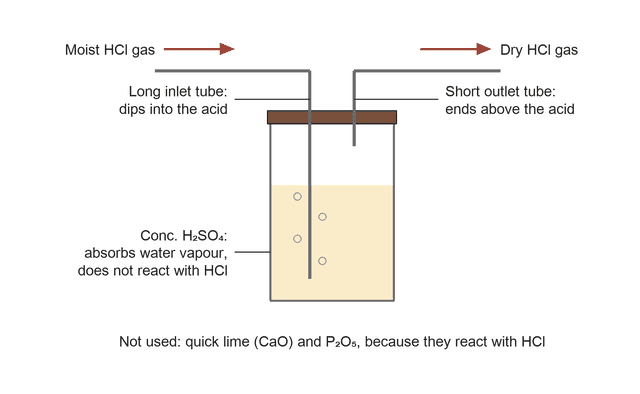
Concentrated sulphuric acid is itself an acid, so it does not react with hydrogen chloride, and it absorbs water vapour strongly. The moist gas is bubbled through it in a wash bottle and comes out dry.
Step 2 — Check the oxides.
Zinc oxide and aluminium oxide are amphoteric and calcium oxide is basic, so all three react with hydrogen chloride. For example, quick lime forms calcium chloride and water:
Watch out: A substance that absorbs water is not automatically a drying agent for every gas; it must not react with the gas.
Why the other options are wrong:
- (B) ZnO: zinc oxide is amphoteric; it reacts with HCl to form zinc chloride and water, so it would absorb the gas.
- (C) : aluminium oxide is also amphoteric and reacts with HCl to form aluminium chloride and water.
- (D) CaO: calcium oxide (quick lime) is a basic oxide; it neutralises HCl to form calcium chloride and water.
Therefore, the drying agent used to dry HCl gas is conc. H₂SO₄, option (A).
- 111 mark
Question 11
Fill in the blanks with the choices given in brackets:
When sodium chloride is heated with concentrated sulphuric acid below 200°C, one of the products formed is ............... (sodium hydrogen sulphate / sodium sulphate / chlorine)
Solve with AIWritten solution
Solution:
Concept: The product of sodium chloride and concentrated sulphuric acid depends on the temperature. Below 200 °C the reaction stops at the acid salt, sodium hydrogen sulphate; above 200 °C it goes on to the normal salt, sodium sulphate.
Step 1 — Write the reaction below 200 °C.
At the lower temperature only one hydrogen of the sulphuric acid is replaced, so the products are sodium hydrogen sulphate and hydrogen chloride.
Step 2 — Compare with the reaction above 200 °C.
At a higher temperature both hydrogens are replaced and sodium sulphate forms.
The laboratory preparation is kept below 200 °C: a higher temperature wastes fuel, may crack the glass, and the sodium sulphate forms a hard crust that sticks to the flask.
Step 3 — Rule out chlorine.
Chlorine is not formed, because concentrated sulphuric acid does not oxidise the chloride here; chlorine needs an oxidising agent such as manganese dioxide.
Watch out: 'Below 200 °C' points to the hydrogen sulphate (NaHSO₄), not the sulphate (Na₂SO₄).
Therefore, one of the products formed is sodium hydrogen sulphate.
- 121 mark
Question 12
State one relevant reason for each of the following:
(v) Hydrogen chloride gas fumes in moist air.
Solve with AIWritten solution
Solution:
Concept: Hydrogen chloride is extremely soluble in water, even in the tiny amount of water vapour present in the air.
Step 1 — Follow the gas into moist air.
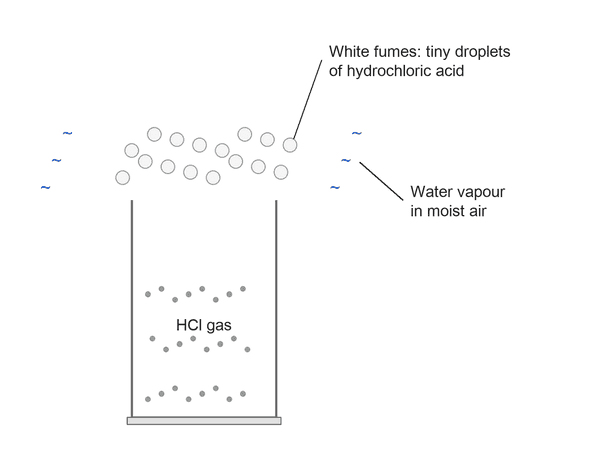
When hydrogen chloride escapes into moist air, it dissolves in the water vapour of the air.
Step 2 — Explain the fumes.
Each tiny drop of water takes up the gas and becomes a droplet of hydrochloric acid. A cloud of these tiny droplets scatters light and is seen as white fumes, for example at the mouth of a jar full of the gas.
Watch out: The fumes are droplets of hydrochloric acid; dry hydrogen chloride itself is a colourless gas.
Therefore, hydrogen chloride fumes in moist air because it dissolves in the atmospheric water vapour, forming tiny droplets of hydrochloric acid, which are seen as white fumes.
- 133 marks
Question 13
Complete the following by selecting the correct option from the choices given:
(i) pH of acetic acid is greater than dilute sulphuric acid. So acetic acid contains ............... concentration of ions. (greater, same, low)
(ii) The indicator which does not change colour on passage of HCl gas is ............... . (methyl orange, moist blue litmus, phenolphthalein)
(iii) The acid which cannot act as an oxidizing agent is ............... . (conc. , conc. , conc. HCl)
Solve with AIWritten solution
Solution:
Concept: The pH of a solution measures its hydrogen ion concentration: the higher the pH, the lower the concentration of H⁺ (H₃O⁺) ions. Indicators change colour with H⁺ ions, and an acid that is itself easily oxidised cannot act as an oxidising agent.
Step 1 — (i) Compare acetic acid with dilute sulphuric acid.
Acetic acid is a weak acid that ionises only partly, while sulphuric acid is a strong acid that ionises almost completely. Acetic acid therefore has a higher pH, which means it contains a low concentration of ions.
Step 2 — (ii) Find the indicator that stays the same.
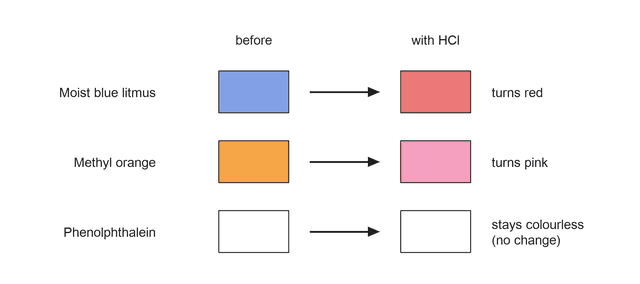
Hydrogen chloride dissolves in the water of a moist indicator and forms hydrochloric acid. Moist blue litmus turns red and methyl orange turns pink (red), but phenolphthalein is colourless in acids and in neutral solutions, so it stays colourless: it shows no change.
Step 3 — (iii) Find the acid that cannot act as an oxidising agent.
Concentrated sulphuric acid and concentrated nitric acid both act as oxidising agents. Concentrated hydrochloric acid is instead oxidised by strong oxidising agents such as manganese dioxide, giving chlorine; so it acts as a reducing agent.
Watch out: In (i), a greater pH means FEWER H⁺ ions, not more.
Therefore, (i) low; (ii) phenolphthalein; (iii) conc. HCl.
- 144 marks
Question 14
Hydrogen chloride gas is prepared in the laboratory using concentrated sulphuric acid and sodium chloride. Answer the questions that follow based on this reaction:
(i) Give the balanced chemical equation for the reaction with suitable condition(s) if any.
(ii) Why is concentrated sulphuric acid used instead of concentrated nitric acid?
(iii) How is the gas collected?
(iv) Name the drying agent not used for drying the gas.
Solve with AIWritten solution
Solution:
Concept: In the laboratory, hydrogen chloride is made by heating sodium chloride (rock salt) with concentrated sulphuric acid. The temperature is kept below 200 °C, so the reaction stops at sodium hydrogen sulphate (NaHSO₄); the more volatile acid, HCl, is driven off by the less volatile (non-volatile) sulphuric acid. The gas is acidic, heavier than air and very soluble in water; these facts decide how it is dried and collected.
Step 1 — (i) Write the equation with its condition.
Sodium chloride is heated gently with concentrated sulphuric acid, keeping the temperature below 200 °C.
Above 200 °C sodium sulphate would form instead, but the higher temperature is avoided: it wastes fuel, may crack the glass, and the sodium sulphate forms a hard crust that is difficult to remove from the flask.
Step 2 — (ii) Explain the choice of sulphuric acid.
Concentrated sulphuric acid is non-volatile, so it stays in the flask while the volatile hydrogen chloride escapes. Concentrated nitric acid is volatile; it would vaporise and come out with the hydrogen chloride, making the gas impure.
Step 3 — (iii) Decide how the gas is collected.
We compare the vapour density of hydrogen chloride with that of air (14.4).
Hydrogen chloride is about 1.27 times as heavy as air, so it is collected by upward displacement of air in a gas jar kept mouth upward. It is not collected over water because it is highly soluble in water.
Step 4 — (iv) Name a drying agent that is not used.
Quick lime (calcium oxide) is not used. It is a basic oxide and reacts with the acidic gas instead of only removing the water vapour.
Phosphorus pentoxide is not used either, because it also reacts with hydrogen chloride:
The gas is dried by bubbling it through concentrated sulphuric acid.
Watch out: The condition 'below 200 °C' is part of the answer to (i); without it the equation is incomplete.
Therefore, (i) NaCl + H₂SO₄ → NaHSO₄ + HCl, heated below 200 °C; (ii) conc. H₂SO₄ is non-volatile, while conc. HNO₃ is volatile and would make the gas impure; (iii) by upward displacement of air; (iv) quick lime, CaO (also P₂O₅).
- 151 mark
Question 15
Hydrogen chloride gas is not collected over water, as:
Solve with AIAnswer
- Correct
(A) It is highly soluble in water.
(B) It is less soluble in water.
(C) It is lighter than air.
(D) It is heavier than air.
Answer: (A) It is highly soluble in water.
Concept: A gas can be collected over water only if it hardly dissolves in water. Hydrogen chloride dissolves in water to a very large extent.
Step 1 — Recall how soluble the gas is.
One volume of water dissolves about 450 volumes of hydrogen chloride, so the gas is highly soluble in water.
Step 2 — See what would happen over water.
If the gas were bubbled into a jar of water, it would dissolve and form hydrochloric acid instead of collecting in the jar. So it is collected by upward displacement of air instead.
Watch out: Being heavier than air is also true, but it explains HOW the gas is collected, not why water is avoided.
Why the other options are wrong:
- (B) It is less soluble in water: hydrogen chloride is highly soluble, not less soluble, in water; a gas of low solubility could be collected over water.
- (C) It is lighter than air: the vapour density of HCl is 18.25 against 14.4 for air, so it is about 1.27 times heavier than air, not lighter.
- (D) It is heavier than air: it is indeed heavier than air, but that decides the method of collection (upward displacement of air), not why it is not collected over water.
Therefore, HCl is not collected over water because it is highly soluble in water, option (A).
- 161 mark
Question 16
Identify the terms for the following:
(b) The experiment used to demonstrate the high solubility of HCl gas.
Solve with AIWritten solution
Solution:
Concept: The high solubility of hydrogen chloride can be shown by making water rush into a flask of the gas so fast that it sprays like a fountain.
Step 1 — Name the experiment.
The experiment is the fountain experiment.
Step 2 — Say how it shows the solubility.
A dry flask of dry hydrogen chloride is clamped upside down with a jet tube dipping into blue litmus solution. A few drops of water from a dropper dissolve so much gas that the pressure inside the flask falls sharply. The air pressure outside pushes the litmus solution up the jet tube, and it sprays into the flask as a red fountain (red because the solution is acidic).
Therefore, the experiment is the fountain experiment.
- 172 marks
Question 17
Write the balanced chemical equation for the following:
(a) Action of heat on manganese dioxide and concentrated hydrochloric acid.
(b) Zinc reacts with dilute hydrochloric acid to form zinc chloride.
Solve with AIWritten solution
Solution:
Concept: Manganese dioxide is an oxidising agent that oxidises concentrated hydrochloric acid to chlorine. Zinc is above hydrogen in the activity series, so it displaces hydrogen from dilute hydrochloric acid.
Step 1 — (a) Write the equation for manganese dioxide and conc. HCl.
On heating, manganese dioxide oxidises the acid; manganese (II) chloride, water and chlorine are formed.
A greenish-yellow gas, chlorine, is given off.
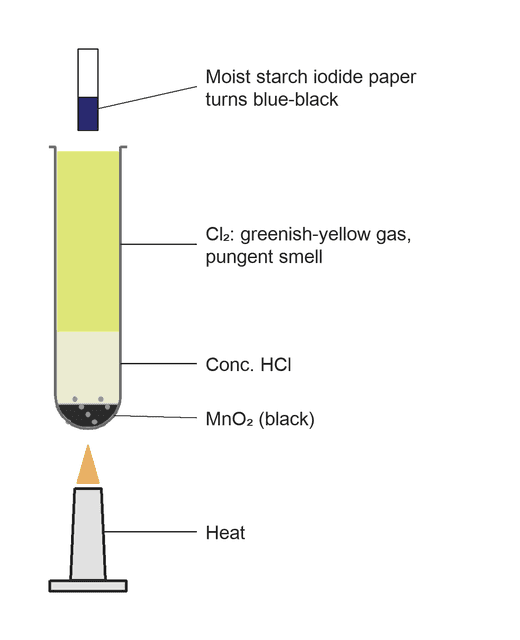
Step 2 — (b) Write the equation for zinc and dilute HCl.
Zinc displaces hydrogen from the acid and forms zinc chloride.
Zinc dissolves with effervescence; the hydrogen burns with a 'pop' sound.
Watch out: In (a) four molecules of HCl are needed: two give chlorine and two combine with manganese as MnCl₂.
Therefore, (a) MnO₂ + 4HCl → MnCl₂ + 2H₂O + Cl₂ (on heating); (b) Zn + 2HCl → ZnCl₂ + H₂.
- 181 mark
Question 18
In the laboratory preparation, HCl gas is dried by passing through:
Solve with AIAnswer
(A) dilute nitric acid
- Correct
(B) concentrated sulphuric acid
(C) dilute sulphuric acid
(D) acidified water
Answer: (B) concentrated sulphuric acid
Concept: A drying agent must absorb water vapour and must not react with, or dissolve, the gas being dried. Concentrated sulphuric acid absorbs water strongly; dilute solutions are mostly water.
Step 1 — Pick the liquid that removes water vapour.
Concentrated sulphuric acid absorbs water vapour strongly and does not react with hydrogen chloride, which is itself acidic.
Step 2 — Describe how it is used.
The moist gas is bubbled through concentrated sulphuric acid in a wash bottle (long tube in, short tube out); it comes out dry and is then collected by upward displacement of air.
Watch out: Only the CONCENTRATED acid is a drying agent; a dilute acid is mostly water.
Why the other options are wrong:
- (A) dilute nitric acid: dilute nitric acid is mostly water. Hydrogen chloride, being highly soluble, would dissolve in it, and a dilute acid cannot remove water vapour.
- (C) dilute sulphuric acid: dilute sulphuric acid is also mostly water, so the gas would dissolve in it instead of being dried.
- (D) acidified water: acidified water is water; the gas would dissolve in it and form hydrochloric acid.
Therefore, HCl gas is dried by passing it through concentrated sulphuric acid, option (B).
- 191 mark
Question 19
The property exhibited by concentrated sulphuric acid when it is used to prepare hydrogen chloride gas from potassium chloride:
Solve with AIAnswer
(A) Dehydrating property
(B) Drying property
(C) Oxidizing property
- Correct
(D) Non-volatile acid property
Answer: (D) Non-volatile acid property
Concept: A non-volatile acid, on heating, drives out a volatile acid from its salt. Concentrated sulphuric acid is non-volatile; hydrogen chloride is volatile.
Step 1 — Write the reaction.
Potassium chloride is heated with concentrated sulphuric acid below 200 °C, giving potassium hydrogen sulphate and hydrogen chloride.
Step 2 — Name the property used.
On heating, the volatile hydrogen chloride escapes as a gas, while the sulphuric acid, which boils only at about 338 °C, stays behind. So the property used is that sulphuric acid is a non-volatile acid.
Watch out: Conc. sulphuric acid has several properties; ask what it does in THIS reaction.
Why the other options are wrong:
- (A) Dehydrating property: the dehydrating property means removing the elements of water from a compound, as when the acid chars sugar. No water is removed from potassium chloride here.
- (B) Drying property: the drying property is used later, when the gas is passed through conc. sulphuric acid to remove moisture; it plays no part in producing the gas.
- (C) Oxidizing property: no element changes its oxidation number in this reaction, and the chloride is not oxidised to chlorine, so the oxidising property is not used.
Therefore, the property shown is the non-volatile acid property, option (D).
- 201 mark
Question 20
State a relevant reason for the following:
(a) Hydrogen chloride gas cannot be dried over quick lime.
Solve with AIWritten solution
Solution:
Concept: A drying agent must remove water vapour without reacting with the gas it dries.
Step 1 — Compare the natures of the two substances.
Quick lime (calcium oxide) is a basic oxide, while hydrogen chloride is an acidic gas.
Step 2 — See what happens when they meet.
A base and an acid react. Quick lime would neutralise the hydrogen chloride, forming calcium chloride and water, so the gas would be used up instead of dried.
Step 3 — State the right drying agent.
Hydrogen chloride is therefore dried by bubbling it through concentrated sulphuric acid.
Therefore, HCl cannot be dried over quick lime because quick lime is basic and reacts with the acidic HCl gas (forming calcium chloride and water).
- 211 mark
Question 21
Convert the following reactions into a balanced chemical equation:
(c) Ferrous sulphide to hydrogen sulphide using hydrochloric acid.
Solve with AIWritten solution
Solution:
Concept: Dilute hydrochloric acid decomposes a metal sulphide, giving the metal chloride and hydrogen sulphide gas.
Step 1 — Write the formulae.
Ferrous sulphide is iron (II) sulphide, ; with hydrochloric acid it gives iron (II) chloride, , and hydrogen sulphide, .
Step 2 — Balance the equation.
Two chlorine atoms are needed for FeCl₂, so two molecules of HCl are used; this also gives the two hydrogen atoms of H₂S.
Each side now has 1 Fe, 1 S, 2 H and 2 Cl.
Therefore, FeS + 2HCl → FeCl₂ + H₂S.
- 221 mark
Question 22
Identify the gas evolved in each of the following reactions:
(c) reacts with concentrated HCl.
Solve with AIWritten solution
Solution:
Concept: Manganese dioxide is a strong oxidising agent; on heating, it oxidises concentrated hydrochloric acid to chlorine.
Step 1 — Write the reaction.
Manganese dioxide takes hydrogen away from the acid as water, and chlorine is set free.
Step 2 — Describe and test the gas.
Chlorine is a greenish-yellow gas with a pungent, choking smell. It turns moist starch iodide paper blue-black, because it sets free iodine from potassium iodide and iodine turns starch blue-black.
Therefore, the gas evolved is chlorine (Cl₂).
- 233 marks
Question 23
Hydrogen chloride gas is prepared in the laboratory by the action of concentrated sulphuric acid on sodium chloride.
(a) Give balanced chemical equation for the above reaction.
(b) State the method of collection of the gas formed above.
(c) What is the property of sulphuric acid that makes it a suitable reagent for the reaction?
Solve with AIWritten solution
Solution:
Concept: In the laboratory, hydrogen chloride is made by heating sodium chloride (rock salt) with concentrated sulphuric acid. The temperature is kept below 200 °C, so the reaction stops at sodium hydrogen sulphate (NaHSO₄); the more volatile acid, HCl, is driven off by the less volatile (non-volatile) sulphuric acid.
Step 1 — (a) Write the balanced equation.
Sodium chloride is heated gently with concentrated sulphuric acid, below 200 °C.
Step 2 — (b) State the method of collection.
We compare the vapour density of hydrogen chloride with that of air (14.4).
Hydrogen chloride is about 1.27 times as heavy as air, so it is collected by upward displacement of air (downward delivery) in a gas jar kept mouth upward. It is not collected over water because it is highly soluble in water.
Step 3 — (c) Name the property of sulphuric acid.
Sulphuric acid is a non-volatile acid (it boils only at about 338 °C). On heating, the volatile hydrogen chloride escapes while the sulphuric acid stays in the flask, so the gas comes off free from acid vapour.
Watch out: The property asked in (c) is non-volatility, not the drying (dehydrating) property.
Therefore, (a) NaCl + H₂SO₄ → NaHSO₄ + HCl (below 200 °C); (b) by upward displacement of air; (c) sulphuric acid is a non-volatile acid.
- 243 marks
Question 24
Rohit took two different salt solutions in test tubes C and D as shown in the figure below. He added dilute to each of the two test tubes. The products formed in the test tubes C and D are silver chloride and lead chloride respectively.
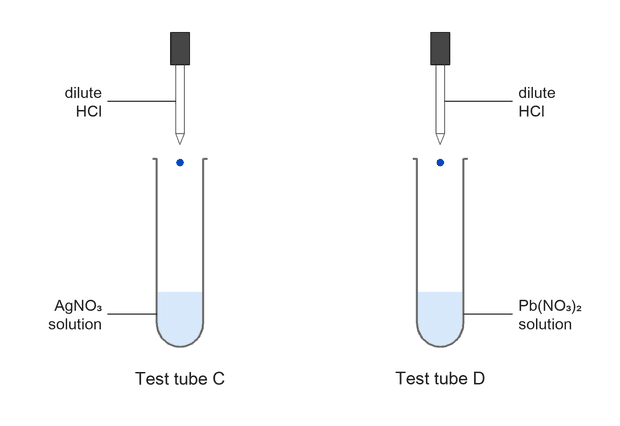
State:
(a) one common observation made by Rohit in both the reactions.
(b) the observations made by him on addition of excess of ammonium hydroxide to the products formed in:
(1) test tube C
(2) test tube D
Solve with AIWritten solution
Solution:
Concept: Silver chloride and lead chloride are both white and insoluble in cold water. Ammonium hydroxide tells them apart: silver chloride dissolves in it, forming a soluble complex, while lead chloride gives a white precipitate of lead hydroxide that does not dissolve in excess.
Step 1 — (a) Find the common observation.
Dilute hydrochloric acid gives silver chloride in test tube C and lead chloride in test tube D. Both are insoluble, so a white precipitate forms in both test tubes.
Step 2 — (b)(1) Add excess ammonium hydroxide to test tube C.
Silver chloride dissolves in excess ammonium hydroxide, forming the soluble complex salt diammine silver (I) chloride. The white precipitate dissolves and a clear, colourless solution is obtained.
Step 3 — (b)(2) Add excess ammonium hydroxide to test tube D.
Lead chloride reacts to form lead hydroxide, which is also white and does not dissolve in excess ammonium hydroxide. So a white precipitate remains (it is insoluble in excess).
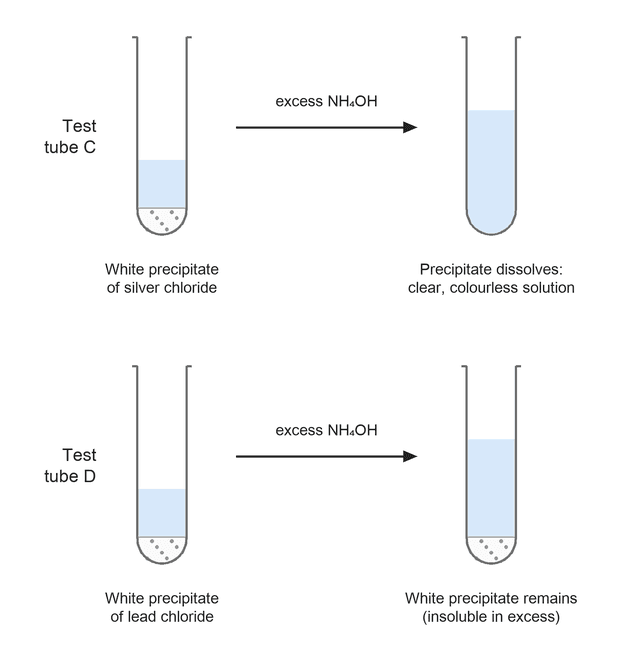
Watch out: Both precipitates look the same at first; only the excess ammonium hydroxide shows the difference.
Therefore, (a) a white precipitate forms in both test tubes; (b)(1) in C the white precipitate dissolves in excess NH₄OH, giving a clear colourless solution; (b)(2) in D a white precipitate remains, insoluble in excess NH₄OH.
- 251 mark
Question 25
A white precipitate is formed when dilute hydrochloric acid reacts with ‘X’. The white precipitate is soluble in excess of and insoluble in dilute . Identify ‘X’.
Solve with AIAnswer
- Correct
(A)
(B)
(C)
(D)
Answer: (A)
Concept: Two tests show HCl and chloride ions: (1) a glass rod dipped in ammonia solution gives dense white fumes of ammonium chloride; (2) silver nitrate solution gives a curdy white precipitate of silver chloride, which is insoluble in dilute nitric acid but soluble in ammonium hydroxide.
Step 1 — Form the precipitate.
Silver nitrate solution reacts with dilute hydrochloric acid and gives a curdy white precipitate of silver chloride.
Step 2 — Match the two tests in the question.
Silver chloride does not dissolve in dilute nitric acid, but it dissolves in excess ammonium hydroxide, forming the soluble complex diammine silver (I) chloride. Both facts match the question, so X is silver nitrate.
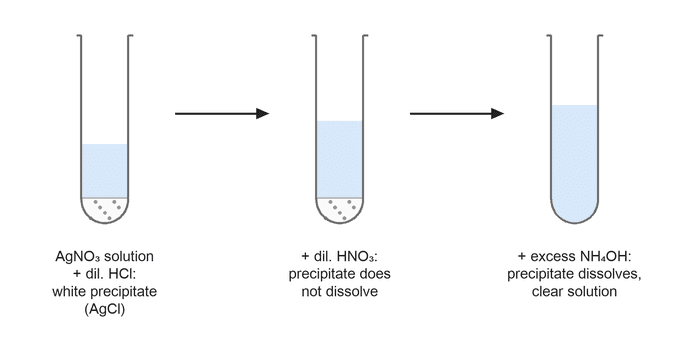
Watch out: AgCl is the PRECIPITATE; the question asks for X, the substance that reacts with the acid.
Why the other options are wrong:
- (B) : ammonium chloride is itself a chloride; with hydrochloric acid it forms no new insoluble substance, so no precipitate appears.
- (C) : silver chloride is the white precipitate itself, the product of the test, not the substance that reacts with the acid to form it.
- (D) : calcium chloride is a soluble chloride; it gives no precipitate with hydrochloric acid.
Therefore, X is silver nitrate, AgNO₃, option (A).
- 262 marks
Question 26
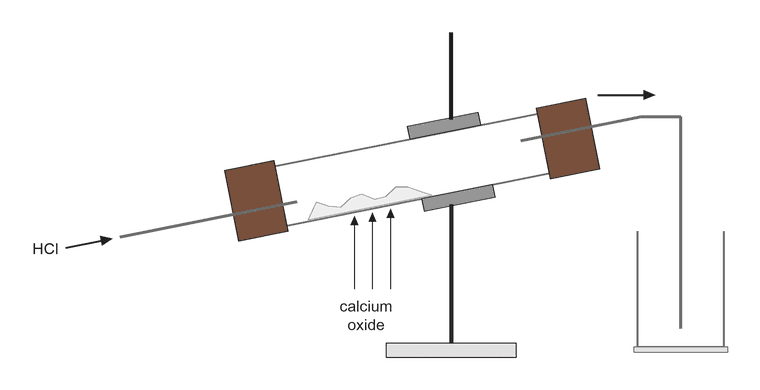
Calcium oxide is a drying agent which removes water vapour. A student wanted to collect a dry sample of the hydrogen chloride gas produced. The student set up the apparatus as shown below but was unsuccessful in collecting any gas.
(a) What mistake did the student make?
(b) What change should be made by the student in order to collect the dry gas?
Solve with AIWritten solution
Solution:
Concept: A drying agent must remove water vapour without reacting with the gas. Hydrogen chloride is an acidic gas, so it cannot be dried with a basic substance.
Step 1 — (a) Find the mistake.
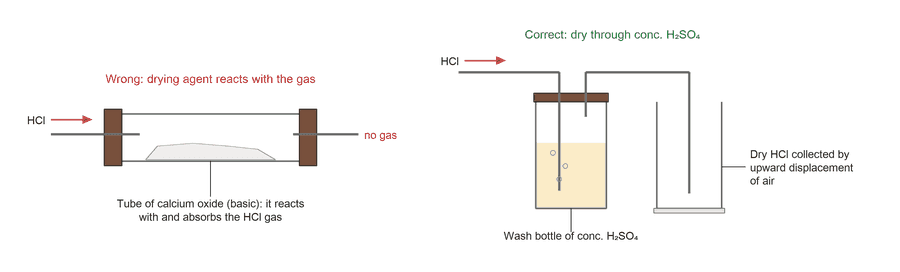
The student passed the gas over calcium oxide (quick lime). Calcium oxide is a basic oxide, so it reacts with the acidic hydrogen chloride and absorbs it. No hydrogen chloride came out of the tube, so none could be collected.
Step 2 — (b) Choose the right drying agent.
Calcium oxide should be replaced by concentrated sulphuric acid, which removes water vapour and does not react with hydrogen chloride. The gas is bubbled through the acid in a wash bottle: the inlet tube dips into the acid and the outlet tube ends above it.
Step 3 — (b) Collect the dry gas.
The dry gas is then collected, as in the student's set-up, by upward displacement of air, because hydrogen chloride is heavier than air.
Watch out: Calcium oxide IS a drying agent, but only for gases that do not react with it (for example ammonia); a drying agent must suit the gas.
Therefore, (a) the student used calcium oxide, a basic drying agent, which reacts with and absorbs the acidic HCl gas; (b) the gas should be dried by passing it through concentrated sulphuric acid instead.
- 271 mark
Question 27
What do you observe when concentrated hydrochloric acid is added to manganese dioxide and then heated?
Solve with AIAnswer
(A) A colourless gas is liberated that puts out a burning splinter with a 'pop' sound.
(B) A reddish-brown gas is liberated that turns moist potassium iodide paper brown.
(C) A colourless gas is liberated that turns lime water milky.
- Correct
(D) A greenish yellow gas is liberated that turns moist starch iodide paper blue-black.
Answer: (D) A greenish yellow gas is liberated that turns moist starch iodide paper blue-black.
Concept: Manganese dioxide is an oxidising agent. On heating, it oxidises concentrated hydrochloric acid to chlorine.
Step 1 — Write the reaction.
Manganese dioxide and concentrated hydrochloric acid give manganese (II) chloride, water and chlorine.
Step 2 — Describe the gas.
Chlorine is a greenish-yellow gas with a pungent smell.
Step 3 — Recall its test.
Chlorine sets free iodine from potassium iodide, and iodine turns starch blue-black, so moist starch iodide paper turns blue-black.
Why the other options are wrong:
- (A) A colourless gas is liberated that puts out a burning splinter with a 'pop' sound: a colourless gas that burns with a 'pop' is hydrogen, given off when dilute hydrochloric acid acts on an active metal such as zinc, not on manganese dioxide.
- (B) A reddish-brown gas is liberated that turns moist potassium iodide paper brown: a reddish-brown gas is nitrogen dioxide (or bromine vapour); chlorine is greenish yellow, not reddish brown.
- (C) A colourless gas is liberated that turns lime water milky: a colourless gas that turns lime water milky is carbon dioxide, given off when the acid acts on a carbonate.
Therefore, a greenish-yellow gas (chlorine) is given off that turns moist starch iodide paper blue-black, option (D).