
Question 181 markMCQAsked 2023Easy
In the laboratory preparation, HCl gas is dried by passing through:
Confirming your payment
Sign up now and get 250 free tokens.
Previous Year Questions · Question 18 of 27
In the laboratory preparation, HCl gas is dried by passing through:
(A) dilute nitric acid
(B) concentrated sulphuric acid
(C) dilute sulphuric acid
(D) acidified water
Answer: (B) concentrated sulphuric acid
Concept: A drying agent must absorb water vapour and must not react with, or dissolve, the gas being dried. Concentrated sulphuric acid absorbs water strongly; dilute solutions are mostly water.
Step 1 — Pick the liquid that removes water vapour.
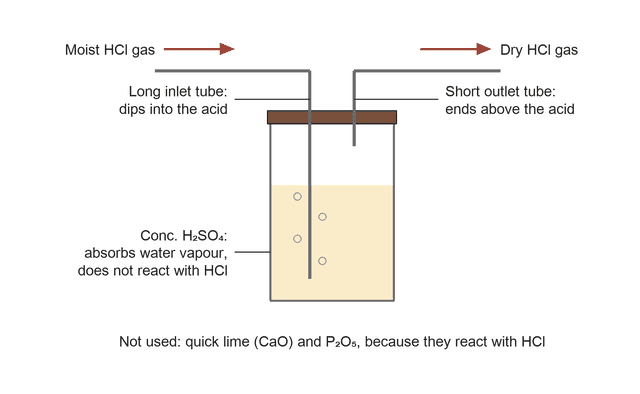
Concentrated sulphuric acid absorbs water vapour strongly and does not react with hydrogen chloride, which is itself acidic.
Step 2 — Describe how it is used.
The moist gas is bubbled through concentrated sulphuric acid in a wash bottle (long tube in, short tube out); it comes out dry and is then collected by upward displacement of air.
Watch out: Only the CONCENTRATED acid is a drying agent; a dilute acid is mostly water.
Why the other options are wrong:
Therefore, HCl gas is dried by passing it through concentrated sulphuric acid, option (B).