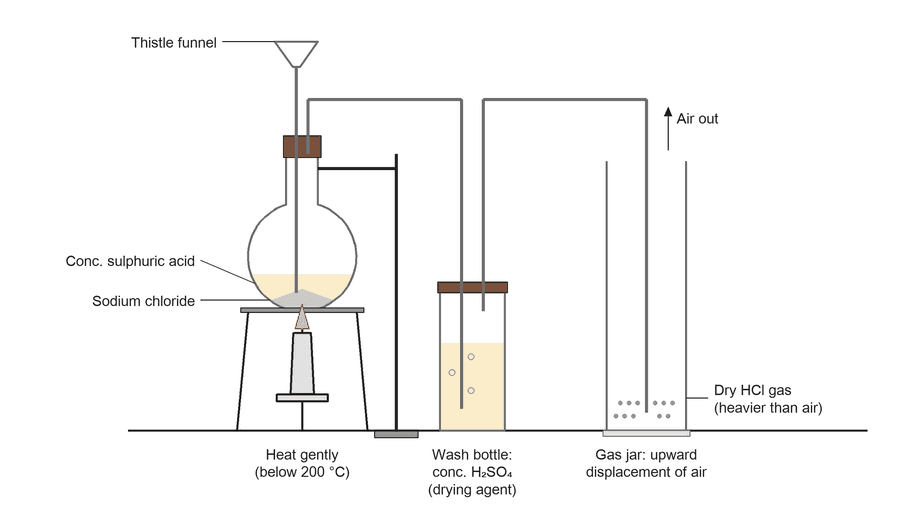
Hydrogen chloride gas is prepared in the laboratory using concentrated sulphuric acid and sodium chloride.
Question 144 marksAsked 2020Medium
Hydrogen chloride gas is prepared in the laboratory using concentrated sulphuric acid and sodium chloride. Answer the questions that follow based on this reaction:
(i) Give the balanced chemical equation for the reaction with suitable condition(s) if any.
(ii) Why is concentrated sulphuric acid used instead of concentrated nitric acid?
(iii) How is the gas collected?
(iv) Name the drying agent not used for drying the gas.
Solution:
Concept: In the laboratory, hydrogen chloride is made by heating sodium chloride (rock salt) with concentrated sulphuric acid. The temperature is kept below 200 °C, so the reaction stops at sodium hydrogen sulphate (NaHSO₄); the more volatile acid, HCl, is driven off by the less volatile (non-volatile) sulphuric acid. The gas is acidic, heavier than air and very soluble in water; these facts decide how it is dried and collected.
Step 1 — (i) Write the equation with its condition.
Sodium chloride is heated gently with concentrated sulphuric acid, keeping the temperature below 200 °C.
NaCl+H2SO4below 200 °CNaHSO4+HCl↑
Above 200 °C sodium sulphate would form instead, but the higher temperature is avoided: it wastes fuel, may crack the glass, and the sodium sulphate forms a hard crust that is difficult to remove from the flask.
Step 2 — (ii) Explain the choice of sulphuric acid.
Concentrated sulphuric acid is non-volatile, so it stays in the flask while the volatile hydrogen chloride escapes. Concentrated nitric acid is volatile; it would vaporise and come out with the hydrogen chloride, making the gas impure.
Step 3 — (iii) Decide how the gas is collected.
We compare the vapour density of hydrogen chloride with that of air (14.4).
V.D. of HCl=2molar mass=236.5=18.25V.D. of airV.D. of HCl=14.418.25=1.27
Hydrogen chloride is about 1.27 times as heavy as air, so it is collected by upward displacement of air in a gas jar kept mouth upward. It is not collected over water because it is highly soluble in water.
Step 4 — (iv) Name a drying agent that is not used.
Quick lime (calcium oxide) is not used. It is a basic oxide and reacts with the acidic gas instead of only removing the water vapour.
CaO+2HCl→CaCl2+H2O
Phosphorus pentoxide is not used either, because it also reacts with hydrogen chloride:
2P2O5+3HCl→POCl3+3HPO3
The gas is dried by bubbling it through concentrated sulphuric acid.
Watch out: The condition 'below 200 °C' is part of the answer to (i); without it the equation is incomplete.
Therefore, (i) NaCl + H₂SO₄ → NaHSO₄ + HCl, heated below 200 °C; (ii) conc. H₂SO₄ is non-volatile, while conc. HNO₃ is volatile and would make the gas impure; (iii) by upward displacement of air; (iv) quick lime, CaO (also P₂O₅).