
Question 271 markMCQAsked 2026Easy
What do you observe when concentrated hydrochloric acid is added to manganese dioxide and then heated?
Confirming your payment
Sign up now and get 250 free tokens.
Previous Year Questions · Question 27 of 27
What do you observe when concentrated hydrochloric acid is added to manganese dioxide and then heated?
(A) A colourless gas is liberated that puts out a burning splinter with a 'pop' sound.
(B) A reddish-brown gas is liberated that turns moist potassium iodide paper brown.
(C) A colourless gas is liberated that turns lime water milky.
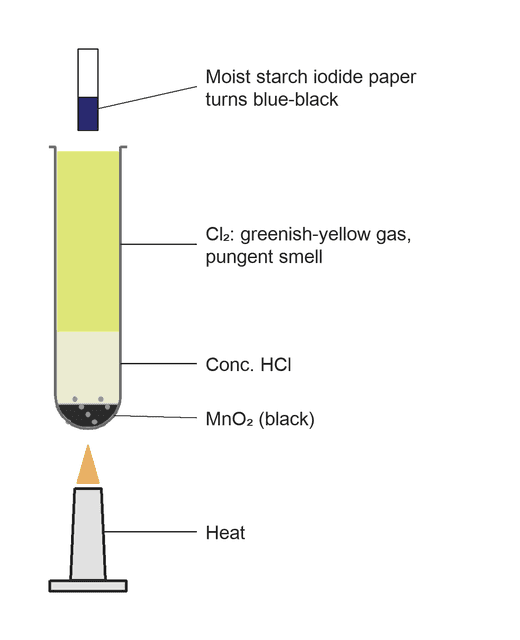
(D) A greenish yellow gas is liberated that turns moist starch iodide paper blue-black.
Answer: (D) A greenish yellow gas is liberated that turns moist starch iodide paper blue-black.
Concept: Manganese dioxide is an oxidising agent. On heating, it oxidises concentrated hydrochloric acid to chlorine.
Step 1 — Write the reaction.
Manganese dioxide and concentrated hydrochloric acid give manganese (II) chloride, water and chlorine.
Step 2 — Describe the gas.
Chlorine is a greenish-yellow gas with a pungent smell.
Step 3 — Recall its test.
Chlorine sets free iodine from potassium iodide, and iodine turns starch blue-black, so moist starch iodide paper turns blue-black.
Why the other options are wrong:
Therefore, a greenish-yellow gas (chlorine) is given off that turns moist starch iodide paper blue-black, option (D).