
Question 251 markMCQAsked 2025Easy
A white precipitate is formed when dilute hydrochloric acid reacts with ‘X’. The white precipitate is soluble in excess of and insoluble in dilute . Identify ‘X’.
Confirming your payment
Sign up now and get 250 free tokens.
Previous Year Questions · Question 25 of 27
A white precipitate is formed when dilute hydrochloric acid reacts with ‘X’. The white precipitate is soluble in excess of and insoluble in dilute . Identify ‘X’.
(A)
(B)
(C)
(D)
Answer: (A)
Concept: Two tests show HCl and chloride ions: (1) a glass rod dipped in ammonia solution gives dense white fumes of ammonium chloride; (2) silver nitrate solution gives a curdy white precipitate of silver chloride, which is insoluble in dilute nitric acid but soluble in ammonium hydroxide.
Step 1 — Form the precipitate.
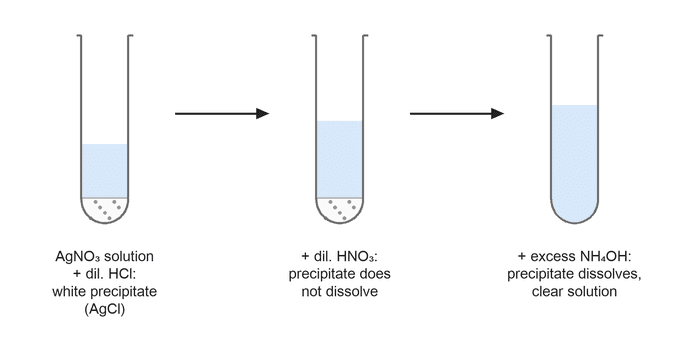
Silver nitrate solution reacts with dilute hydrochloric acid and gives a curdy white precipitate of silver chloride.
Step 2 — Match the two tests in the question.
Silver chloride does not dissolve in dilute nitric acid, but it dissolves in excess ammonium hydroxide, forming the soluble complex diammine silver (I) chloride. Both facts match the question, so X is silver nitrate.
Watch out: AgCl is the PRECIPITATE; the question asks for X, the substance that reacts with the acid.
Why the other options are wrong:
Therefore, X is silver nitrate, AgNO₃, option (A).