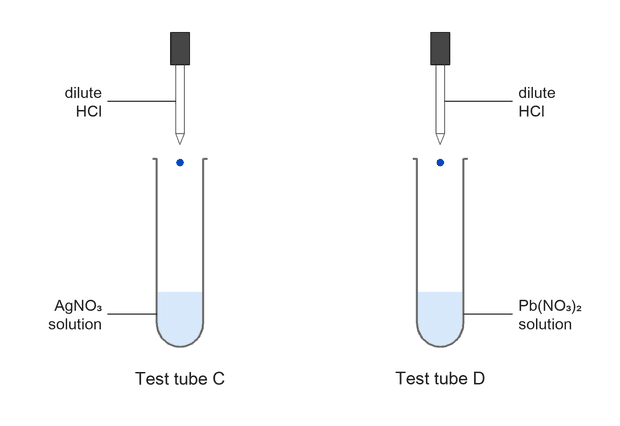
Solution:
Concept: Silver chloride and lead chloride are both white and insoluble in cold water. Ammonium hydroxide tells them apart: silver chloride dissolves in it, forming a soluble complex, while lead chloride gives a white precipitate of lead hydroxide that does not dissolve in excess.
Step 1 — (a) Find the common observation.
Dilute hydrochloric acid gives silver chloride in test tube C and lead chloride in test tube D. Both are insoluble, so a white precipitate forms in both test tubes.
AgNO3+HCl→AgCl↓+HNO3
Pb(NO3)2+2HCl→PbCl2↓+2HNO3
Step 2 — (b)(1) Add excess ammonium hydroxide to test tube C.
Silver chloride dissolves in excess ammonium hydroxide, forming the soluble complex salt diammine silver (I) chloride. The white precipitate dissolves and a clear, colourless solution is obtained.
AgCl+2NH4OH→[Ag(NH3)2]Cl+2H2O
Step 3 — (b)(2) Add excess ammonium hydroxide to test tube D.
Lead chloride reacts to form lead hydroxide, which is also white and does not dissolve in excess ammonium hydroxide. So a white precipitate remains (it is insoluble in excess).
PbCl2+2NH4OH→Pb(OH)2↓+2NH4Cl
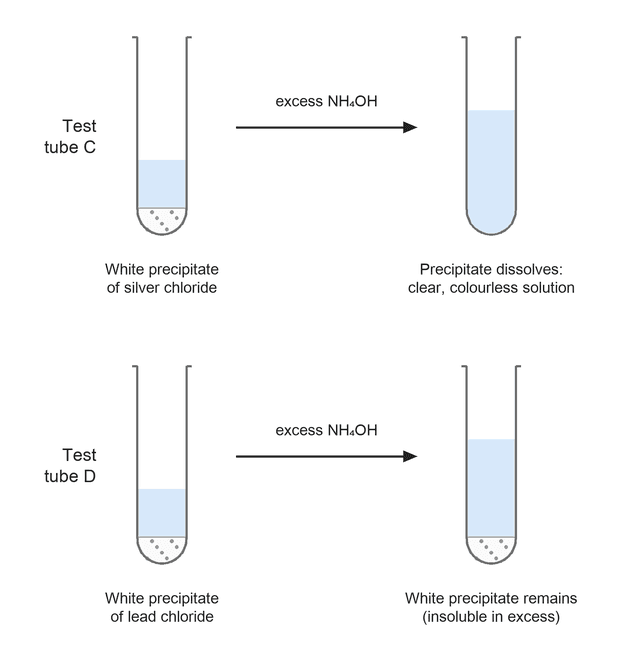
Watch out: Both precipitates look the same at first; only the excess ammonium hydroxide shows the difference.
Therefore, (a) a white precipitate forms in both test tubes; (b)(1) in C the white precipitate dissolves in excess NH₄OH, giving a clear colourless solution; (b)(2) in D a white precipitate remains, insoluble in excess NH₄OH.