(i) Name the acid used for the preparation of hydrogen chloride gas in the laboratory.
Question 83 marksAsked 2018Easy
(i) Name the acid used for the preparation of hydrogen chloride gas in the laboratory. Why is this particular acid preferred to other acids?
(ii) Write the balanced chemical equation for the laboratory preparation of hydrogen chloride gas.
Solution:
Concept: Hydrogen chloride is volatile (it boils easily). When a chloride is heated with a non-volatile acid, the volatile hydrogen chloride is driven out as a gas while the non-volatile acid stays behind.
Step 1 — (i) Name the acid.
The acid used is concentrated sulphuric acid, heated with sodium chloride.
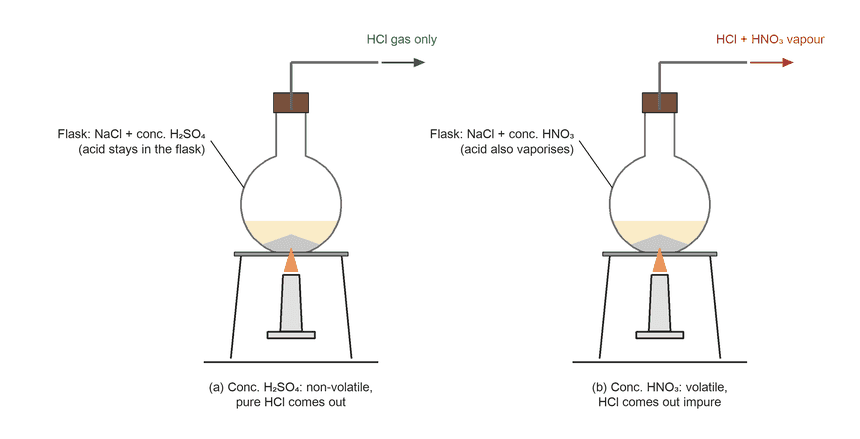
Step 2 — (i) Say why it is preferred.
Concentrated sulphuric acid is non-volatile (it has a high boiling point, about 338 °C). On heating, the hydrogen chloride escapes while the sulphuric acid stays in the flask, so the gas comes off free from acid vapour. A volatile acid such as concentrated nitric acid would vaporise and come out with the hydrogen chloride, making the gas impure.
Step 3 — (ii) Write the balanced equation.
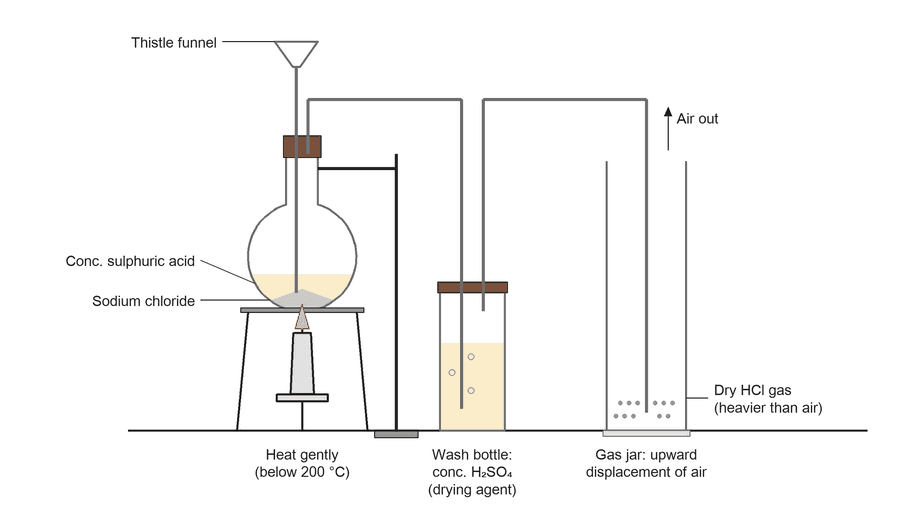
Sodium chloride is heated gently with concentrated sulphuric acid, keeping the temperature below 200 °C, so the reaction stops at sodium hydrogen sulphate.
NaCl+H2SO4below 200 °CNaHSO4+HCl↑
The hydrogen chloride keeps escaping as a gas, so the reaction goes on until the salt is used up.
Watch out: The reason is that sulphuric acid is non-volatile, not that it is a drying agent; its drying action is used later, in the wash bottle.
Therefore, (i) concentrated sulphuric acid is used because it is non-volatile, so the volatile HCl escapes free from acid vapour; (ii) NaCl + H₂SO₄ → NaHSO₄ + HCl (below 200 °C).