
Question 92 marksAsked 2018Medium
For the preparation of hydrochloric acid in the laboratory:
(i) Why is direct absorption of hydrogen chloride gas in water not feasible?
(ii) What arrangement is done to dissolve hydrogen chloride gas in water?
Confirming your payment
Sign up now and get 250 free tokens.
Previous Year Questions · Question 9 of 27
For the preparation of hydrochloric acid in the laboratory:
(i) Why is direct absorption of hydrogen chloride gas in water not feasible?
(ii) What arrangement is done to dissolve hydrogen chloride gas in water?
Solution:
Concept: Hydrogen chloride dissolves in water extremely fast and in very large amounts (about 450 volumes in one volume of water). If the gas is led straight into water, the pressure in the apparatus falls and water is sucked back.
Step 1 — (i) Explain what goes wrong with a delivery tube dipping into water.
The gas dissolves so quickly that the pressure in the delivery tube and the generating flask falls below the air pressure outside. The outside air pressure then forces water back up the tube into the hot flask. This is called back suction.
Step 2 — (i) Say why back suction is dangerous.
The water meets hot concentrated sulphuric acid in the flask. A lot of heat is given out at once, so the acid can spurt and the flask can crack; the preparation is also spoilt.
Step 3 — (ii) Describe the arrangement.
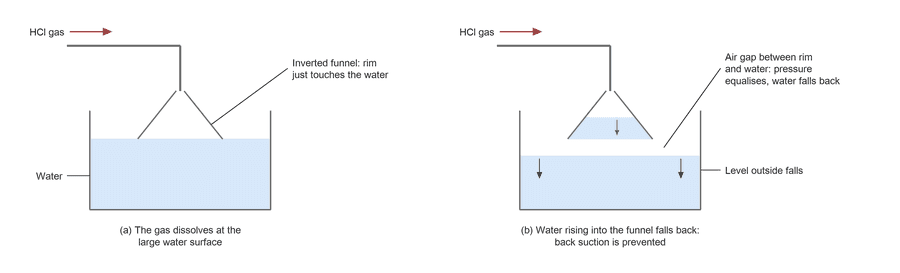
The delivery tube is joined to an inverted funnel whose rim just touches the water in a beaker or trough.
Step 4 — (ii) Explain how the funnel stops back suction.
When the gas dissolves fast, water rises into the wide funnel. This lowers the water level outside, so the rim comes out of the water and an air gap forms. Air enters, the pressure inside becomes equal to the pressure outside, and the water in the funnel falls back. This repeats until the water is saturated with the gas and becomes hydrochloric acid.
Step 5 — (ii) Note the second advantage.
The wide mouth of the funnel also gives a large surface area of water, so the gas is absorbed quickly. For extra safety, an empty flask can be placed between the generating flask and the funnel, so that any water sucked back collects there.
Watch out: The funnel's rim should only touch the water; if the funnel is pushed deep under the water, the air gap cannot form and back suction is not prevented.
Therefore, (i) direct absorption is not feasible because HCl is so soluble that water is sucked back into the generating flask (back suction); (ii) the gas is led through an inverted funnel whose rim just touches the water, which prevents back suction and gives a large surface for absorption.