Study of Compounds – Hydrogen Chloride · Question 29 of 40
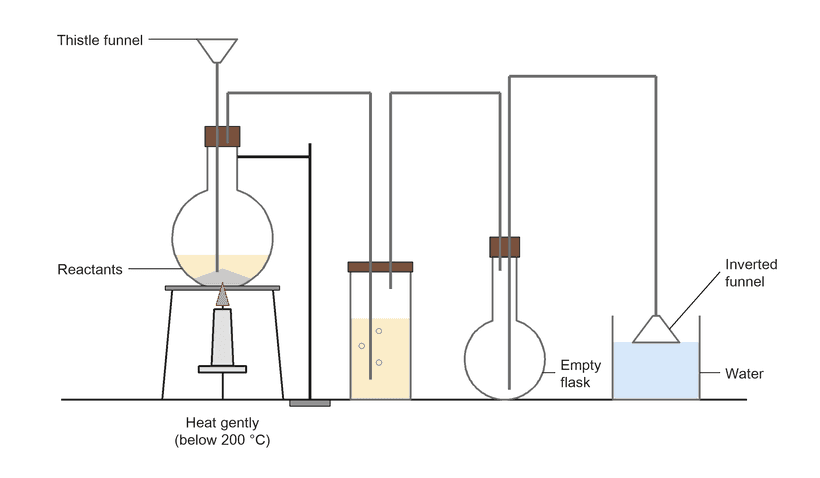
The given set up in the figure is for the preparation of an acid.
Question 295 marksMedium
The given set up in the figure is for the preparation of an acid.
(a) Name the acid prepared by this method.
(b) Name the reactants used.
(c) Why an empty flask is used ?
(d) What is the drying agent used ? Why is this drying agent chosen ?
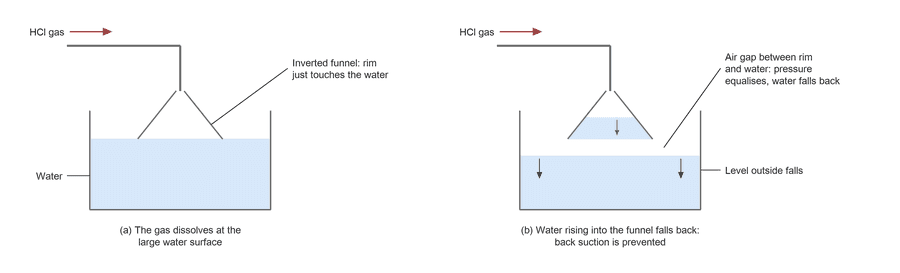
(e) What is the role of inverted funnel in the arrangement?
Solution:
Concept: This is the laboratory preparation of hydrochloric acid: HCl gas is generated, dried, passed through an empty safety flask and then dissolved in water through an inverted funnel.
Step 1 — (a) The acid prepared.
The gas is finally dissolved in water, so the acid prepared is hydrochloric acid (a solution of hydrogen chloride gas in water).
Step 2 — (b) The reactants.
The reactants are sodium chloride and concentrated sulphuric acid, heated below 200 °C:
NaCl+H2SO4below 200 °CNaHSO4+HCl↑
Step 3 — (c) Why an empty flask is used.
The empty flask is an anti-suction device. If water is sucked back from the beaker, it collects in this empty flask and does not reach the hot conc. sulphuric acid in the generating flask, which could otherwise crack or explode. The tube to the water side reaches the bottom of the flask, while the tube from the generator side ends just below the stopper, so the trapped water cannot pass on.
Step 4 — (d) The drying agent, and why.
The drying agent is concentrated sulphuric acid in the wash bottle. It absorbs moisture but does not react with hydrogen chloride, unlike quick lime and phosphorus pentoxide, which react with it.
Step 5 — (e) The role of the inverted funnel.
With its rim just touching the water, the funnel does two jobs:
it prevents back suction of water: when water starts to rise into the funnel, the water level in the beaker falls below the rim. Air then enters under the rim, the pressure inside and outside becomes equal, and the water falls back. So the water can never be sucked back into the generating flask.
it provides a large surface area for the gas to dissolve.
Watch out: The empty flask and the inverted funnel both guard against back suction, but only the funnel also helps the gas to dissolve.
Therefore, (a) hydrochloric acid; (b) sodium chloride and conc. sulphuric acid; (c) to trap any sucked-back water; (d) conc. sulphuric acid, as it does not react with HCl; (e) it prevents back suction and gives a large surface for absorption.