Study of Compounds – Hydrogen Chloride · Question 28 of 40
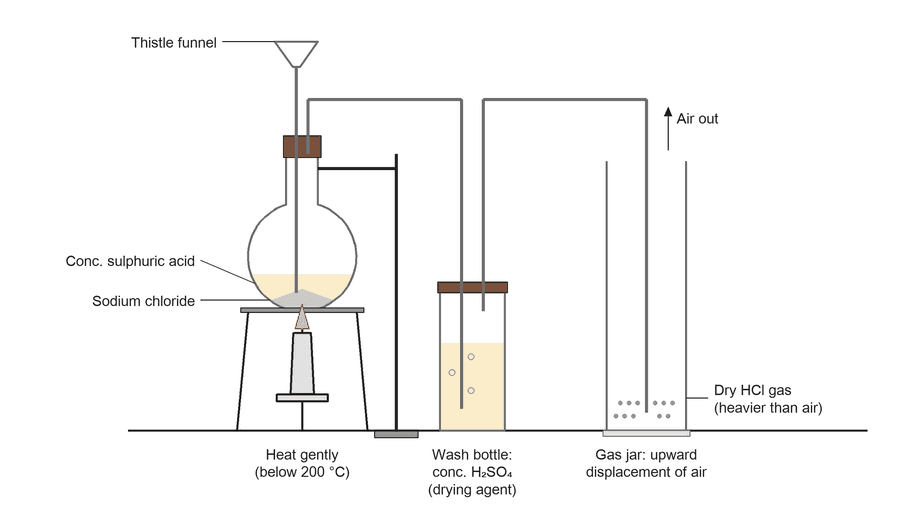
Draw a labelled diagram for the laboratory preparation of hydrogen chloride gas and answer the following.
Question 285 marksMedium
Draw a labelled diagram for the laboratory preparation of hydrogen chloride gas and answer the following.
(a) Name the acid used. Why is this particular acid preferred to other acids ?
(b) Give the balanced equation for the reaction.
(c) Name the drying agent used in drying hydrogen chloride gas.
(d) Phosphorus pentoxide and calcium oxide are good drying agents but they cannot be used to dry hydrogen chloride gas. Why ?
(e) Why is direct absorption of HCl gas in water not feasible ?
(f) What arrangement is done to dissolve HCl gas in water ?
Solution:
Concept: Hydrogen chloride is made by heating sodium chloride with conc. sulphuric acid below 200 °C. The gas is dried by bubbling it through conc. sulphuric acid and collected by upward displacement of air, because it is about 1.27 times heavier than air.
Step 1 — Draw the labelled diagram.
The flask holds sodium chloride and conc. sulphuric acid, with a thistle funnel dipping into the acid. The gas passes through a wash bottle of conc. sulphuric acid (long tube in, short tube out) and is led to the bottom of an upright gas jar.
Step 2 — (a) The acid used, and why.
Concentrated sulphuric acid is used. It is non-volatile (it has a high boiling point), so on heating it drives the volatile hydrogen chloride out of sodium chloride while it stays in the flask itself. Conc. nitric acid is not used because it is volatile: it would vaporise and come out mixed with the hydrogen chloride.
Step 3 — (b) The balanced equation.
At a temperature below 200 °C the reaction is:
NaCl+H2SO4below 200 °CNaHSO4+HCl↑
Step 4 — (c) The drying agent.
Concentrated sulphuric acid is used, because it absorbs moisture but does not react with HCl.
Step 5 — (d) Why not phosphorus pentoxide or calcium oxide.
A drying agent must not react with the gas it dries. Both of these react with hydrogen chloride, so the gas would be used up instead of dried:
2P2O5+3HCl→POCl3+3HPO3CaO+2HCl→CaCl2+H2O
Step 6 — (e) Why HCl is not absorbed directly in water.
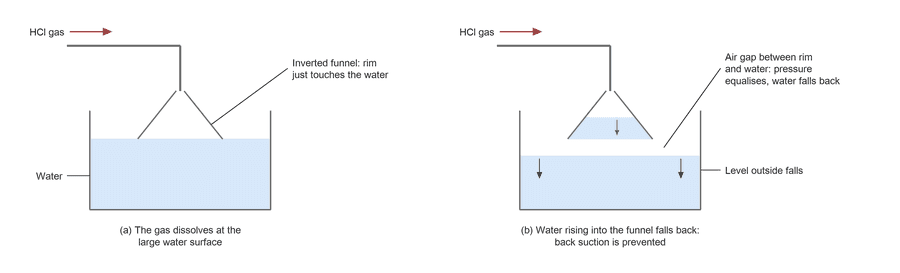
HCl is so highly soluble that it dissolves faster than it is produced. If the delivery tube dipped straight into water, the pressure in the tube and flask would fall and water would be sucked back into the generating flask of hot conc. sulphuric acid. Water meeting hot conc. sulphuric acid gives out a lot of heat, which can crack the flask or even cause an explosion.
Step 7 — (f) The arrangement for dissolving HCl in water.
The delivery tube is joined to an inverted funnel whose rim just touches the water in a beaker. When water starts to rise into the funnel, the water level in the beaker falls below the rim. Air then enters under the rim, the pressure inside and outside becomes equal, and the water falls back. So the water can never be sucked back into the generating flask. The wide funnel also gives a large surface area for the gas to dissolve.
Watch out: The thistle funnel must dip into the acid, or the gas would escape through it; the delivery tube must start above the liquid.
Therefore, (a) conc. sulphuric acid, as it is non-volatile; (b) NaCl + H₂SO₄ → NaHSO₄ + HCl below 200 °C; (c) conc. sulphuric acid; (d) they react with HCl; (e) back suction would occur; (f) an inverted funnel with its rim just touching the water.