Solution:
Concept: Hydrogen chloride is a polar covalent gas. As a dry gas, as a liquid or in toluene it exists as molecules with no ions. Only in water does it ionise:
HCl+H2O→H3O++Cl−
Step 1 — (a) Anhydrous HCl conducts poorly; aqueous HCl conducts well.
Electricity is carried through a liquid by moving ions. Anhydrous HCl is covalent and has no ions, so it does not conduct. In water it ionises almost completely into H3O+ and Cl− ions, which carry the current.
Step 2 — (b) Fumes when a bottle of HCl gas is opened.
The escaping gas dissolves in the water vapour of the air and forms tiny droplets of hydrochloric acid. These droplets are seen as white fumes.
Step 3 — (c) Water solution and toluene solution.
In water HCl ionises: the H3O+ ions turn blue litmus red, and the free ions conduct electricity. Toluene is an organic solvent in which HCl stays as covalent molecules, so:
- (i) there are no H3O+ ions, so there is no effect on litmus;
- (ii) there are no free ions, so it does not conduct electricity.

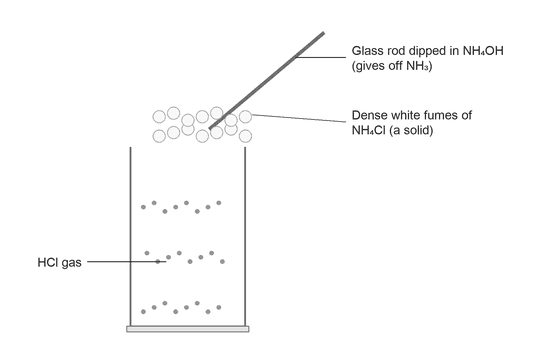
Step 4 — (d) Dense white fumes with a rod dipped in ammonium hydroxide.
Ammonia gas escapes from the ammonium hydroxide and combines with hydrogen chloride to form tiny particles of solid ammonium chloride, seen as dense white fumes:
NH3+HCl→NH4Cl
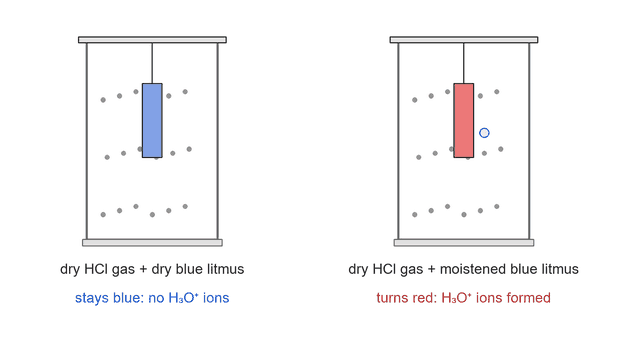
Step 5 — (e) Dry HCl and dry blue litmus.
Dry HCl does not ionise, so it has no H3O+ ions to act on the litmus. A drop of water lets the gas ionise, and the H3O+ ions formed turn the blue litmus red.
Step 6 — (f) HCl not collected over water.
HCl is extremely soluble in water (one volume of water dissolves about 450 volumes of the gas), so it would dissolve in the water instead of collecting in the jar. It is collected by upward displacement of air.
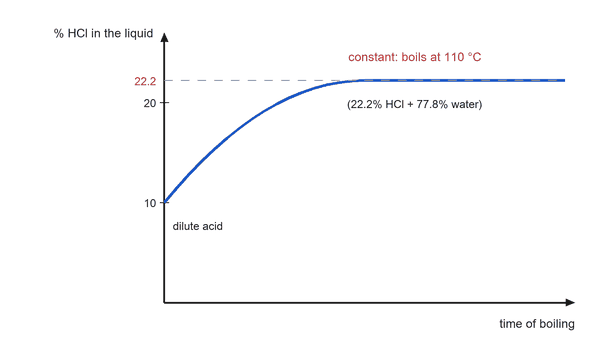
Step 7 — (g) Dilute HCl cannot be concentrated beyond 22.2% by boiling.
On boiling dilute acid, mostly water escapes at first, so the acid becomes stronger. At 22.2% HCl the solution becomes a constant boiling mixture (azeotrope), which boils at 110 °C. Its vapour now has the same composition as the liquid, so further boiling does not change the concentration.
Step 8 — (h) HCl not dried over quick lime.
Quick lime is a basic oxide and reacts with the acidic gas, so the gas would be absorbed instead of dried:
CaO+2HCl→CaCl2+H2O
Watch out: "no ions, no acidic properties": dry HCl, liquid HCl and HCl in toluene behave alike, and only the water solution is acidic.
Note: 22.2% and 110 °C are the values given in the textbook. Modern data give the constant boiling mixture as about 20.2% HCl, boiling at about 108.6 °C at normal pressure; for the exam, use the book's values.
Therefore, every part follows from one fact: HCl forms ions only in water, and it is very soluble in water.
