
Question 215 marksEasy
Write an equation for the reactions of hydrochloric acid on :
(a) silver nitrate solution, (b) magnesium foil,
(c) caustic soda solution, (d) zinc carbonate,
(e) manganese (IV) oxide, (f) copper oxide.
Confirming your payment
Sign up now and get 250 free tokens.
Study of Compounds – Hydrogen Chloride · Question 21 of 40
Write an equation for the reactions of hydrochloric acid on :
(a) silver nitrate solution, (b) magnesium foil,
(c) caustic soda solution, (d) zinc carbonate,
(e) manganese (IV) oxide, (f) copper oxide.
Solution:
Concept: Hydrochloric acid shows the typical reactions of an acid (with metals, bases and carbonates), gives a precipitate with silver nitrate, and is oxidised to chlorine by manganese (IV) oxide.
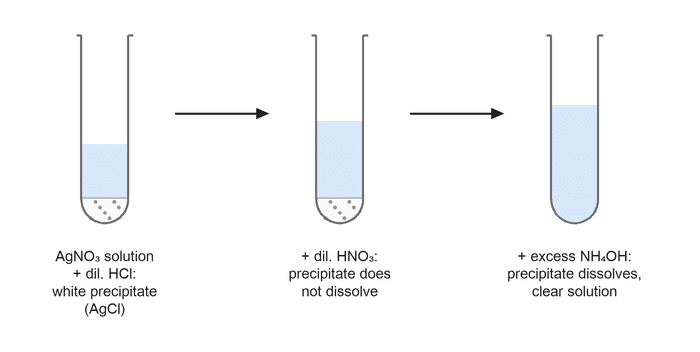
Step 1 — (a) Silver nitrate solution.
Chloride ions combine with silver ions to give a curdy white precipitate of silver chloride:
Step 2 — (b) Magnesium foil.
Magnesium is above hydrogen in the activity series, so it displaces hydrogen:
Step 3 — (c) Caustic soda solution.
Caustic soda (sodium hydroxide) is a base, so the acid neutralises it, giving salt and water:
Step 4 — (d) Zinc carbonate.
The carbonate is decomposed with effervescence of carbon dioxide:
Step 5 — (e) Manganese (IV) oxide.
With the conc. acid on heating, manganese (IV) oxide oxidises the acid to chlorine:
Step 6 — (f) Copper oxide.
Copper (II) oxide is a basic oxide. It dissolves to give a bluish-green solution of copper (II) chloride and water:
Watch out: Count the chlorine atoms: one HCl for silver nitrate and caustic soda, two for magnesium, zinc carbonate and copper oxide, four for manganese (IV) oxide.
Therefore, the six balanced equations are as written in Steps 1 to 6.