Study of Compounds – Hydrogen Chloride · Question 39 of 40
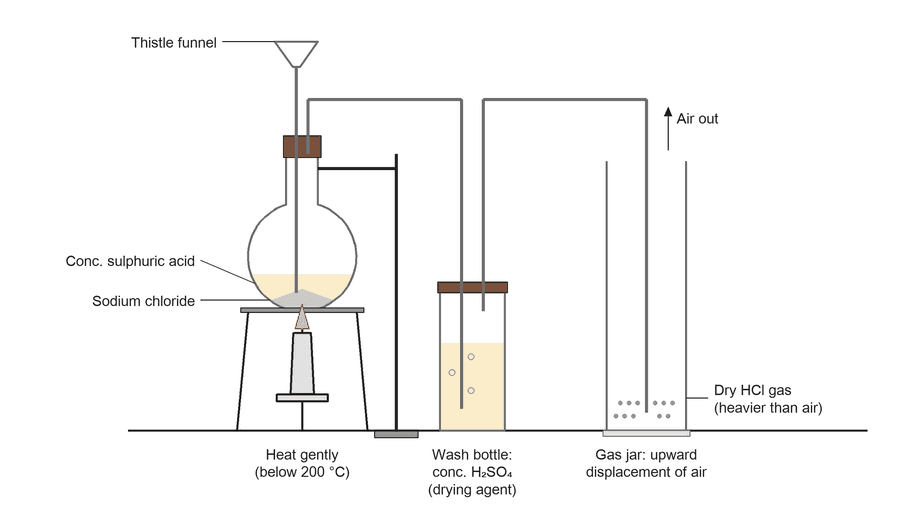
The following questions pertain to the laboratory preparation of hydrogen chloride gas.
Question 395 marksEasy
The following questions pertain to the laboratory preparation of hydrogen chloride gas.
(a) Write the equation for its preparation, mentioning the conditions required.
(b) Name the drying agent used in the above preparation and give a reason for the choice.
(c) State a safety precaution taken during the preparation of hydrochloric acid.
Solution:
Concept: Sodium chloride is heated with conc. sulphuric acid, keeping the temperature below 200 °C. The gas is dried with conc. sulphuric acid and collected by upward displacement of air.
Step 1 — (a) The equation and conditions.
Sodium chloride is heated gently with concentrated sulphuric acid at a temperature below 200 °C:
NaCl+H2SO4below 200 °CNaHSO4+HCl↑
Above 200 °C sodium sulphate forms a hard crust, the glass may crack and fuel is wasted, so the higher temperature is avoided.
Step 2 — (b) The drying agent and the reason.
The drying agent is concentrated sulphuric acid, because it absorbs moisture but does not react with HCl. Quick lime and phosphorus pentoxide cannot be used, because they react with HCl.
Step 3 — (c) A safety precaution in preparing hydrochloric acid.
The gas is dissolved in water through an inverted funnel whose rim just touches the water, so that water is not sucked back into the flask of hot conc. sulphuric acid. An empty flask between the generator and the water also traps any water that is sucked back.
Watch out: The condition is "conc. acid, below 200 °C"; leaving out the temperature loses the mark for conditions.
Therefore, (a) NaCl + H₂SO₄ → NaHSO₄ + HCl, with conc. acid below 200 °C; (b) conc. sulphuric acid, as it does not react with HCl; (c) the gas is dissolved through an inverted funnel to prevent back suction.