
Question 385 marksEasy
Distinguish by using HCl.
(a) Lead nitrate solution and silver nitrate solution.
(b) Potassium sulphite and potassium sulphide.
Confirming your payment
Sign up now and get 250 free tokens.
Study of Compounds – Hydrogen Chloride · Question 38 of 40
Distinguish by using HCl.
(a) Lead nitrate solution and silver nitrate solution.
(b) Potassium sulphite and potassium sulphide.
Solution:
Concept: Add dilute HCl to each and compare what forms. In (a) both give white precipitates, so we then heat them; in (b) the two gases have different smells and tests.
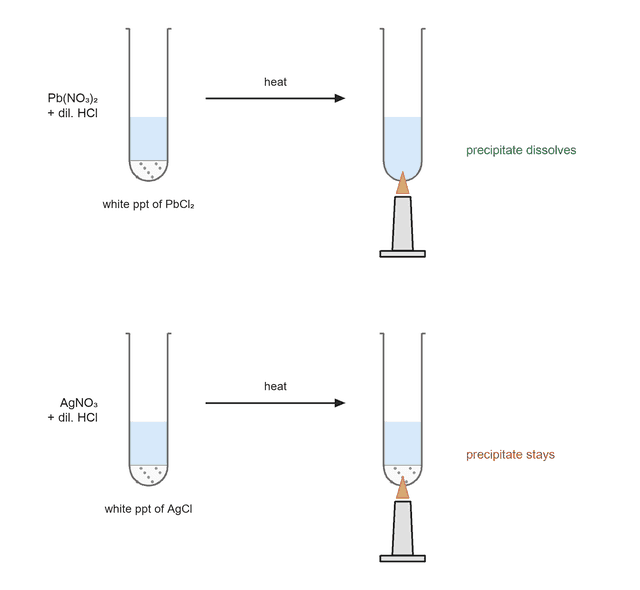
Step 1 — (a) Add dilute HCl to both nitrate solutions.
Both give a white precipitate, so this step alone cannot tell them apart:
Step 2 — (a) Heat both precipitates.
Now we heat each mixture. The lead chloride precipitate dissolves, because it is soluble in hot water. The silver chloride precipitate does not dissolve (it dissolves only in ammonium hydroxide).
Step 3 — (b) Potassium sulphite.
Potassium sulphite gives sulphur dioxide, which smells of burning sulphur and turns acidified potassium dichromate paper from orange to green:
Step 4 — (b) Potassium sulphide.
Potassium sulphide gives hydrogen sulphide, which smells of rotten eggs and turns moist lead acetate paper silvery black:
Watch out: In (a) the first observation is the same for both; the difference appears only on heating.
Therefore, (a) the precipitate from lead nitrate dissolves on heating, while that from silver nitrate does not; (b) potassium sulphite gives (burning-sulphur smell), while potassium sulphide gives (rotten-egg smell).