
Question 405 marksEasy
Identify the gas evolved and give chemical test in each of the following cases.
Dilute hydrochloric acid reacts with :
(i) Iron (II) sulphide (ii) Sodium sulphite.
Confirming your payment
Sign up now and get 250 free tokens.
Study of Compounds – Hydrogen Chloride · Question 40 of 40
Identify the gas evolved and give chemical test in each of the following cases.
Dilute hydrochloric acid reacts with :
(i) Iron (II) sulphide (ii) Sodium sulphite.
Solution:
Concept: Dilute HCl gives hydrogen sulphide with a sulphide and sulphur dioxide with a sulphite. Each gas has its own test paper.
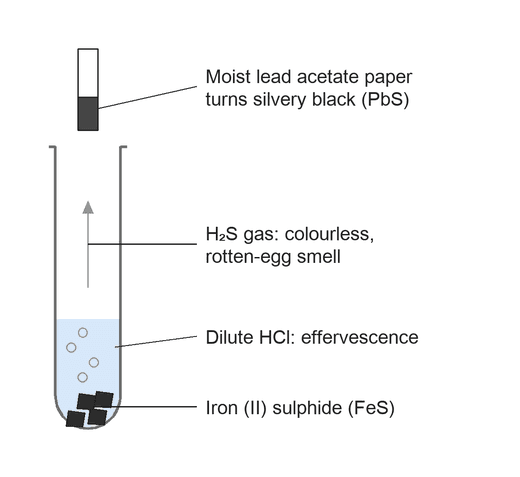
Step 1 — (i) Iron (II) sulphide: the gas.
The sulphide is the salt of the weak acid hydrogen sulphide, so the gas given off is hydrogen sulphide:
Step 2 — (i) Iron (II) sulphide: the test.
Hydrogen sulphide smells of rotten eggs and turns moist lead acetate paper silvery black, because black lead sulphide forms:
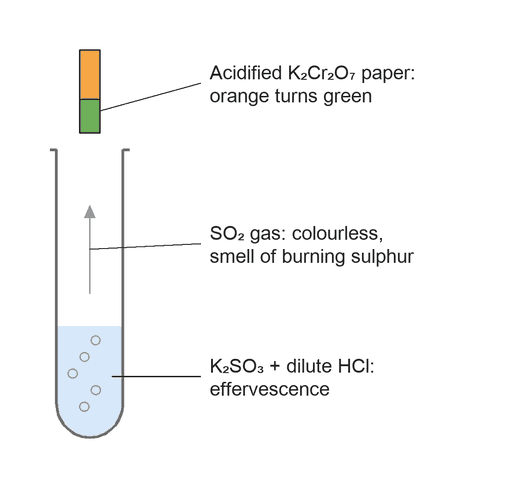
Step 3 — (ii) Sodium sulphite: the gas.
The sulphite gives sulphur dioxide:
Step 4 — (ii) Sodium sulphite: the test.
Sulphur dioxide smells of burning sulphur and turns acidified potassium dichromate paper from orange to green, because the orange dichromate is reduced to green chromium (III) sulphate:
Watch out: The lead acetate test is for and the dichromate test is for ; do not swap them.
Therefore, (i) the gas is hydrogen sulphide, which turns lead acetate paper silvery black; (ii) the gas is sulphur dioxide, which turns acidified potassium dichromate paper green.