Solution:
Concept: In each case we add dilute hydrochloric acid. It precipitates insoluble chlorides from nitrate solutions, dissolves basic oxides and carbonates as soluble chlorides, and sets free hydrogen sulphide from sulphides.
Step 1 — (a) Two soluble nitrates to insoluble chlorides.
Silver chloride and lead chloride are insoluble in cold water, so silver nitrate and lead nitrate solutions give white precipitates:
AgNO3+HCl→AgCl↓+HNO3
Pb(NO3)2+2HCl→PbCl2↓+2HNO3
Step 2 — (b) Insoluble iron (II) oxide to a soluble compound.
Iron (II) oxide is a basic oxide, so it dissolves in the acid as soluble iron (II) chloride:
FeO+2HCl→FeCl2+H2O
Step 3 — (c) Insoluble carbonate to a soluble chloride.
Calcium carbonate dissolves with effervescence, forming soluble calcium chloride:
CaCO3+2HCl→CaCl2+H2O+CO2↑
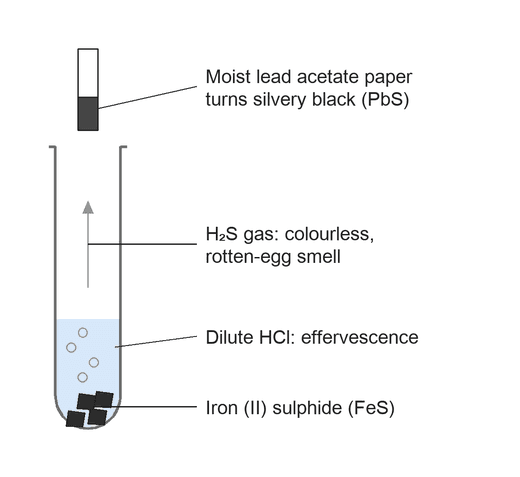
Step 4 — (d) Metal sulphide to an offensive-smelling gas.
Iron (II) sulphide gives hydrogen sulphide, which smells of rotten eggs:
FeS+2HCl→FeCl2+H2S↑
Watch out: In (a) the chloride must be insoluble; most chlorides are soluble, but silver and lead chlorides are not.
Therefore, each conversion is made with dilute hydrochloric acid, as shown by the equations in Steps 1 to 4.
