
Opening your dashboard
Class 10 Physics Chapter 11: Calorimetry Solutions
108 textbook questions with step-by-step answers, free to read, for ICSE 2026-27.
Get talked through Ch 11, not just shown the answer
Reading a finished solution is not the same as being able to do it. The AI tutor takes one question at a time and works it with you, in your own words, until you can.
- Ask it out loud, in your own words
- It gives you the next step, not the answer
- Stuck on part (ii)? Start there
108 questions with solutions
1–5 marks · Mixed difficulty
- 11 mark
Question 1
The total internal energy of all molecules of a substance is called :
Solve with AIAnswer
(A) magnetic energy
(B) heat energy
- Correct
(C) thermal energy
(D) electrical energy
Answer: (C) thermal energy
Concept: Every molecule of a substance has kinetic energy (because it moves) and potential energy (because of the forces between molecules). The total of these energies for all the molecules is the internal energy of the substance, which the book calls its thermal energy.
Step 1 — Add up the energies of the molecules.
The question asks for the name of the total internal energy (kinetic + potential) of all the molecules of a substance.
Step 2 — Name it.
This total energy held by the molecules is called the thermal energy (internal energy) of the substance.
Step 3 — Separate it from heat.
Heat is only the part of this energy that flows from a hotter body to a colder one because of a difference in temperature, so heat is energy in transfer, not the energy held.
Watch out: Do not call the stored energy 'heat'; heat is the name for the energy while it flows.
Why the other options are wrong:
- (A) magnetic energy: Magnetic energy is the energy stored in a magnetic field, not the energy of the molecules.
- (B) heat energy: Heat energy is the energy that flows between bodies at different temperatures, not the total energy the molecules hold.
- (D) electrical energy: Electrical energy is the energy of electric charges and currents, not of moving and attracting molecules.
Therefore, the total internal energy of all the molecules of a substance is its thermal energy, option (C).
- 21 mark
Question 2
The unit of heat is :
Solve with AIAnswer
(A) Watt
(B) Joule
(C) Calorie
- Correct
(D) Both (b) and (c)
Answer: (D) Both (b) and (c)
Concept: Heat is a form of energy, so it is measured in the units of energy. Its S.I. unit is the joule (J), and the calorie (cal) is another unit still in common use.
Step 1 — Find the S.I. unit.
Like every form of energy, heat has the joule as its S.I. unit, so the joule is a unit of heat.
Step 2 — Check the calorie.
One calorie is the heat needed to raise the temperature of 1 g of water by 1 °C, so the calorie is also a unit of heat. The two are linked as follows.
Step 3 — Choose the option.
Since both the joule and the calorie are units of heat, the option naming both is the complete answer.
Watch out: The watt looks like an energy unit but it is the unit of power (energy per second).
Why the other options are wrong:
- (A) Watt: The watt is the unit of power (1 W = 1 J s⁻¹), the rate of supplying energy, not of heat itself.
- (B) Joule: The joule is a unit of heat, but this option leaves out the calorie, which is also a unit of heat.
- (C) Calorie: The calorie is a unit of heat, but this option leaves out the joule, the S.I. unit of heat.
Therefore, both the joule and the calorie are units of heat, option (D).
- 31 mark
Question 3
The specific heat capacity of water is :
Solve with AIAnswer
- Correct
(A) 4200 J kg K
(B) 420 J g K
(C) 0·42 J g K
(D) 4·2 J kg K
Answer: (A) 4200 J kg K
Concept: The specific heat capacity c of a substance is the heat needed to raise the temperature of unit mass (1 kg) of it by 1 K (or 1 °C). Its S.I. unit is J kg⁻¹ K⁻¹; for water it is about 4200 J kg⁻¹ K⁻¹, which is the same as 4.2 J g⁻¹ K⁻¹.
Step 1 — Recall the value per kilogram.
1 kg of water needs about 4200 J of heat to warm by 1 K, so the specific heat capacity of water is 4200 J kg⁻¹ K⁻¹.
Step 2 — Change it to per gram.
Since 1 kg = 1000 g, the heat for each gram is one-thousandth of this.
Step 3 — Compare with the options.
Only option (A) gives a correct value with a matching unit: 4200 with J kg⁻¹ K⁻¹ (or 4.2 with J g⁻¹ K⁻¹, which is not offered).
Watch out: The number depends on the unit: 4200 goes with kg, 4.2 goes with g.
Why the other options are wrong:
- (B) 420 J g K: 420 J g⁻¹ K⁻¹ is 100 times too large; per gram the value is 4.2.
- (C) 0·42 J g K: 0.42 J g⁻¹ K⁻¹ is 10 times too small; per gram the value is 4.2.
- (D) 4·2 J kg K: 4.2 is the per-gram number written with the per-kilogram unit, so it is 1000 times too small.
Therefore, the specific heat capacity of water is 4200 J kg⁻¹ K⁻¹, option (A).
- 41 mark
Question 4
Temperature determines the direction of :
Solve with AIAnswer
- Correct
(A) flow of heat
(B) flow of energy
(C) flow of motion
(D) none of the above
Answer: (A) flow of heat
Concept: Temperature is the degree of hotness or coldness of a body. It measures the average kinetic energy of the molecules, and it decides the direction in which heat flows: always from the higher temperature to the lower one.
Step 1 — Think of an example.
Drop a hot iron nail at 200 °C into a bucket of water at 30 °C. The water has far more heat energy, because its mass is much larger.
Step 2 — See which way the heat goes.
Even so, heat flows from the nail to the water, because the nail is at the higher temperature. The flow stops when both reach the same temperature.

Step 3 — Draw the conclusion.
So it is the temperature, not the amount of heat held, that decides the direction in which heat flows.
Watch out: Heat does not flow from the body with more heat to the body with less; it flows from the higher temperature to the lower temperature.
Why the other options are wrong:
- (B) flow of energy: 'Flow of energy' is too general: electrical or mechanical energy is not made to flow by a difference in temperature.
- (C) flow of motion: 'Flow of motion' is not a physical quantity, so temperature cannot decide its direction.
- (D) none of the above: Option (A) is correct, so 'none of the above' cannot be the answer.
Therefore, temperature determines the direction of flow of heat, option (A).
- 51 mark
Question 5
The amount of heat energy contained in a body depends on its :
Solve with AIAnswer
(A) mass
(B) temperature
(C) material of the body
- Correct
(D) all of the above
Answer: (D) all of the above
Concept: The heat energy a body holds (and the heat it gives out on cooling to a given temperature) grows with the number of molecules, with how energetic they are and with the kind of substance: in short, with its mass, its temperature and its material (through Q = m × c × Δt).
Step 1 — Mass.
More mass means more molecules, so more heat energy; twice the mass holds twice the heat at the same temperature.
Step 2 — Temperature.
At a higher temperature the molecules have more energy, so the same body holds more heat energy.
Step 3 — Material.
Different materials have different specific heat capacities; 1 kg of water holds far more heat than 1 kg of copper heated through the same range, because c of water is much larger.
Why the other options are wrong:
- (A) mass: Mass is one factor, but the heat energy also depends on the temperature and the material.
- (B) temperature: Temperature is one factor, but the heat energy also depends on the mass and the material.
- (C) material of the body: The material is one factor, but the heat energy also depends on the mass and the temperature.
Therefore, the heat energy in a body depends on its mass, temperature and material, option (D).
- 61 mark
Question 6
The correct relation between heat capacity and specific heat capacity is :
Solve with AIAnswer
- Correct
(A)
(B)
(C)
(D)
Answer: (A)
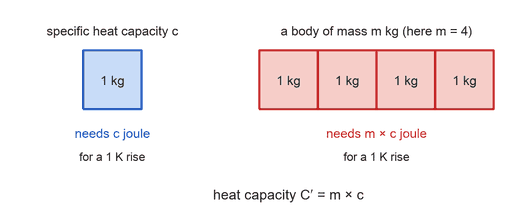
Concept: Specific heat capacity c is the heat needed to warm 1 kg of a substance by 1 K. Heat capacity C′ is the heat needed to warm the whole body by 1 K.
Step 1 — Split the body into kilograms.
A body of mass m kg is made of m such kilograms, and each kilogram needs c joule for a 1 K rise.
Step 2 — Add up for the whole body.
So the whole body needs m times c joule for a 1 K rise, and this is its heat capacity.
Step 3 — Check the unit.
The unit of m × c is kg × J kg⁻¹ K⁻¹, which is J K⁻¹, the unit of heat capacity.
Watch out: C′ (with a dash) is the heat capacity of the body; c (small) is the specific heat capacity of the substance.
Why the other options are wrong:
- (B) : 1/(mc) would make the heat capacity smaller for a bigger body, but a bigger body needs more heat.
- (C) : m/c would make the heat capacity smaller for a material that needs more heat per kilogram, which is wrong.
- (D) : It swaps the symbols: C′ is the heat capacity and c the specific heat capacity, so 'C = mc′' is not the relation.
Therefore, heat capacity = mass × specific heat capacity, C′ = m × c, option (A).
- 71 mark
Question 7
A good conductor of heat has a ........... specific heat capacity, while a bad conductor has a ....... specific heat capacity.
Solve with AIAnswer
- Correct
(A) low, high
(B) low, low
(C) high, low
(D) high, high
Answer: (A) low, high
Concept: The heat taken in (or given out) by a body of mass m, made of a substance of specific heat capacity c, when its temperature rises (or falls) by Δt is Q = m × c × Δt. So for the same heat, the rise Δt = Q ÷ (mc) is large when c is small.
Step 1 — Look at metals.
Metals such as copper (385 J kg⁻¹ K⁻¹) and cast iron (554 J kg⁻¹ K⁻¹) have low specific heat capacities. They warm up quickly and pass heat on quickly, and they are good conductors of heat.
Step 2 — Look at poor conductors.
Water (4200 J kg⁻¹ K⁻¹) has a high specific heat capacity; it warms up slowly and is a poor conductor of heat.
Step 3 — Fill the blanks.
So, in the book's statement, a good conductor has a low specific heat capacity and a bad conductor has a high one.
Note: this is a rule of thumb that fits the chapter's examples (metals against water); the two properties are not strictly linked for every substance.
Why the other options are wrong:
- (B) low, low: 'Low, low' gives both kinds the same value, which does not match copper and water.
- (C) high, low: 'High, low' has the two the wrong way round: copper, a good conductor, has the low value.
- (D) high, high: 'High, high' gives both kinds the same value, which does not match copper and water.
Therefore, a good conductor has a low specific heat capacity and a bad conductor a high one, option (A).
- 81 mark
Question 8
The specific heat capacity is maximum for :
Solve with AIAnswer
(A) copper
(B) zinc
(C) iron
- Correct
(D) hydrogen
Answer: (D) hydrogen
Concept: Hydrogen gas has the highest specific heat capacity of all substances, about 14630 J kg⁻¹ K⁻¹, more than three times that of water.
Step 1 — List the values.
In J kg⁻¹ K⁻¹, the values are: hydrogen 14630, cast iron 554, zinc 391 and copper 385.

Step 2 — Pick the largest.
Hydrogen's value is many times larger than any of the three metals, so its specific heat capacity is the maximum.
Watch out: Do not pick a metal because it is heavy; metals have low specific heat capacities.
Why the other options are wrong:
- (A) copper: Copper has a low specific heat capacity, 385 J kg⁻¹ K⁻¹.
- (B) zinc: Zinc has a low specific heat capacity, 391 J kg⁻¹ K⁻¹.
- (C) iron: Cast iron has a low specific heat capacity, 554 J kg⁻¹ K⁻¹ in the book's table.
Therefore, the specific heat capacity is maximum for hydrogen, option (D).
- 91 mark
Question 9
The principle of calorimetry is based on :
Solve with AIAnswer
(A) law of conservation of heat
(B) law of conservation of energy
- Correct
(C) both (a) and (b)
(D) conservation of momentum
Answer: (C) both (a) and (b)
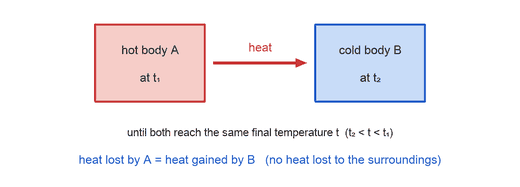
Concept: Principle of method of mixtures (principle of calorimetry): when a hot body and a cold body are mixed and no heat is lost to the surroundings, heat flows from the hot body to the cold body until both reach the same final temperature, and heat lost by the hot body = heat gained by the cold body.
Step 1 — Read the principle as a conservation law.
Heat lost = heat gained says no heat is created or destroyed during the mixing. That is the conservation of heat, so (a) applies.
Step 2 — See the wider law.
Heat is a form of energy, so the conservation of heat is a particular case of the law of conservation of energy. So (b) applies too.
Step 3 — Choose the option.
Since both laws describe the principle, the option naming both is correct.
Why the other options are wrong:
- (A) law of conservation of heat: The conservation of heat is correct, but this option leaves out the law of conservation of energy on which it rests.
- (B) law of conservation of energy: The conservation of energy is correct, but this option leaves out the conservation of heat, which is the form the principle actually uses.
- (D) conservation of momentum: Conservation of momentum is about moving bodies and collisions, not about the exchange of heat.
Therefore, the principle of calorimetry is based on both the conservation of heat and the conservation of energy, option (C).
- 101 mark
Question 10
Heat is measured by :
Solve with AIAnswer
(A) thermometer
(B) barometer
- Correct
(C) principle of calorimetry
(D) both (a) and (b)
Answer: (C) principle of calorimetry
Concept: No instrument reads heat directly. Heat is worked out from the change in temperature it causes, using Q = m × c × Δt and the rule heat lost = heat gained.
Step 1 — Measure what can be measured.
In a calorimeter, a hot body gives heat to water of known mass, and the rise in the water's temperature is read on a thermometer.
Step 2 — Work out the heat.
The heat gained by the water, m × c × Δt, equals the heat given by the body. This is the principle of calorimetry, so heat is measured by this principle.
Step 3 — Place the thermometer correctly.
The thermometer only supplies the change in temperature Δt used in the calculation; it does not measure the heat itself.
Watch out: A thermometer measures temperature, not heat.
Why the other options are wrong:
- (A) thermometer: A thermometer measures temperature, not the amount of heat.
- (B) barometer: A barometer measures atmospheric pressure, not heat.
- (D) both (a) and (b): Neither a thermometer nor a barometer measures heat, so 'both' is wrong too.
Therefore, heat is measured by the principle of calorimetry, option (C).
- 111 mark
Question 11
Assertion (A) : The specific heat capacity of a substance is the amount of heat required to raise the temperature of unit mass of that substance by 1°C.
Reason (R) : The specific heat capacity of a substance is not its characteristic property.
Solve with AIAnswer
(A) both A and R are true and R is the correct explanation of A
(B) both A and R are True and R is not the correct explanation of A
(C) assertion is false but reason is true
- Correct
(D) assertion is true but reason is false
Answer: (D) assertion is true but reason is false
Concept: In an assertion–reason item, judge the assertion (A) and the reason (R) separately as true or false, and then decide whether R correctly explains A.
Step 1 — Judge the assertion.
The assertion is the definition of specific heat capacity: the heat needed to raise the temperature of unit mass of the substance by 1 °C (or 1 K). So the assertion is true.
Step 2 — Judge the reason.
Specific heat capacity has a definite value for each substance (water 4200, copper 385, lead 130, all in J kg⁻¹ K⁻¹) whatever the mass taken, so it is a characteristic property of the substance. The reason says it is not, so the reason is false.
Step 3 — Choose the option.
The assertion is true and the reason is false.
Why the other options are wrong:
- (A) both A and R are true and R is the correct explanation of A: This needs the reason to be true, but the reason is false.
- (B) both A and R are True and R is not the correct explanation of A: This also needs the reason to be true, but it is false.
- (C) assertion is false but reason is true: This calls the assertion false, but the assertion is the correct definition.
Therefore, the assertion is true but the reason is false, option (D).
- 121 mark
Question 12
Assertion (A) : The principle of the method of mixtures involves mixing substances at different temperatures to find the final temperature.
Reason (R) : The law of conservation of energy states that the energy is neither created nor destroyed in an isolated system.
Solve with AIAnswer
- Correct
(A) both A and R are true and R is the correct explanation of A
(B) both A and R are True and R is not the correct explanation of A
(C) assertion is false but reason is true
(D) assertion is true but reason is false
Answer: (A) both A and R are true and R is the correct explanation of A
Concept: In an assertion–reason item, judge the assertion (A) and the reason (R) separately as true or false, and then decide whether R correctly explains A.
Step 1 — Judge the assertion.
In the method of mixtures, a hot and a cold substance are mixed, heat flows from the hot one to the cold one, and the common final temperature is found. So the assertion is true.
Step 2 — Judge the reason.
The law of conservation of energy says energy is neither created nor destroyed in an isolated system. So the reason is true.
Step 3 — Decide whether R explains A.
The final temperature is found from heat lost by the hot body = heat gained by the cold body. This equation holds only because no energy is created or lost in the isolated system, so the reason is the very law the method rests on.
Why the other options are wrong:
- (B) both A and R are True and R is not the correct explanation of A: R is not merely a true statement here; it is the law that the method of mixtures is built on, so it does explain A.
- (C) assertion is false but reason is true: This calls the assertion false, but it correctly describes the method of mixtures.
- (D) assertion is true but reason is false: This calls the reason false, but the law of conservation of energy is true.
Therefore, both A and R are true and R is the correct explanation of A, option (A).
- 131 mark
Question 13
Name the S.I. unit of heat.
Solve with AIWritten solution
Solution:
Concept: Heat is the form of energy that flows from a body at a higher temperature to a body at a lower temperature. Its S.I. unit is the joule (J); another unit is the calorie (1 cal ≈ 4.2 J).
Step 1 — Recall what heat is.
Heat is a form of energy, so it is measured in the same unit as every other form of energy.
Step 2 — Name the S.I. unit.
The S.I. unit of energy, and so of heat, is the joule (J). The calorie is another unit in common use, with 1 cal ≈ 4.2 J.
Therefore, the S.I. unit of heat is the joule (J).
- 141 mark
Question 14
How is heat capacity of a body related to specific heat capacity of its substance ?
Solve with AIWritten solution
Solution:
Concept: The heat capacity C′ of a body is the heat needed to raise the temperature of the whole body by 1 K. It is linked to the specific heat capacity c of its substance by C′ = m × c, and its S.I. unit is J K⁻¹.
Step 1 — Start from the definitions.
Specific heat capacity c is the heat needed to warm 1 kg of the substance by 1 K, while heat capacity C′ is the heat needed to warm the whole body by 1 K.
Step 2 — Build the whole body from kilograms.
A body of mass m kg is m such kilograms, so it needs m × c joule for a 1 K rise.
Watch out: The heat capacity depends on the mass of the body, but the specific heat capacity does not.
Therefore, the heat capacity of a body equals its mass multiplied by the specific heat capacity of its substance: C′ = m × c.
- 151 mark
Question 15
Name a liquid which has the highest specific heat capacity.
Solve with AIWritten solution
Solution:
Concept: The specific heat capacity c of a substance is the heat needed to raise the temperature of unit mass (1 kg) of it by 1 K (or 1 °C). Its S.I. unit is J kg⁻¹ K⁻¹; for water it is about 4200 J kg⁻¹ K⁻¹, which is the same as 4.2 J g⁻¹ K⁻¹.
Step 1 — Compare common liquids.
Water has a specific heat capacity of about 4200 J kg⁻¹ K⁻¹, sea water about 3900, kerosene 2100 and mercury only 139 J kg⁻¹ K⁻¹.

Step 2 — Pick the highest.
Water's value is the largest of these: about twice that of kerosene and about 30 times that of mercury.
Therefore, water is the liquid with the highest specific heat capacity (about 4200 J kg⁻¹ K⁻¹).
- 161 mark
Question 16
Write the approximate value of specific heat capacity of water in S.I. unit.
Solve with AIWritten solution
Solution:
Concept: The specific heat capacity c of a substance is the heat needed to raise the temperature of unit mass (1 kg) of it by 1 K (or 1 °C). Its S.I. unit is J kg⁻¹ K⁻¹; for water it is about 4200 J kg⁻¹ K⁻¹, which is the same as 4.2 J g⁻¹ K⁻¹.
Step 1 — State the value.
The heat needed to warm 1 kg of water by 1 K is about 4200 J.
Step 2 — Say what it means.
So 1 kg of water needs 4200 J of heat for each 1 K (1 °C) rise. The more precise value is 4180 J kg⁻¹ K⁻¹; 4200 is used for convenience.
Therefore, the specific heat capacity of water is approximately 4200 J kg⁻¹ K⁻¹.
- 171 mark
Question 17
Write the expression for the heat energy received by kg of a substance of specific heat capacity J kg K when it is heated through °C.
Solve with AIWritten solution
Solution:
Concept: The specific heat capacity c of a substance is the heat needed to raise the temperature of unit mass (1 kg) of it by 1 K (or 1 °C). Its S.I. unit is J kg⁻¹ K⁻¹; for water it is about 4200 J kg⁻¹ K⁻¹, which is the same as 4.2 J g⁻¹ K⁻¹.
Step 1 — Heat for 1 kg and 1 °C.
By definition, c joule warms 1 kg of the substance by 1 °C.
Step 2 — Heat for m kg and 1 °C.
m kg need m times as much, that is m × c joule, for a 1 °C rise.
Step 3 — Heat for m kg and Δt °C.
For a rise of Δt °C, the heat needed is Δt times this.
Watch out: The mass must be in kg when c is in J kg⁻¹ K⁻¹.
Therefore, the heat received is Q = m × c × Δt joule.
- 181 mark
Question 18
Same amount of heat is supplied to two liquids A and B. The liquid A shows a greater rise in temperature. What can you say about the heat capacity of A as compared to that of B ?
Solve with AIWritten solution
Solution:
Concept: The heat capacity C′ of a body is the heat needed to raise the temperature of the whole body by 1 K. It is linked to the specific heat capacity c of its substance by C′ = m × c, and its S.I. unit is J K⁻¹. So C′ = Q ÷ Δt.
Step 1 — Use the same heat for both.
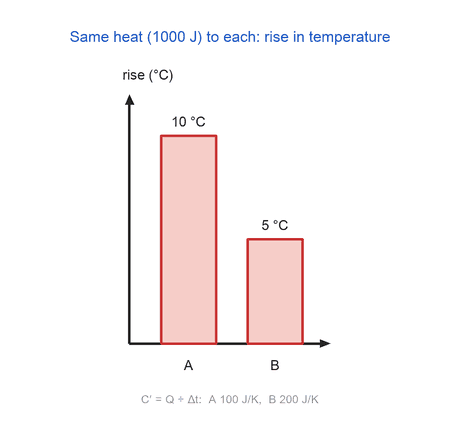
Both liquids get the same heat Q, and heat capacity is C′ = Q ÷ Δt, so the liquid with the greater rise Δt has the smaller heat capacity.
Step 2 — Apply it to A.
Liquid A shows the greater rise in temperature, so its heat capacity is the smaller one.
Step 3 — Check with numbers.
For example, if 1000 J warms A by 10 °C and B by 5 °C, then the heat capacity of A is 100 J K⁻¹ and that of B is 200 J K⁻¹.
Watch out: A bigger rise in temperature for the same heat means a SMALLER heat capacity, not a bigger one.
Therefore, the heat capacity of A is less than that of B.
- 192 marks
Question 19
Give one example each where high specific heat capacity of water is used (i) as coolant, (ii) as heat reservoir.
Solve with AIWritten solution
Solution:
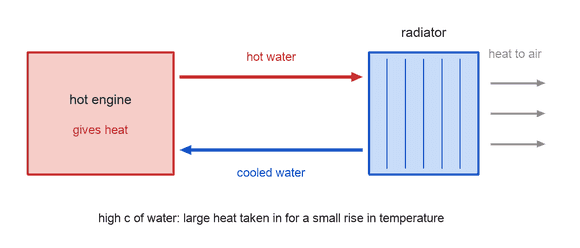
Concept: Water has a very high specific heat capacity (4200 J kg⁻¹ K⁻¹). So a given mass of water takes in a large amount of heat for only a small rise in its temperature, and gives out a large amount of heat for only a small fall.
(i)
Step 1 — Water as a coolant.
Water is circulated through the radiator of a car engine. It takes in a large amount of heat from the engine while its own temperature rises only a little, and gives this heat out to the air in the radiator.
(ii)
Step 2 — Water as a heat reservoir.
Hot water bottles are used for fomentation. The hot water stores a large amount of heat and gives it out slowly for a long time. (Farmers flooding their fields on frosty nights, and juice bottles kept in water so that they do not freeze, are other examples.)
Therefore, (i) water is used as a coolant in car radiators, and (ii) as a heat reservoir in hot water bottles for fomentation.
- 202 marks
Question 20
A liquid X has specific heat capacity higher than the liquid Y. Which liquid is useful as (i) coolant in car radiators, and (ii) heat reservoir to keep juice bottles without freezing ?
Solve with AIWritten solution
Solution:
Concept: A liquid with a higher specific heat capacity takes in or gives out more heat for the same change in its temperature, because Q = m × c × Δt.
(i)
Step 1 — Choose the coolant.
Liquid X has the higher specific heat capacity, so it can absorb more heat from the engine for only a small rise in its own temperature. So X cools the engine better.
(ii)
Step 2 — Choose the heat reservoir.
As liquid X cools, it gives out more heat for each degree its temperature falls. So it keeps the juice bottles from cooling down to their freezing point for a longer time.
Note: a spelling slip in the printed question (“reservior”) has been corrected to “reservoir”.
Therefore, liquid X is useful both (i) as the coolant in car radiators and (ii) as the heat reservoir for the juice bottles.
- 212 marks
Question 21
Define the term heat.
Solve with AIWritten solution
Solution:
Concept: Temperature is the degree of hotness or coldness of a body. It measures the average kinetic energy of the molecules, and it decides the direction in which heat flows: always from the higher temperature to the lower one.
Step 1 — State the definition.
Heat is the form of energy that flows from a body at a higher temperature to a body at a lower temperature, because of the difference in their temperatures.
Step 2 — Say what flows.
The energy that flows is part of the internal (thermal) energy of the molecules, their kinetic plus potential energy. The flow stops when both bodies reach the same temperature.
Step 3 — Give the unit.
Heat is energy, so its S.I. unit is the joule (J).
Watch out: Heat is energy on the move; a body 'contains' thermal energy, and heat is the part of it that flows.
Therefore, heat is the energy that flows from a hotter body to a colder body because of their difference in temperature; its S.I. unit is the joule.
- 222 marks
Question 22
Define the term calorie. How is it related to joule ?
Solve with AIWritten solution
Solution:
Concept: Heat is the form of energy that flows from a body at a higher temperature to a body at a lower temperature. Its S.I. unit is the joule (J); another unit is the calorie (1 cal ≈ 4.2 J).
Step 1 — Define the calorie.
One calorie is the amount of heat energy needed to raise the temperature of 1 g of water by 1 °C (strictly, from 14.5 °C to 15.5 °C).
Step 2 — Relate it to the joule.
Measurements show that one calorie of heat is the same energy as about 4.2 joules (more precisely 4.186 J).
Step 3 — Compare the sizes.
So the joule is the smaller unit: about 4.2 joules make one calorie.
Therefore, one calorie is the heat needed to raise the temperature of 1 g of water by 1 °C, and 1 cal ≈ 4.2 J.
- 232 marks
Question 23
Define one kilo-calorie of heat.
Solve with AIWritten solution
Solution:
Concept: Heat is the form of energy that flows from a body at a higher temperature to a body at a lower temperature. Its S.I. unit is the joule (J); another unit is the calorie (1 cal ≈ 4.2 J).
Step 1 — Define the kilocalorie.
One kilocalorie is the amount of heat energy needed to raise the temperature of 1 kg of water by 1 °C (from 14.5 °C to 15.5 °C).
Step 2 — Relate it to the calorie.
Since 1 kg is 1000 g, it is 1000 times the heat of one calorie.
Step 3 — Change it to joule.
Each calorie is 4.186 J, so one kilocalorie is 1000 times that.
Therefore, one kilocalorie is the heat needed to raise the temperature of 1 kg of water by 1 °C (1 kcal = 1000 cal ≈ 4186 J).
- 242 marks
Question 24
Define temperature and name its S.I. unit.
Solve with AIWritten solution
Solution:
Concept: Temperature is the degree of hotness or coldness of a body. It measures the average kinetic energy of the molecules, and it decides the direction in which heat flows: always from the higher temperature to the lower one.
Step 1 — Define temperature.
Temperature is the quantity that tells the degree of hotness or coldness of a body. It is a measure of the average kinetic energy of its molecules, and it decides the direction of flow of heat.
Step 2 — Name the S.I. unit.
The S.I. unit of temperature is the kelvin (K). The Celsius scale is also used; the two are linked as follows.
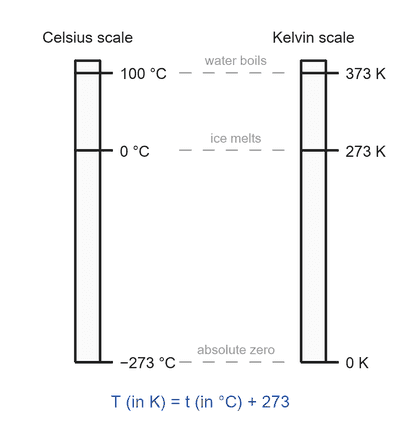
Therefore, temperature is the degree of hotness or coldness of a body, and its S.I. unit is the kelvin (K).
- 253 marks
Question 25
State three differences between heat and temperature.
Solve with AIWritten solution
Solution:
Concept: Heat is energy that flows; temperature is the level of hotness that decides which way it flows.
Step 1 — Compare them point by point.
The table sets the two side by side; any three rows answer the question.
Heat Temperature It is a form of energy: the internal energy that flows from a hotter body to a colder one. It is the degree of hotness, a measure of the average kinetic energy of the molecules. Its S.I. unit is the joule (J). Its S.I. unit is the kelvin (K). It is measured by the principle of calorimetry. It is measured with a thermometer. The heat in a body depends on its mass, its temperature and its material. It does not depend on the mass of the body. When two bodies are in contact, heat is what flows between them. It decides the direction of that flow: from the higher to the lower temperature. Step 2 — See the difference in an example.
A bucket of water at 30 °C holds far more heat than a hot iron nail at 200 °C, yet heat flows from the nail to the water, because the nail's temperature is higher.
Therefore, heat is energy (in joule, found by calorimetry, depending on mass), while temperature is the degree of hotness (in kelvin, read on a thermometer, independent of mass).
- 262 marks
Question 26
State the principle of calorimetry.
Solve with AIWritten solution
Solution:
Concept: Principle of method of mixtures (principle of calorimetry): when a hot body and a cold body are mixed and no heat is lost to the surroundings, heat flows from the hot body to the cold body until both reach the same final temperature, and heat lost by the hot body = heat gained by the cold body.
Step 1 — Describe the situation.
A hot body is put in contact with (or mixed with) a cold body, and no heat is lost to the surroundings. Heat flows from the hot body to the cold body until both reach the same temperature.
Step 2 — State the principle.
All the heat that leaves the hot body goes into the cold body, so the two amounts are equal.
Step 3 — Name the law behind it.
This follows from the law of conservation of energy: heat is neither created nor destroyed while it passes from one body to the other.
Watch out: The principle holds only when no heat is lost to the surroundings or the container.
Therefore, heat energy lost by the hot body = heat energy gained by the cold body (when no heat is lost to the surroundings).
- 272 marks
Question 27
Define the term heat capacity and state its S.I. unit.
Solve with AIWritten solution
Solution:
Concept: The heat capacity C′ of a body is the heat needed to raise the temperature of the whole body by 1 K. It is linked to the specific heat capacity c of its substance by C′ = m × c, and its S.I. unit is J K⁻¹.
Step 1 — Define heat capacity.
The heat capacity of a body is the amount of heat energy needed to raise the temperature of the whole body by 1 °C (or 1 K). If heat Q raises its temperature by Δt, then:
Step 2 — Give the S.I. unit.
Heat is in joule and the rise in kelvin, so the S.I. unit is the joule per kelvin (J K⁻¹).
Step 3 — See it on a graph.
On a graph of the heat supplied Q against the rise in temperature Δt, the heat capacity is the slope of the straight line.
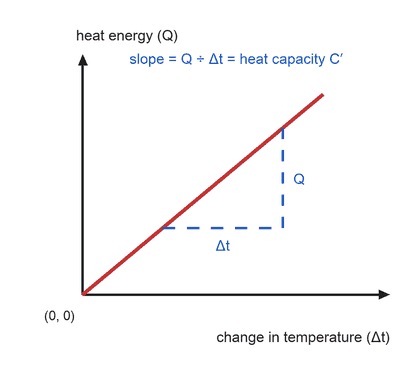
Therefore, heat capacity is the heat needed to raise the temperature of the whole body by 1 K, and its S.I. unit is J K⁻¹.
- 282 marks
Question 28
Define the term specific heat capacity and state its S.I. unit.
Solve with AIWritten solution
Solution:
Concept: The specific heat capacity c of a substance is the heat needed to raise the temperature of unit mass (1 kg) of it by 1 K (or 1 °C). Its S.I. unit is J kg⁻¹ K⁻¹; for water it is about 4200 J kg⁻¹ K⁻¹, which is the same as 4.2 J g⁻¹ K⁻¹.
Step 1 — Define specific heat capacity.
The specific heat capacity of a substance is the amount of heat energy needed to raise the temperature of unit mass (1 kg) of the substance by 1 °C (or 1 K). If heat Q warms mass m by Δt, then:
Step 2 — Give the S.I. unit.
Heat is in joule, mass in kilogram and the rise in kelvin, so the S.I. unit is the joule per kilogram per kelvin (J kg⁻¹ K⁻¹).
Step 3 — Give an example.
For water, c = 4200 J kg⁻¹ K⁻¹, so 1 kg of water needs 4200 J to warm by 1 K. It is a characteristic property of the substance and does not depend on the mass taken.
Therefore, specific heat capacity is the heat needed to raise the temperature of 1 kg of a substance by 1 K, and its S.I. unit is J kg⁻¹ K⁻¹.
- 293 marks
Question 29
State three differences between the heat capacity and specific heat capacity.
Solve with AIWritten solution
Solution:
Concept: Heat capacity belongs to a whole body; specific heat capacity belongs to unit mass of a substance. They are linked by C′ = m × c.
Step 1 — Compare them point by point.
The table sets the two side by side; any three rows answer the question.
Heat capacity Specific heat capacity It is the heat needed to raise the temperature of the whole body by 1 K. It is the heat needed to raise the temperature of unit mass of the substance by 1 K. It depends on the mass of the body (and on its material). It does not depend on the mass; it depends only on the material. Its S.I. unit is J K⁻¹. Its S.I. unit is J kg⁻¹ K⁻¹. It is a property of a particular body. It is a characteristic property of a substance. Step 2 — See the difference in an example.
2 kg of water has twice the heat capacity of 1 kg of water (8400 J K⁻¹ against 4200 J K⁻¹), but both have the same specific heat capacity, 4200 J kg⁻¹ K⁻¹.
Therefore, heat capacity is for the whole body, depends on its mass and is in J K⁻¹; specific heat capacity is for unit mass, depends only on the material and is in J kg⁻¹ K⁻¹.
- 302 marks
Question 30
What do you mean by the following statements :
(i) the heat capacity of a body is 50 J K ?
(ii) the specific heat capacity of copper is 0·4 J g K ?
Solve with AIWritten solution
Solution:
Concept: Heat capacity is the heat for a 1 K rise of the whole body; specific heat capacity is the heat for a 1 K rise of unit mass of the substance.
(i)
Step 1 — Read the heat capacity.
A heat capacity of 50 J K⁻¹ means the body needs 50 J of heat energy to raise its temperature by 1 K (1 °C). It also gives out 50 J when it cools by 1 K.
(ii)
Step 2 — Read the specific heat capacity.
A specific heat capacity of 0.4 J g⁻¹ K⁻¹ means 1 g of copper needs 0.4 J of heat energy to raise its temperature by 1 K (1 °C).
Step 3 — Change it to per kilogram.
For 1 kg (1000 g) of copper, the heat for a 1 K rise is 1000 times as much.
Therefore, (i) the body needs 50 J for each 1 K rise in its temperature, and (ii) 1 g of copper needs 0.4 J for each 1 K rise (400 J for 1 kg).
- 312 marks
Question 31
Specific heat capacity of a substance A is 3·8 J g K and of the substance B is 0·4 J g K. Which substance is a good conductor of heat ? How did you arrive at your conclusion ?
Solve with AIWritten solution
Solution:
Concept: The heat taken in (or given out) by a body of mass m, made of a substance of specific heat capacity c, when its temperature rises (or falls) by Δt is Q = m × c × Δt. So for the same Q and m, the rise Δt = Q ÷ (mc) is larger when c is smaller.
Step 1 — Compare the rises.
Give the same heat to the same mass of A and of B. The ratio of their rises is the inverse ratio of their specific heat capacities.

Step 2 — Interpret the result.
B's temperature rises 9.5 times as much as A's. B warms up quickly and passes the heat on quickly, which is how a good conductor such as a metal behaves.
Step 3 — Conclude.
So the substance with the much lower specific heat capacity, B, is the good conductor of heat.
Watch out: This is the book's rule of thumb (low specific heat capacity goes with good conduction, as for metals); the two properties are not strictly linked for every substance.
Therefore, substance B is the good conductor: for the same heat and the same mass its temperature rises more (9.5 times as much as A's).
- 322 marks
Question 32
Name two factors on which the heat energy liberated by a body on cooling depends.
Solve with AIWritten solution
Solution:
Concept: The heat taken in (or given out) by a body of mass m, made of a substance of specific heat capacity c, when its temperature rises (or falls) by Δt is Q = m × c × Δt. Here Δt is the fall in temperature.
Step 1 — First factor: the mass.
A larger mass gives out more heat for the same fall in temperature, because Q is proportional to m.
Step 2 — Second factor: the fall in temperature.
The more the body cools, the more heat it gives out, because Q is proportional to Δt.
Step 3 — A third factor.
The material of the body also matters, through its specific heat capacity c; water gives out far more heat than the same mass of copper cooling by the same amount.
Note: a spelling slip in the printed question (“librated”) has been corrected to “liberated”.
Therefore, the heat liberated by a cooling body depends on (i) its mass and (ii) the fall in its temperature (and also on its material).
- 333 marks
Question 33
Name three factors on which the heat energy absorbed by a body depends and state how does it depend on them.
Solve with AIWritten solution
Solution:
Concept: The heat taken in (or given out) by a body of mass m, made of a substance of specific heat capacity c, when its temperature rises (or falls) by Δt is Q = m × c × Δt. So the heat is directly proportional to each of the three quantities.
Step 1 — Mass of the body.
Q ∝ m: twice the mass needs twice the heat for the same rise in temperature.
Step 2 — Rise in temperature.
Q ∝ Δt: raising the temperature by 20 °C needs twice the heat needed for 10 °C.
Step 3 — Material of the body.
Q ∝ c: 1 kg of water (4200 J kg⁻¹ K⁻¹) needs about 11 times the heat that 1 kg of copper (385 J kg⁻¹ K⁻¹) needs for the same rise.
Therefore, the heat absorbed is directly proportional to (i) the mass, (ii) the rise in temperature and (iii) the specific heat capacity of the material of the body.
- 342 marks
Question 34
Two blocks P and Q of different metals having their mass in the ratio 2 : 1 are given same amount of heat. Their temperature rises by same amount. Compare their specific heat capacities.
Solve with AIWritten solution
Solution:
Concept: The heat taken in (or given out) by a body of mass m, made of a substance of specific heat capacity c, when its temperature rises (or falls) by Δt is Q = m × c × Δt. With the same Q and the same Δt for both blocks, the product m × c must be the same for both.
Given: m_P : m_Q = 2 : 1; the same heat Q; the same rise in temperature Δt.
Step 1 — Write the heat for each block.
The same heat Q raises both temperatures by the same Δt, so the two expressions for Q are equal.
Step 2 — Cancel the common rise.
Δt is the same on both sides, so it cancels.
Step 3 — Find the ratio.
Dividing, the ratio of specific heat capacities is the inverse of the ratio of masses, and the masses are in the ratio 2 : 1.
Step 4 — Explain the meaning.
P has twice the mass but needs the same heat, so each kilogram of P needs only half as much heat as each kilogram of Q.
Watch out: The ratio of specific heat capacities is the INVERSE of the mass ratio, not equal to it.
Therefore, c_P : c_Q = 1 : 2.
- 352 marks
Question 35
What is the principle of method of mixture ? What other name is given to it ? Name the law on which this principle is based.
Solve with AIWritten solution
Solution:
Concept: Principle of method of mixtures (principle of calorimetry): when a hot body and a cold body are mixed and no heat is lost to the surroundings, heat flows from the hot body to the cold body until both reach the same final temperature, and heat lost by the hot body = heat gained by the cold body.
Step 1 — State the principle.
When a hot body is mixed with (or kept in contact with) a cold body, heat flows from the hot body to the cold body until both reach the same final temperature. If no heat is lost to the surroundings, heat lost by the hot body = heat gained by the cold body.
Step 2 — Give its other name.
It is also called the principle of calorimetry.
Step 3 — Name the law.
It is based on the law of conservation of energy: energy cannot be created or destroyed, so all the heat leaving the hot body must appear in the cold body.
Therefore, the principle of method of mixtures is heat lost by the hot body = heat gained by the cold body; it is also called the principle of calorimetry and is based on the law of conservation of energy.
- 362 marks
Question 36
Why do the farmers fill their fields with water on a cold winter night ?
Solve with AIWritten solution
Solution:
Concept: Water has a very high specific heat capacity (4200 J kg⁻¹ K⁻¹). So a given mass of water takes in a large amount of heat for only a small rise in its temperature, and gives out a large amount of heat for only a small fall.
Step 1 — See the danger.
On a cold winter night the temperature of the surroundings may fall below 0 °C. The water in the plants could then freeze, and frost would damage the crops.
Step 2 — See how the water helps.
The water in the field keeps giving out its stored heat to the soil and the air near the plants through the night. Because it releases so much heat for each degree it cools, the temperature around the plants does not fall to freezing.
Therefore, farmers fill their fields with water because its high specific heat capacity lets it give out a lot of heat at night, which keeps the crops from freezing.
- 372 marks
Question 37
Water is used in hot water bottles for fomentation. Give a reason.
Solve with AIWritten solution
Solution:
Concept: Water has a very high specific heat capacity (4200 J kg⁻¹ K⁻¹). So a given mass of water takes in a large amount of heat for only a small rise in its temperature, and gives out a large amount of heat for only a small fall.
Step 1 — Hot water stores a lot of heat.
Since c of water is large, a given mass of hot water stores a large amount of heat, because Q = m × c × Δt is large.
Step 2 — It gives the heat out slowly.
As it cools, water gives out a lot of heat for each degree its temperature falls. So its temperature falls only slowly, and it keeps supplying warmth to the body for a long time during fomentation.
Therefore, water is used in hot water bottles because its high specific heat capacity lets it store a lot of heat and give it out slowly for a long time.
- 381 mark
Question 38
What property of water makes it an effective coolant ?
Solve with AIWritten solution
Solution:
Concept: Water has a very high specific heat capacity (4200 J kg⁻¹ K⁻¹). So a given mass of water takes in a large amount of heat for only a small rise in its temperature, and gives out a large amount of heat for only a small fall.
Step 1 — Name the property.
The property is the high specific heat capacity of water, 4200 J kg⁻¹ K⁻¹.
Step 2 — Explain why it cools well.
Water can absorb a large amount of heat with only a small rise in its own temperature. So it carries away a lot of heat from an engine and stays cool enough to keep doing so; this is why it is used in car radiators.
Therefore, the high specific heat capacity of water makes it an effective coolant.
- 392 marks
Question 39
Why is the base of a cooking pan made thick and heavy?
Solve with AIWritten solution
Solution:
Concept: The heat capacity C′ of a body is the heat needed to raise the temperature of the whole body by 1 K. It is linked to the specific heat capacity c of its substance by C′ = m × c, and its S.I. unit is J K⁻¹. A thick, heavy base has a large mass, so it has a large heat capacity.
Step 1 — Even cooking.
The heavy base takes in a large amount of heat from the flame and passes it on slowly and uniformly to the food. Its temperature does not shoot up at one spot, so the food cooks evenly and does not get charred.
Step 2 — Food stays warm.
The heavy base stores a lot of heat. After the flame is turned off, it gives this heat out slowly and keeps the food warm for a long time.
Therefore, the base is made thick and heavy so that its large heat capacity gives the food heat slowly and evenly and keeps it warm for a long time.
- 404 marks
Question 40
A mass of a substance of specific heat capacity at temperature is mixed with a mass of other substance of specific heat capacity at a lower temperature . Deduce the expression for the temperature of the mixture. State the assumption made, if any.
Solve with AIWritten solution
Solution:
Concept: Principle of method of mixtures (principle of calorimetry): when a hot body and a cold body are mixed and no heat is lost to the surroundings, heat flows from the hot body to the cold body until both reach the same final temperature, and heat lost by the hot body = heat gained by the cold body. Here t₂ < t < t₁.
Step 1 — Heat lost by the hot substance.
The first substance cools from t₁ to t, so the heat it loses is:
Step 2 — Heat gained by the cold substance.
The second substance warms from t₂ to t, so the heat it gains is:
Step 3 — Equate them.
With no heat lost, heat lost = heat gained.
Step 4 — Expand both sides.
Multiply out the brackets.
Step 5 — Collect the terms in t.
Move every term with t to one side and the rest to the other.
Step 6 — Solve for t.
Divide by the bracket.
Step 7 — State the assumption.
We assumed that there is no loss of heat to the surroundings or to the container, so all the heat lost by the hot substance is gained by the cold one.
Step 8 — Read the result.
t is a weighted average of t₁ and t₂, weighted by the heat capacities m₁c₁ and m₂c₂, so the final temperature lies nearer the starting temperature of the substance with the larger heat capacity.
Watch out: Write each temperature change as (higher − lower), so that both heats come out positive.
Therefore, t = (m₁c₁t₁ + m₂c₂t₂) ÷ (m₁c₁ + m₂c₂), assuming no heat is lost to the surroundings.
- 414 marks
Question 41
Discuss the role of high specific heat capacity of water with reference to climate in coastal areas.
Solve with AIWritten solution
Solution:
Concept: Water has a very high specific heat capacity (4200 J kg⁻¹ K⁻¹). So a given mass of water takes in a large amount of heat for only a small rise in its temperature, and gives out a large amount of heat for only a small fall. Land (sand and soil) has a much lower specific heat capacity, roughly 800 J kg⁻¹ K⁻¹, so for the same sunshine the sea warms up, and later cools down, much more slowly than the land.
Step 1 — During the day.
The sun heats both land and sea. The land heats up quickly, but the sea warms only slightly. The air over the hot land becomes warm, gets lighter and rises, and cooler air from the sea blows in to take its place. This sea breeze keeps days at the coast from becoming very hot.
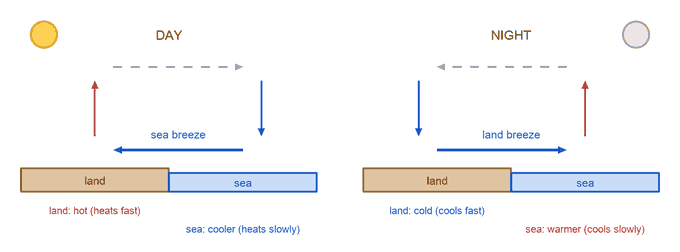
Step 2 — At night.
The land cools quickly, but the sea gives out its stored heat slowly and stays warmer than the land. Now the air over the sea rises, and air from the land blows towards the sea (the land breeze). The warm sea also warms the coast, so the nights do not become very cold.
Step 3 — Over the year.
In the same way, the sea warms slowly in summer and cools slowly in winter, so it acts as a heat reservoir for the coast.
Therefore, because of the high specific heat capacity of water, the climate of coastal areas is moderate: the difference between day and night (and summer and winter) temperatures is much smaller than far from the sea.
- 425 marks
Question 42
(a) What is a calorimeter ?
(b) Name the material of which it is made of. Give two reasons for using the material stated by you.
(c) Out of the three metals A, B and C of specific heat capacity 900 J kg °C, 380 J kg °C and 460 J kg °C respectively, which will you prefer for calorimeter ? Give reason.
(d) How is the loss of heat due to radiation minimised in a calorimeter ?
Solve with AIWritten solution
Solution:
Concept: A calorimeter should take up as little heat as possible from its contents and let as little heat escape as possible, so that heat lost = heat gained holds closely.
(a)
Step 1 — Say what a calorimeter is.
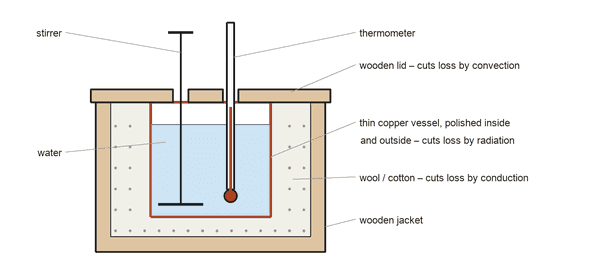
A calorimeter is a cylindrical vessel (with a stirrer and a lid) used to measure the amount of heat gained or lost by a body when it is mixed with another body, using the principle of calorimetry.
(b)
Step 2 — Name the material.
It is usually made of thin copper, for two reasons.
- Copper is a good conductor of heat, so the vessel quickly reaches the same temperature as its contents.
- Copper has a low specific heat capacity, so a thin copper vessel has a small heat capacity and itself takes up very little of the heat being measured.
(c)
Step 3 — Choose the metal.
The best metal is the one with the lowest specific heat capacity, since for the same mass it takes up the least heat from the contents. Of 900, 380 and 460 J kg⁻¹ °C⁻¹, the lowest is 380, metal B.
(d)
Step 4 — Reduce the loss by radiation.
The inner and outer surfaces of the calorimeter are highly polished, because a shiny surface is a poor radiator (and absorber) of heat. It is also kept in a wooden jacket with wool or cotton packed around it, which cuts the loss by conduction and convection.
Therefore, (a) a calorimeter is a vessel for measuring heat by the method of mixtures; (b) it is made of copper, a good conductor with a low specific heat capacity; (c) metal B is preferred, as it has the lowest specific heat capacity; (d) loss by radiation is cut by polishing its surfaces.
- 432 marks
Question 43
By imparting heat to a body, its temperature rises by 15°C. What is the corresponding rise in temperature on kelvin scale ?
Solve with AIWritten solution
Solution:
Concept: The Celsius and Kelvin scales have degrees of the same size; they differ only in where their zero is (T in K = t in °C + 273). So a change of temperature has the same number on both scales.
Given: Rise in temperature = 15 °C.
Step 1 — Write the two readings in kelvin.
Let the temperature rise from t °C to (t + 15) °C. In kelvin, the readings are (t + 273) K and (t + 15 + 273) K.
Step 2 — Subtract them.
The rise is the difference of the two kelvin readings; the 273 cancels.
Watch out: Do not add 273 to a CHANGE in temperature; 273 is added only to a reading.
Therefore, the rise in temperature on the kelvin scale is 15 K.
- 443 marks
Question 44
(a) Calculate the heat capacity of a copper vessel of mass 200 g if the specific heat capacity of copper is 410 J kg K.
(b) How much heat energy will be required to increase the temperature of the vessel in part (a) from 25°C to 35°C ?
Solve with AIWritten solution
Solution:
Concept: The heat capacity C′ of a body is the heat needed to raise the temperature of the whole body by 1 K. It is linked to the specific heat capacity c of its substance by C′ = m × c, and its S.I. unit is J K⁻¹. Once C′ is known, the heat for any rise is Q = C′ × Δt.
Given: m = 200 g; c = 410 J kg⁻¹ K⁻¹; temperature rises from 25 °C to 35 °C.
(a)
Step 1 — Change the mass to kg.
The specific heat capacity is per kilogram, so the mass must be in kilogram: 200 g = 0.2 kg.
Step 2 — Find the heat capacity.
Multiply the mass by the specific heat capacity.
(b)
Step 3 — Find the rise in temperature.
The vessel warms from 25 °C to 35 °C.
Step 4 — Find the heat.
The vessel needs 82 J for each 1 K rise, so for 10 K it needs ten times as much.
Watch out: Change 200 g to 0.2 kg before multiplying, because c is given per kilogram.
Therefore, (a) the heat capacity of the vessel is 82 J K⁻¹, and (b) the heat required is 820 J.
- 453 marks
Question 45
A piece of iron of mass 2·0 kg has a heat capacity of 966 J K. Find : (i) heat energy needed to warm it by 15°C, and (ii) its specific heat capacity in S.I. unit.
Solve with AIWritten solution
Solution:
Concept: The heat capacity C′ of a body is the heat needed to raise the temperature of the whole body by 1 K. It is linked to the specific heat capacity c of its substance by C′ = m × c, and its S.I. unit is J K⁻¹. So Q = C′ × Δt, and c = C′ ÷ m.
Given: m = 2.0 kg; C′ = 966 J K⁻¹; Δt = 15 K (a rise of 15 °C).
(i)
Step 1 — Find the heat for a 15 °C rise.
The heat capacity is the heat for each 1 K rise, and a rise of 15 °C is a rise of 15 K.
(ii)
Step 2 — Find the specific heat capacity.
Dividing the heat capacity of the whole piece by its mass gives the heat for 1 kg.
Therefore, (i) the heat needed is 14490 J, and (ii) the specific heat capacity of iron is 483 J kg⁻¹ K⁻¹.
- 463 marks
Question 46
Calculate the amount of heat energy required to raise the temperature of 200 g of copper from 20°C to 70°C. Specific heat capacity of copper = 390 J kg K.
Solve with AIWritten solution
Solution:
Concept: The heat taken in (or given out) by a body of mass m, made of a substance of specific heat capacity c, when its temperature rises (or falls) by Δt is Q = m × c × Δt.
Given: m = 200 g; c = 390 J kg⁻¹ K⁻¹; temperature rises from 20 °C to 70 °C.
Step 1 — Get the quantities ready.
The mass must be in kg to match the unit of c, and the rise is the difference of the two temperatures.
Step 2 — Find the heat.
Multiply the mass, the specific heat capacity and the rise in temperature.
Step 3 — Compare with water.
Copper has a low specific heat capacity, so only 3900 J warms 200 g of it by 50 K; the same mass of water would need about 11 times as much.
Watch out: Change 200 g to 0.2 kg before multiplying, because c is given per kilogram.
Therefore, the heat energy required is 3900 J.
- 473 marks
Question 47
1300 J of heat energy is supplied to raise the temperature of 0·5 kg of lead from 20°C to 40°C. Calculate the specific heat capacity of lead.
Solve with AIWritten solution
Solution:
Concept: The heat taken in (or given out) by a body of mass m, made of a substance of specific heat capacity c, when its temperature rises (or falls) by Δt is Q = m × c × Δt. So, rearranged, c = Q ÷ (m × Δt).
Given: Q = 1300 J; m = 0.5 kg; temperature rises from 20 °C to 40 °C.
Step 1 — Find the rise in temperature.
The lead warms from 20 °C to 40 °C.
Step 2 — Rearrange for c.
Divide the heat by the product of the mass and the rise.
Step 3 — Put in the values.
Use Q = 1300 J, m = 0.5 kg and Δt = 20 K.
Step 4 — Check with the book's table.
This matches the value for lead in the table of specific heat capacities, one of the lowest of all metals.
Therefore, the specific heat capacity of lead is 130 J kg⁻¹ K⁻¹.
- 483 marks
Question 48
A car's cooling system uses water to absorb heat from the engine. If 5 kg of water absorbs 420 kJ of heat, what is the temperature increase of water ? (Specific heat capacity of water = 4200 J kgK).
Solve with AIWritten solution
Solution:
Concept: The heat taken in (or given out) by a body of mass m, made of a substance of specific heat capacity c, when its temperature rises (or falls) by Δt is Q = m × c × Δt. So, rearranged, the rise is Δt = Q ÷ (m × c).
Given: m = 5 kg; Q = 420 kJ; c = 4200 J kg⁻¹ K⁻¹.
Step 1 — Change kJ to J.
The specific heat capacity is in joule, so the heat must be in joule too.
Step 2 — Rearrange for the rise.
Divide the heat by the product of the mass and the specific heat capacity.
Step 3 — Put in the values.
Use Q = 420000 J, m = 5 kg and c = 4200 J kg⁻¹ K⁻¹.
Step 4 — Interpret.
A rise of 20 K is the same as a rise of 20 °C. Even after taking in 420 kJ, 5 kg of water warms by only 20 °C; this is why water makes a good coolant.
Watch out: Change kJ to J first; using 420 instead of 420000 gives a rise 1000 times too small.
Therefore, the temperature of the water increases by 20 °C.
- 493 marks
Question 49
Find the time taken by a 500 W heater to raise the temperature of 50 kg of material of specific heat capacity 960 J kg K from 18°C to 38°C. Assume that all the heat energy supplied by heater is given to the material.
Solve with AIWritten solution
Solution:
Concept: The heat taken in (or given out) by a body of mass m, made of a substance of specific heat capacity c, when its temperature rises (or falls) by Δt is Q = m × c × Δt. A heater of power P supplies P joule every second, so the time taken is t = Q ÷ P.
Given: P = 500 W; m = 50 kg; c = 960 J kg⁻¹ K⁻¹; temperature rises from 18 °C to 38 °C.
Step 1 — Find the rise in temperature.
The material warms from 18 °C to 38 °C.
Step 2 — Find the heat needed.
Multiply the mass, the specific heat capacity and the rise.
Step 3 — Find the time.
All the heat comes from the 500 W heater, which supplies 500 J each second.
Step 4 — Change to minutes.
There are 60 seconds in a minute.
Therefore, the heater takes 1920 s, that is 32 minutes.
- 503 marks
Question 50
A fire truck uses 10,000 litres of water to extinguish a fire, cooling down the burning material from 500°C to 100°. If the temperature of water increases by 40°C, how much heat energy is absorbed by it ? (Specific heat capacity of water = 4200 J kgK).
Solve with AIWritten solution
Solution:
Concept: The heat taken in (or given out) by a body of mass m, made of a substance of specific heat capacity c, when its temperature rises (or falls) by Δt is Q = m × c × Δt. The heat absorbed by the water depends only on the water's own mass, specific heat capacity and rise in temperature; the temperatures of the burning material are extra information.
Given: Volume of water = 10000 litres; rise in temperature = 40 °C; c = 4200 J kg⁻¹ K⁻¹.
Step 1 — Find the mass of the water.
1 litre of water has a mass of 1 kg, so 10000 litres of water have a mass of 10000 kg.
Step 2 — Find the heat absorbed.
Multiply the mass, the specific heat capacity and the rise of 40 °C (40 K).
Step 3 — Write it as in the book.
The same value can be written with 10⁷.
Step 4 — See where the heat comes from.
This huge amount of heat is taken from the burning material, which is how water puts out the fire.
Watch out: Use the water's rise of 40 °C, not the fall of the burning material (500 °C to 100 °C).
Therefore, the water absorbs 1.68 × 10⁹ J (168 × 10⁷ J) of heat energy.
- 513 marks
Question 51
An electric heater of power 600 W raises the temperature of 4·0 kg of a liquid from 10·0 °C to 15·0 °C in 100 s. Calculate : (i) the heat capacity of 4·0 kg of liquid, and (ii) the specific heat capacity of liquid.
Solve with AIWritten solution
Solution:
Concept: The heat capacity C′ of a body is the heat needed to raise the temperature of the whole body by 1 K. It is linked to the specific heat capacity c of its substance by C′ = m × c, and its S.I. unit is J K⁻¹. A heater of power P working for time t supplies Q = P × t.
Given: P = 600 W; t = 100 s; m = 4.0 kg; temperature rises from 10.0 °C to 15.0 °C.
Step 1 — Find the heat supplied.
The heater gives 600 J every second for 100 s.
Step 2 — Find the rise in temperature.
The liquid warms from 10.0 °C to 15.0 °C.
(i)
Step 3 — Find the heat capacity.
Heat capacity is the heat per kelvin rise of the whole 4.0 kg of liquid.
(ii)
Step 4 — Find the specific heat capacity.
Divide the heat capacity by the mass to get the heat per kilogram.
Therefore, (i) the heat capacity of the liquid is 1.2 × 10⁴ J K⁻¹, and (ii) its specific heat capacity is 3.0 × 10³ J kg⁻¹ K⁻¹.
- 523 marks
Question 52
0·5 kg of lemon squash at 30°C is placed in a refrigerator which can remove heat at an average rate of 30 J s. How long will it take to cool the lemon squash to 5°C ? Specific heat capacity of squash = 4200 J kg K.
Solve with AIWritten solution
Solution:
Concept: The heat taken in (or given out) by a body of mass m, made of a substance of specific heat capacity c, when its temperature rises (or falls) by Δt is Q = m × c × Δt. The refrigerator removes 30 J every second, so the time taken is the heat to be removed divided by 30 J s⁻¹.
Given: m = 0.5 kg; c = 4200 J kg⁻¹ K⁻¹; temperature falls from 30 °C to 5 °C; rate of removal = 30 J s⁻¹.
Step 1 — Find the fall in temperature.
The squash cools from 30 °C to 5 °C.
Step 2 — Find the heat to be removed.
Multiply the mass, the specific heat capacity and the fall.
Step 3 — Find the time.
Divide the heat by the rate at which it is removed.
Step 4 — Change to minutes and seconds.
1750 s is 29 whole minutes (1740 s) and 10 s more.
Therefore, the squash takes 1750 s, that is 29 min 10 s, to cool to 5 °C.
- 534 marks
Question 53
A mass of 50 g of a certain metal at 150°C is immersed in 100 g of water at 11°C. The final temperature is 20°C. Calculate the specific heat capacity of the metal. Assume that the specific heat capacity of water is 4·2 J g K.
Solve with AIWritten solution
Solution:
Concept: Principle of method of mixtures (principle of calorimetry): when a hot body and a cold body are mixed and no heat is lost to the surroundings, heat flows from the hot body to the cold body until both reach the same final temperature, and heat lost by the hot body = heat gained by the cold body. The heat taken in (or given out) by a body of mass m, made of a substance of specific heat capacity c, when its temperature rises (or falls) by Δt is Q = m × c × Δt.
Given: Metal: 50 g, 150 °C → 20 °C; water: 100 g, 11 °C → 20 °C, c = 4.2 J g⁻¹ K⁻¹.
Step 1 — Heat lost by the metal.
The metal cools from 150 °C to 20 °C, a fall of 130 °C. Let its specific heat capacity be c (in J g⁻¹ K⁻¹; grams are used because c of water is given per gram).
Step 2 — Heat gained by the water.
The water warms from 11 °C to 20 °C, a rise of 9 °C.
Step 3 — Equate them.
With no heat lost, heat lost by the metal = heat gained by the water.
Step 4 — Solve for c.
Divide both sides by 6500 and round to three significant figures.

Watch out: The metal's fall (150 − 20) and the water's rise (20 − 11) are different numbers; work each one out.
Therefore, the specific heat capacity of the metal is about 0.582 J g⁻¹ K⁻¹ (582 J kg⁻¹ K⁻¹).
- 544 marks
Question 54
45 g of water at 50°C in a beaker is cooled when 50 g of copper at 18°C is added to it. The contents are stirred till a final constant temperature is reached. Calculate the final temperature. The specific heat capacity of copper is 0·39 J g K and that of water is 4·2 J g K. State the assumption used.
Solve with AIWritten solution
Solution:
Concept: Principle of method of mixtures (principle of calorimetry): when a hot body and a cold body are mixed and no heat is lost to the surroundings, heat flows from the hot body to the cold body until both reach the same final temperature, and heat lost by the hot body = heat gained by the cold body.
Given: Water: 45 g at 50 °C, c = 4.2 J g⁻¹ K⁻¹; copper: 50 g at 18 °C, c = 0.39 J g⁻¹ K⁻¹.
Step 1 — Heat lost by the water.
The water cools from 50 °C to the final temperature t.
Step 2 — Heat gained by the copper.
The copper warms from 18 °C to t.
Step 3 — Equate them.
With no heat lost, heat lost by the water = heat gained by the copper.
Step 4 — Expand both sides.
Multiply out the brackets.
Step 5 — Collect the terms.
Add 189t and 351 to both sides.
Step 6 — Solve for t.
Divide by 208.5.

Step 7 — State the assumption.
We assumed that no heat is lost to the beaker or to the surroundings.
Watch out: The temperature falls only 3 °C because the water's heat capacity (189 J K⁻¹) is nearly 10 times the copper's (19.5 J K⁻¹); a final temperature near the middle would be a sign of a slip.
Therefore, the final temperature is about 47 °C, assuming no heat is lost to the beaker or the surroundings.
- 553 marks
Question 55
200 g of hot water at 80°C is added to 400 g of cold water at 10°C. Neglecting the heat taken by the container, calculate the final temperature of the mixture of water. Specific heat capacity of water = 4200 J kg K.
Solve with AIWritten solution
Solution:
Concept: Principle of method of mixtures (principle of calorimetry): when a hot body and a cold body are mixed and no heat is lost to the surroundings, heat flows from the hot body to the cold body until both reach the same final temperature, and heat lost by the hot body = heat gained by the cold body. Both liquids are water, so c is the same on both sides and cancels.
Given: Hot water: 200 g at 80 °C; cold water: 400 g at 10 °C; c = 4200 J kg⁻¹ K⁻¹.
Step 1 — Equate heat lost and heat gained.
The hot water (0.2 kg) cools from 80 °C to t, and the cold water (0.4 kg) warms from 10 °C to t.
Step 2 — Cancel 4200 and simplify.
Divide both sides by 0.2 × 4200.
Step 3 — Expand.
Multiply out the bracket.
Step 4 — Collect the terms.
Add t and 20 to both sides.
Step 5 — Solve for t.
Divide by 3.

Check: Each side gives the same heat, about 39200 J.
Watch out: There is twice as much cold water, so t lies twice as close to 10 °C as to 80 °C, not half-way.
Therefore, the final temperature of the mixture is about 33.3 °C.
- 563 marks
Question 56
The temperature of 600 g of cold water rises by 15°C when 300 g of hot water at 50°C is added to it. What was the initial temperature of the cold water?
Solve with AIWritten solution
Solution:
Concept: Principle of method of mixtures (principle of calorimetry): when a hot body and a cold body are mixed and no heat is lost to the surroundings, heat flows from the hot body to the cold body until both reach the same final temperature, and heat lost by the hot body = heat gained by the cold body. Both liquids are water, so c cancels.
Given: Cold water: 600 g, rises by 15 °C; hot water: 300 g at 50 °C.
Step 1 — Name the unknown.
Let the cold water start at T °C. It rises by 15 °C, so the final temperature of the mixture is (T + 15) °C, which the hot water also reaches.
Step 2 — Equate heat gained and heat lost.
The cold water (600 g) rises by 15 °C; the hot water (300 g) falls from 50 °C to (T + 15) °C.
Step 3 — Cancel c and simplify.
Divide both sides by c and work out the bracket.
Step 4 — Divide by 300.
This leaves a simple equation in T.
Step 5 — Solve for T.
Subtract to find T.
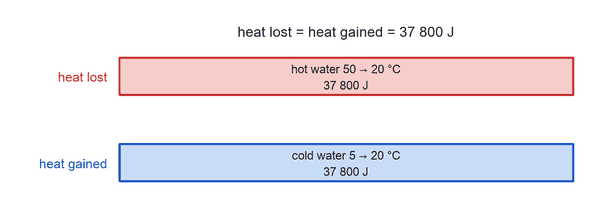
Check: The final temperature is 20 °C; the hot water falls 30 °C and the cold water rises 15 °C. The hot water has half the mass, so its fall must be twice the rise, as it is (each side is 37800 J with c = 4.2 J g⁻¹ K⁻¹).
Watch out: The 15 °C is the cold water's RISE, not its final temperature.
Therefore, the initial temperature of the cold water was 5 °C.
- 573 marks
Question 57
1·0 kg of water is contained in a 1·25 kW kettle. Calculate the time taken for the temperature of water to rise from 25°C to its boiling point 100°C. Specific heat capacity of water = 4·2 J g K.
Solve with AIWritten solution
Solution:
Concept: The heat taken in (or given out) by a body of mass m, made of a substance of specific heat capacity c, when its temperature rises (or falls) by Δt is Q = m × c × Δt. The kettle supplies P joule every second, so the time taken is t = Q ÷ P.
Given: m = 1.0 kg; c = 4.2 J g⁻¹ K⁻¹; temperature rises from 25 °C to 100 °C; P = 1.25 kW.
Step 1 — Get the quantities ready.
Since c is given per gram, use the mass in grams; the rise is from 25 °C to 100 °C, and the power in watt.
Step 2 — Find the heat needed.
Multiply the mass, the specific heat capacity and the rise.
Step 3 — Find the time.
Divide the heat by the power.
Step 4 — Change to minutes and seconds.
252 s is 4 whole minutes (240 s) and 12 s more.
Watch out: This assumes all the heat from the kettle goes into the water; a real kettle takes a little longer.
Therefore, the time taken is 252 s, that is 4 min 12 s.
- 581 mark
Question 58
Heat energy is ............ during melting and it is ............ during freezing at a constant temperature.
Solve with AIAnswer
(A) rejected, absorbed
(B) rejected, rejected
(C) absorbed, absorbed
- Correct
(D) absorbed, rejected
Answer: (D) absorbed, rejected
Concept: During a change of phase (melting, freezing, boiling, condensation) the temperature stays constant. The heat taken in or given out then is the latent heat, Q = m × L, where L is the specific latent heat. For ice, L = 336 J g⁻¹ (336000 J kg⁻¹, or 80 cal g⁻¹).
Step 1 — Melting.
To change from solid to liquid, a substance must absorb latent heat; for ice it is 336 J for every gram, at 0 °C.

Step 2 — Freezing.
To change back from liquid to solid, the liquid gives out (rejects) exactly the same latent heat, at the same temperature.
Step 3 — Fill the blanks.
So heat is absorbed during melting and rejected during freezing.
Watch out: Melting and freezing take place at the same temperature but in opposite directions of heat flow.
Why the other options are wrong:
- (A) rejected, absorbed: It has the two words the wrong way round.
- (B) rejected, rejected: It says heat is rejected during melting, but a solid needs heat to melt.
- (C) absorbed, absorbed: It says heat is absorbed during freezing, but a liquid must lose heat to freeze.
Therefore, heat energy is absorbed during melting and rejected during freezing, option (D).
- 591 mark
Question 59
An increase in pressure results in ........... in melting point of ice :
Solve with AIAnswer
(A) increase
(B) no change
- Correct
(C) decrease
(D) none of the above
Answer: (C) decrease
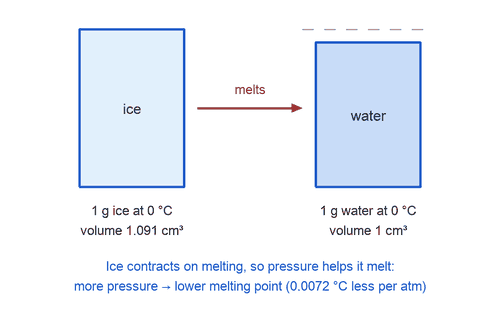
Concept: Ice contracts when it melts (1 g of ice of volume 1.091 cm³ becomes 1 g of water of volume 1 cm³). So an increase in pressure lowers the melting point of ice (by about 0.0072 °C for each extra atmosphere), and a decrease in pressure raises it. An impurity such as salt also lowers the melting point.
Step 1 — See how the volume changes.
Ice contracts when it melts: 1 g of ice (1.091 cm³) becomes 1 g of water of only 1 cm³.
Step 2 — See what pressure does.
Extra pressure favours the smaller volume, so it helps ice to melt. Ice can then melt below 0 °C, so its melting point decreases (by about 0.0072 °C for each extra atmosphere).
Watch out: The rule depends on the substance: wax and most solids expand on melting, and for them pressure RAISES the melting point; ice is the exception.
Why the other options are wrong:
- (A) increase: An increase happens for substances that expand on melting, such as wax, not for ice.
- (B) no change: Pressure does change the melting point of ice; the change is small but real (as in regelation).
- (D) none of the above: Option (C) is correct, so 'none of the above' cannot be the answer.
Therefore, an increase in pressure decreases the melting point of ice, option (C).
- 601 mark
Question 60
At high altitudes, water boils at a temperature of :
Solve with AIAnswer
(A) 100°C
(B) more than 100°C
- Correct
(C) less than 100°C
(D) 150°C
Answer: (C) less than 100°C
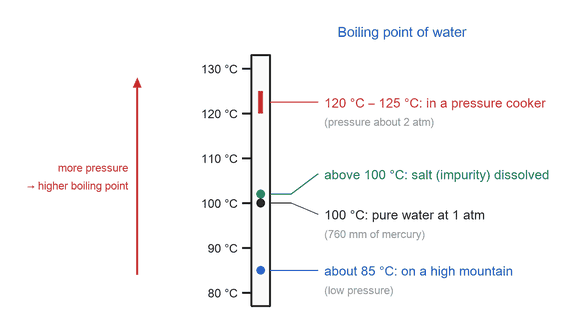
Concept: The boiling point of a liquid increases when the pressure on it increases, and decreases when the pressure decreases. A dissolved impurity (such as salt) also raises the boiling point. Pure water boils at 100 °C at one atmosphere (760 mm of mercury).
Step 1 — Pressure at a height.
At high altitudes, on hills and mountains, the atmospheric pressure is low, less than one atmosphere.
Step 2 — Effect on the boiling point.
A lower pressure lowers the boiling point, so water boils below 100 °C, for example at about 85 °C at a height of about 4500 m.
Why the other options are wrong:
- (A) 100°C: 100 °C is the boiling point at one atmosphere (760 mm of mercury), that is, at sea level.
- (B) more than 100°C: Boiling above 100 °C needs a pressure above one atmosphere, as in a pressure cooker.
- (D) 150°C: Water boils at 150 °C only at a pressure of nearly 5 atmospheres, never at a high altitude.
Therefore, at high altitudes water boils at a temperature less than 100 °C, option (C).
- 611 mark
Question 61
If common salt is added to water, it boils at a temperature of :
Solve with AIAnswer
(A) 100°C
(B) lower than 100°C
- Correct
(C) higher than 100°C
(D) cannot say
Answer: (C) higher than 100°C
Concept: The boiling point of a liquid increases when the pressure on it increases, and decreases when the pressure decreases. A dissolved impurity (such as salt) also raises the boiling point. Pure water boils at 100 °C at one atmosphere (760 mm of mercury).
Step 1 — Identify the impurity.
Common salt dissolved in water is an impurity in it.
Step 2 — Effect on the boiling point.
A dissolved impurity raises the boiling point, so the salt solution boils above 100 °C. This is why salt added while cooking helps vegetables and pulses cook at a higher temperature.
Why the other options are wrong:
- (A) 100°C: 100 °C is the boiling point of PURE water at one atmosphere.
- (B) lower than 100°C: A lower boiling point is caused by a lower pressure (on mountains), not by a dissolved impurity.
- (D) cannot say: We can say: a dissolved impurity always raises the boiling point.
Therefore, salt water boils at a temperature higher than 100 °C, option (C).
- 621 mark
Question 62
The specific latent heat of fusion of water is :
Solve with AIAnswer
- Correct
(A) 80 Cal g
(B) 2260 J g
(C) 80 J g
(D) 336 J kg
Answer: (A) 80 Cal g
Concept: During a change of phase (melting, freezing, boiling, condensation) the temperature stays constant. The heat taken in or given out then is the latent heat, Q = m × L, where L is the specific latent heat. For ice, L = 336 J g⁻¹ (336000 J kg⁻¹, or 80 cal g⁻¹).
Step 1 — Recall the value.
The specific latent heat of fusion of ice is the heat needed to melt unit mass of ice at 0 °C into water at 0 °C. The book gives 336 J g⁻¹.
Step 2 — Change it to calories.
Since 1 cal = 4.2 J, divide by 4.2 to get the value in calories per gram.
Step 3 — Match the option.
So the value is 80 calories per gram, which is option (A).
Watch out: Check the unit as well as the number: 80 goes with cal g⁻¹ and 336 goes with J g⁻¹.
Why the other options are wrong:
- (B) 2260 J g: About 2260 J g⁻¹ is the latent heat of VAPORISATION of water (water to steam), not of fusion.
- (C) 80 J g: 80 is the value in cal g⁻¹; in J g⁻¹ it is 336, so 80 J g⁻¹ is wrong.
- (D) 336 J kg: 336 goes with J g⁻¹; per kilogram the value is 336000 J kg⁻¹, so 336 J kg⁻¹ is 1000 times too small.
Therefore, the specific latent heat of fusion of ice (water) is 80 cal g⁻¹, option (A).
- 631 mark
Question 63
Heat energy supplied during the melting of a substance is utilised in :
Solve with AIAnswer
(A) increasing the kinetic energy of molecules
(B) decreasing the potential energy of molecules
- Correct
(C) increasing the potential energy of molecules
(D) decreasing the kinetic energy of molecules
Answer: (C) increasing the potential energy of molecules
Concept: Temperature measures the average kinetic energy of the molecules. When heat raises the temperature, it increases their average kinetic energy; during a change of phase the temperature is constant, so the heat (latent heat) goes into increasing their potential energy instead, by separating them against their attraction.
Step 1 — Kinetic energy during melting.
The temperature stays constant while a substance melts, so the average kinetic energy of its molecules does not change.
Step 2 — Where the heat goes.
The heat supplied (the latent heat) is used to pull the molecules apart against their attractive forces. This increases their potential energy.
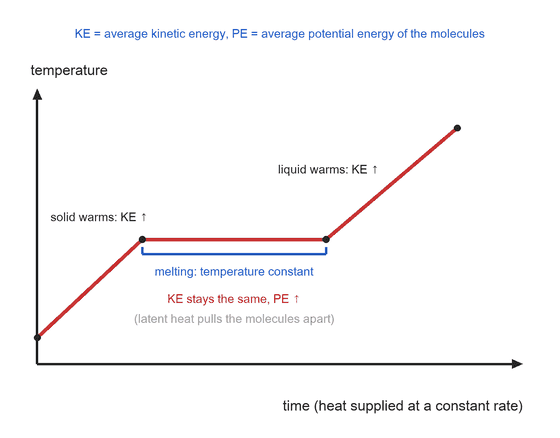
Watch out: A constant temperature means constant kinetic energy, not 'no change in energy'.
Why the other options are wrong:
- (A) increasing the kinetic energy of molecules: The kinetic energy would increase only if the temperature rose, and it does not during melting.
- (B) decreasing the potential energy of molecules: The potential energy decreases during freezing, not during melting.
- (D) decreasing the kinetic energy of molecules: The kinetic energy would decrease only if the temperature fell, and it stays the same.
Therefore, the heat supplied during melting increases the potential energy of the molecules, option (C).
- 641 mark
Question 64
Write down the approximate range of temperature at which water boils in a pressure cooker.
Solve with AIWritten solution
Solution:
Concept: The boiling point of a liquid increases when the pressure on it increases, and decreases when the pressure decreases. A dissolved impurity (such as salt) also raises the boiling point. Pure water boils at 100 °C at one atmosphere (760 mm of mercury).
Step 1 — See what happens to the pressure.
In a pressure cooker the steam is not allowed to escape, so the pressure on the water rises to about twice the atmospheric pressure.
Step 2 — See what happens to the boiling point.
A higher pressure raises the boiling point, so water in the cooker boils at about 120 °C to 125 °C instead of 100 °C.
Therefore, water boils at about 120 °C to 125 °C in a pressure cooker.
- 653 marks
Question 65
Complete the following sentences :
(a) When ice melts, its volume .................... .
(b) Decrease in pressure over ice ...................... its melting point.
(c) Increase in pressure ...................... the boiling point of water.
(d) A pressure cooker is based on the principle that boiling point of water increases with the .................................................... .
(e) The boiling point of water is defined as .................................................... .
(f) Water can be made to boil at 115°C by ............ pressure over its surface.
Solve with AIWritten solution
Solution:
Concept: Ice contracts on melting, so pressure lowers its melting point. Pressure raises the boiling point of water.
(a)
Step 1 — Volume on melting.
1 g of ice of volume 1.091 cm³ becomes 1 g of water of volume 1 cm³, so the volume decreases.
(b)
Step 2 — Lower pressure on ice.
An increase in pressure lowers the melting point of ice, so a decrease in pressure increases it.
(c)
Step 3 — Pressure and boiling.
An increase in pressure increases the boiling point of water.
(d)
Step 4 — Principle of the pressure cooker.
The cooker keeps the steam in, so the pressure inside rises (to about 2 atmospheres) and water boils at about 120 °C. It works because the boiling point increases with the increase in pressure.
(e)
Step 5 — Boiling point.
The boiling point of water is the constant temperature at which water changes into steam; at normal atmospheric pressure it is 100 °C.
(f)
Step 6 — Boiling at 115 °C.
115 °C is above 100 °C, so the pressure over the water must be more than one atmosphere; water boils at 115 °C by increasing the pressure.
Therefore, the blanks are: (a) decreases; (b) increases; (c) increases; (d) increase in pressure; (e) the constant temperature at which water changes into steam; (f) increasing.
- 661 mark
Question 66
Write the approximate value of specific latent heat of ice.
Solve with AIWritten solution
Solution:
Concept: During a change of phase (melting, freezing, boiling, condensation) the temperature stays constant. The heat taken in or given out then is the latent heat, Q = m × L, where L is the specific latent heat. For ice, L = 336 J g⁻¹ (336000 J kg⁻¹, or 80 cal g⁻¹).
Step 1 — Recall the value.
The specific latent heat of fusion of ice is the heat needed to melt 1 kg of ice at 0 °C into water at 0 °C.
Step 2 — Write it in other units.
The same value is 336 kJ kg⁻¹, or 336 J g⁻¹, or 80 cal g⁻¹. So each gram of ice at 0 °C takes in 336 J to become water at 0 °C.

Therefore, the specific latent heat of ice is about 336 kJ kg⁻¹ (336 J g⁻¹).
- 671 mark
Question 67
1 g ice at 0°C melts to form 1 g water at 0°C. State whether the latent heat is absorbed or given out by ice.
Solve with AIWritten solution
Solution:
Concept: During a change of phase (melting, freezing, boiling, condensation) the temperature stays constant. The heat taken in or given out then is the latent heat, Q = m × L, where L is the specific latent heat. For ice, L = 336 J g⁻¹ (336000 J kg⁻¹, or 80 cal g⁻¹).
Step 1 — Decide the direction.
Ice is changing from solid to liquid, and a solid needs heat to melt.
Step 2 — Give the amount.
1 g of ice absorbs 336 J (80 cal) while its temperature stays at 0 °C. The same 336 J is given out when 1 g of water at 0 °C freezes.
Therefore, the latent heat is absorbed by the ice.
- 682 marks
Question 68
A substance on heating, undergoes (i) a rise in its temperature, (ii) a change in its phase without change in its temperature. In each case, state the change in energy of molecules of the substance.
Solve with AIWritten solution
Solution:
Concept: Temperature measures the average kinetic energy of the molecules. When heat raises the temperature, it increases their average kinetic energy; during a change of phase the temperature is constant, so the heat (latent heat) goes into increasing their potential energy instead, by separating them against their attraction.
(i)
Step 1 — Rise in temperature.
Temperature measures the average kinetic energy of the molecules, so when the temperature rises, the average kinetic energy of the molecules increases.
(ii)
Step 2 — Change of phase at constant temperature.
The temperature does not change, so the average kinetic energy stays the same. The heat pulls the molecules farther apart against their attraction, so their average potential energy increases.
Therefore, (i) the average kinetic energy of the molecules increases, and (ii) their average potential energy increases (kinetic energy unchanged).
- 692 marks
Question 69
How does the (a) average kinetic energy (b) average potential energy of molecules of a substance change during its change in phase at a constant temperature, on heating ?
Solve with AIWritten solution
Solution:
Concept: Temperature measures the average kinetic energy of the molecules. When heat raises the temperature, it increases their average kinetic energy; during a change of phase the temperature is constant, so the heat (latent heat) goes into increasing their potential energy instead, by separating them against their attraction.
(a)
Step 1 — Average kinetic energy.
The temperature stays constant during the change of phase, so the average kinetic energy of the molecules does not change.
(b)
Step 2 — Average potential energy.
The heat supplied (latent heat) separates the molecules against their mutual attraction, so their average potential energy increases.
Therefore, (a) the average kinetic energy does not change, and (b) the average potential energy increases.
- 702 marks
Question 70
State the effect of presence of impurity on the melting point of ice. Give one use of it.
Solve with AIWritten solution
Solution:
Concept: Ice contracts when it melts (1 g of ice of volume 1.091 cm³ becomes 1 g of water of volume 1 cm³). So an increase in pressure lowers the melting point of ice (by about 0.0072 °C for each extra atmosphere), and a decrease in pressure raises it. An impurity such as salt also lowers the melting point.
Step 1 — State the effect.
An impurity such as common salt lowers the melting point of ice. Ice mixed with common salt in the right proportion melts at about −22 °C instead of 0 °C.
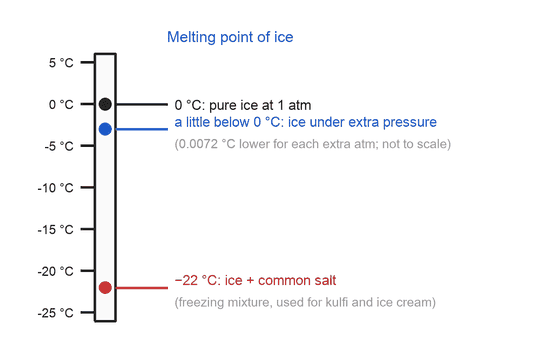
Step 2 — Give a use.
Such a freezing mixture of ice and salt is used to make kulfi and ice cream, which must be cooled below 0 °C. (Salt is also spread on icy roads so that the ice melts.)
Therefore, an impurity lowers the melting point of ice; ice with salt is used as a freezing mixture for making ice cream and kulfi.
- 711 mark
Question 71
State the effect of increase of pressure on the melting point of ice.
Solve with AIWritten solution
Solution:
Concept: Ice contracts when it melts (1 g of ice of volume 1.091 cm³ becomes 1 g of water of volume 1 cm³). So an increase in pressure lowers the melting point of ice (by about 0.0072 °C for each extra atmosphere), and a decrease in pressure raises it. An impurity such as salt also lowers the melting point.
Step 1 — Use the volume change.
Ice contracts on melting (1.091 cm³ of ice becomes 1 cm³ of water), so extra pressure helps it to melt.
Step 2 — State the effect.
So an increase in pressure lowers the melting point of ice, by about 0.0072 °C for each extra atmosphere.
Therefore, an increase in pressure lowers (decreases) the melting point of ice.
- 721 mark
Question 72
How is the boiling point of water affected when some salt is added to it ?
Solve with AIWritten solution
Solution:
Concept: The boiling point of a liquid increases when the pressure on it increases, and decreases when the pressure decreases. A dissolved impurity (such as salt) also raises the boiling point. Pure water boils at 100 °C at one atmosphere (760 mm of mercury).
Step 1 — Identify the impurity.
Salt dissolved in water is an impurity.
Step 2 — State the effect.
A dissolved impurity raises the boiling point, so salt water boils above 100 °C. This is why adding salt helps food cook at a higher temperature.
Therefore, the boiling point of water increases when salt is added to it.
- 731 mark
Question 73
What is the effect of increase in pressure on the boiling point of a liquid ?
Solve with AIWritten solution
Solution:
Concept: The boiling point of a liquid increases when the pressure on it increases, and decreases when the pressure decreases. A dissolved impurity (such as salt) also raises the boiling point. Pure water boils at 100 °C at one atmosphere (760 mm of mercury). A liquid boils when its vapour can push back against the pressure above it, so a higher pressure needs a higher temperature.
Step 1 — State the effect.
An increase in pressure increases the boiling point of a liquid. For water near 100 °C, the boiling point rises by about 1 °C for each increase of about 27 mm of mercury in pressure.
Step 2 — Give examples.
Water boils at about 120–125 °C in a pressure cooker, where the pressure is about 2 atmospheres, but below 100 °C on a mountain, where the pressure is low.
Therefore, an increase in pressure increases the boiling point of a liquid.
- 742 marks
Question 74
Water boils at 120°C in a pressure cooker. Explain the reason.
Solve with AIWritten solution
Solution:
Concept: The boiling point of a liquid increases when the pressure on it increases, and decreases when the pressure decreases. A dissolved impurity (such as salt) also raises the boiling point. Pure water boils at 100 °C at one atmosphere (760 mm of mercury).
Step 1 — The pressure rises.
In a pressure cooker the steam cannot escape until the weight on the vent lifts, so the pressure over the water rises to about twice the atmospheric pressure.
Step 2 — The boiling point rises.
With this higher pressure, the water inside the cooker boils at about 120 °C instead of 100 °C.
Step 3 — The result.
The food is heated to this higher temperature, so it cooks faster, saving time and fuel.
Therefore, water boils at 120 °C in a pressure cooker because the higher pressure inside raises its boiling point.
- 752 marks
Question 75
It is difficult to cook vegetables on hills and mountains. Explain the reason.
Solve with AIWritten solution
Solution:
Concept: The boiling point of a liquid increases when the pressure on it increases, and decreases when the pressure decreases. A dissolved impurity (such as salt) also raises the boiling point. Pure water boils at 100 °C at one atmosphere (760 mm of mercury).
Step 1 — The pressure is low.
On hills and mountains the atmospheric pressure is low, less than one atmosphere.
Step 2 — The boiling point is low.
So water boils below 100 °C (for example, at about 85 °C). Once it boils, its temperature cannot rise any further in an open pot.
Step 3 — The result.
The vegetables are heated only up to this lower temperature, which is not enough to cook them properly, so cooking takes much longer. (A pressure cooker is used there to raise the boiling point.)
Therefore, it is difficult to cook vegetables on mountains because the low pressure there lowers the boiling point of water below 100 °C.
- 762 marks
Question 76
What do you understand by the term latent heat ?
Solve with AIWritten solution
Solution:
Concept: During a change of phase (melting, freezing, boiling, condensation) the temperature stays constant. The heat taken in or given out then is the latent heat, Q = m × L, where L is the specific latent heat. For ice, L = 336 J g⁻¹ (336000 J kg⁻¹, or 80 cal g⁻¹).
Step 1 — Define latent heat.
Latent heat is the heat energy absorbed or given out by a substance during a change of its phase (state) at a constant temperature.
Step 2 — Explain the name.
It is called latent (hidden) because it causes no change in temperature; it only changes the potential energy of the molecules.
Step 3 — Give an example.
1 g of ice at 0 °C absorbs 336 J to become water at 0 °C, and the same 336 J is given out when the water freezes.
Therefore, latent heat is the heat absorbed or given out during a change of phase without any change in temperature.
- 772 marks
Question 77
Define the term specific latent heat of fusion of ice. State its S.I. unit.
Solve with AIWritten solution
Solution:
Concept: 'Specific' means for unit mass, and 'latent' means the temperature does not change.
Step 1 — Define it.
The specific latent heat of fusion of ice is the amount of heat energy needed to convert unit mass (1 kg) of ice at 0 °C into water at 0 °C, without any change in temperature.
Step 2 — Give the S.I. unit.
Heat is in joule and mass in kilogram, so the S.I. unit is the joule per kilogram (J kg⁻¹). Its value is 336000 J kg⁻¹ (336 J g⁻¹, or 80 cal g⁻¹).
Therefore, the specific latent heat of fusion of ice is the heat needed to melt 1 kg of ice at 0 °C into water at 0 °C, and its S.I. unit is J kg⁻¹.
- 782 marks
Question 78
'The specific latent heat of fusion of ice is 336 J g'. Explain the meaning of this statement.
Solve with AIWritten solution
Solution:
Concept: During a change of phase (melting, freezing, boiling, condensation) the temperature stays constant. The heat taken in or given out then is the latent heat, Q = m × L, where L is the specific latent heat. For ice, L = 336 J g⁻¹ (336000 J kg⁻¹, or 80 cal g⁻¹).
Step 1 — Read the statement.
336 J g⁻¹ is a heat per gram for a change of phase at constant temperature.
Step 2 — Say what it means.
1 g of ice at 0 °C absorbs 336 J of heat energy to change into 1 g of water at 0 °C, without any change in temperature. In the same way, 1 g of water at 0 °C gives out 336 J when it freezes.
Therefore, the statement means that 1 g of ice at 0 °C needs 336 J of heat to melt into water at 0 °C.
- 792 marks
Question 79
Which has more heat : 1 g of ice at 0°C or 1 g of water at 0°C ? Give reason.
Solve with AIWritten solution
Solution:
Concept: Two bodies at the same temperature can hold different amounts of heat energy if one of them must still take in latent heat. During a change of phase (melting, freezing, boiling, condensation) the temperature stays constant. The heat taken in or given out then is the latent heat, Q = m × L, where L is the specific latent heat. For ice, L = 336 J g⁻¹ (336000 J kg⁻¹, or 80 cal g⁻¹).
Step 1 — Compare the two.
1 g of ice at 0 °C must absorb 336 J (80 cal) of latent heat to become 1 g of water at 0 °C; the temperature stays the same.
Step 2 — Conclude.
So the water at 0 °C holds 336 J more heat energy than the same mass of ice at 0 °C. In the same way, 1 g of water at 0 °C gives out 336 J (80 cal) when it freezes.
Watch out: The same temperature does not mean the same heat energy.
Therefore, 1 g of water at 0 °C has more heat (by 336 J, or 80 cal) than 1 g of ice at 0 °C.
- 802 marks
Question 80
(a) Which requires more heat : 1 g ice at 0°C or 1 g water at 0°C to raise its temperature to 10°C?
(b) Explain your answer in part (a).
Solve with AIWritten solution
Solution:
Concept: Ice cannot get warmer than 0 °C until it has melted, and melting needs latent heat (Q = mL); only after that does the water formed warm up (Q = mcΔt).
(a)
Step 1 — Name the one needing more heat.
1 g of ice at 0 °C requires more heat to reach 10 °C.
(b)
Step 2 — Heat for the ice.
The ice first melts, taking 336 J with no rise in temperature; then the water formed warms from 0 °C to 10 °C (c = 4.2 J g⁻¹ K⁻¹).
Step 3 — Heat for the water.
The water at 0 °C only has to warm up by 10 °C.

Step 4 — Compare.
The ice needs 378 J against the water's 42 J, that is 9 times as much.
Therefore, (a) 1 g of ice at 0 °C needs more heat, because (b) it must first absorb 336 J of latent heat to melt before it can warm up (378 J in all, against 42 J).
- 812 marks
Question 81
Ice cream appears colder to the mouth than water at 0°C. Give reason.
Solve with AIWritten solution
Solution:
Concept: A body feels cold when it takes heat away from our skin; the more heat it takes, the colder it feels. During a change of phase (melting, freezing, boiling, condensation) the temperature stays constant. The heat taken in or given out then is the latent heat, Q = m × L, where L is the specific latent heat. For ice, L = 336 J g⁻¹ (336000 J kg⁻¹, or 80 cal g⁻¹).
Step 1 — Ice cream must melt.
Ice cream is frozen, at about 0 °C. To melt in the mouth it absorbs a large amount of latent heat (about 336 J for each gram) from the mouth, in addition to the heat it absorbs to warm up.
Step 2 — Water only warms.
Water at 0 °C absorbs only the heat needed to warm up, 4.2 J per gram for each 1 °C.
Step 3 — Compare.
So ice cream takes much more heat from the mouth than water at the same temperature.
Therefore, ice cream appears colder than water at 0 °C because it absorbs extra latent heat from the mouth to melt.
- 822 marks
Question 82
The soft drink bottles are cooled by (i) ice cubes at 0°C, and (ii) iced-water at 0°C. Which will cool the drink quickly ? Give reason.
Solve with AIWritten solution
Solution:
Concept: The cooling depends on how much heat is taken away from the drink. During a change of phase (melting, freezing, boiling, condensation) the temperature stays constant. The heat taken in or given out then is the latent heat, Q = m × L, where L is the specific latent heat. For ice, L = 336 J g⁻¹ (336000 J kg⁻¹, or 80 cal g⁻¹).
Step 1 — Heat taken by ice.
Each gram of ice must first absorb 336 J of latent heat from the bottles to melt, and only then does it warm up like water.
Step 2 — Heat taken by iced water.
Iced water at 0 °C can take heat only by warming up; for example, in warming to 10 °C, 1 g of ice takes 378 J but 1 g of iced water takes only 42 J.
Step 3 — Compare.
So, mass for mass, ice takes much more heat away from the drink, and cools it faster and more.
Therefore, (i) ice cubes at 0 °C cool the drink more quickly, because each gram also absorbs 336 J of latent heat in melting.
- 832 marks
Question 83
It is generally cold after a hail-storm than during and before the hail-storm. Give reason.
Solve with AIWritten solution
Solution:
Concept: During a change of phase (melting, freezing, boiling, condensation) the temperature stays constant. The heat taken in or given out then is the latent heat, Q = m × L, where L is the specific latent heat. For ice, L = 336 J g⁻¹ (336000 J kg⁻¹, or 80 cal g⁻¹).
Step 1 — The hailstones melt.
After a hail-storm, the hailstones (ice) lying around start to melt.

Step 2 — They take latent heat.
To melt, they absorb a large amount of latent heat (336 J for every gram of ice) from the surroundings: the air and the ground.
Step 3 — The surroundings cool.
This removes heat from the surroundings, so their temperature falls.
Therefore, it is colder after a hail-storm because the melting hailstones absorb latent heat from the surroundings.
- 842 marks
Question 84
The temperature of the surrounding starts falling when ice in a frozen lake starts melting. Give reason.
Solve with AIWritten solution
Solution:
Concept: During a change of phase (melting, freezing, boiling, condensation) the temperature stays constant. The heat taken in or given out then is the latent heat, Q = m × L, where L is the specific latent heat. For ice, L = 336 J g⁻¹ (336000 J kg⁻¹, or 80 cal g⁻¹).
Step 1 — The ice melts.
When the ice in a frozen lake starts melting, it must absorb the latent heat of fusion, 336 J for each gram.
Step 2 — Heat comes from the surroundings.
This heat is taken from the surroundings, the air and the land around the lake. A frozen lake holds a huge mass of ice, so a very large amount of heat is taken away.
Step 3 — The temperature falls.
Losing this heat lowers the temperature of the surroundings.
Therefore, the temperature of the surroundings falls because the melting ice absorbs its latent heat from them.
- 852 marks
Question 85
Water in lakes and ponds do not freeze at once in cold countries. Give reason.
Solve with AIWritten solution
Solution:
Concept: During a change of phase (melting, freezing, boiling, condensation) the temperature stays constant. The heat taken in or given out then is the latent heat, Q = m × L, where L is the specific latent heat. For ice, L = 336 J g⁻¹ (336000 J kg⁻¹, or 80 cal g⁻¹).
Step 1 — Large latent heat.
To freeze, water at 0 °C must give out a large amount of latent heat (336 J for every gram) to the surroundings. The cold air can take this heat away only slowly, so the water freezes gradually, layer by layer, not all at once.
Step 2 — Ice layer on top.
Ice is lighter than water, so the ice formed floats as a layer on top. Ice is a bad conductor of heat, so this layer slows down further loss of heat from the water below.
Step 3 — Why it matters.
Because of this, fish and plants survive in the water under the ice.
Therefore, lakes and ponds do not freeze at once because the water must give out a large latent heat, and the ice layer on top (a bad conductor) slows the loss of heat.
- 863 marks
Question 86
(a) What do you understand by the change of phase of a substance ?
(b) Is there any change in temperature during the change of phase ?
(c) Does the substance absorb or liberate any heat energy during the change of phase ?
(d) What is the name given to the energy absorbed during a phase change ?
Solve with AIWritten solution
Solution:
Concept: During a change of phase (melting, freezing, boiling, condensation) the temperature stays constant. The heat taken in or given out then is the latent heat, Q = m × L, where L is the specific latent heat. For ice, L = 336 J g⁻¹ (336000 J kg⁻¹, or 80 cal g⁻¹).
(a)
Step 1 — Change of phase.
The change of phase is the change of a substance from one state to another, for example from solid to liquid (melting) or from liquid to gas (boiling), caused by heating or cooling it.
(b)
Step 2 — Temperature during the change.
No: the temperature remains constant during the change of phase; for example, ice stays at 0 °C until all of it has melted.
(c)
Step 3 — Heat during the change.
Yes: the substance absorbs heat when it changes from solid to liquid or from liquid to gas, and it liberates heat when it changes from gas to liquid or from liquid to solid.
(d)
Step 4 — Name of the energy.
The energy absorbed (or liberated) during a change of phase is called latent heat.
Therefore, (a) a change of phase is a change of state; (b) the temperature does not change; (c) heat is absorbed or liberated; (d) it is called latent heat.
- 873 marks
Question 87
A substance changes from its solid state to the liquid state when heat is supplied to it.
(a) Name the process.
(b) What name is given to heat absorbed by the substance.
(c) How does the average kinetic energy of molecules of the substance change ?
Solve with AIWritten solution
Solution:
Concept: During a change of phase (melting, freezing, boiling, condensation) the temperature stays constant. The heat taken in or given out then is the latent heat, Q = m × L, where L is the specific latent heat. For ice, L = 336 J g⁻¹ (336000 J kg⁻¹, or 80 cal g⁻¹). Temperature measures the average kinetic energy of the molecules. When heat raises the temperature, it increases their average kinetic energy; during a change of phase the temperature is constant, so the heat (latent heat) goes into increasing their potential energy instead, by separating them against their attraction.
(a)
Step 1 — Name the process.
The change from solid to liquid on heating is called melting (fusion).
(b)
Step 2 — Name the heat.
The heat absorbed is the latent heat of fusion; for unit mass it is the specific latent heat of fusion.
(c)
Step 3 — Kinetic energy of the molecules.
The temperature stays constant during melting, so the average kinetic energy of the molecules does not change; the heat only increases their potential energy.
Note: a spelling slip in the printed question (“substnace”) has been corrected to “substance”.
Therefore, (a) the process is melting; (b) the heat is the latent heat of fusion; (c) the average kinetic energy of the molecules does not change.
- 884 marks
Question 88
The diagram in Fig. 11.8 below shows the change of phases of a substance on a temperature-time graph on heating the substances at a constant rate.
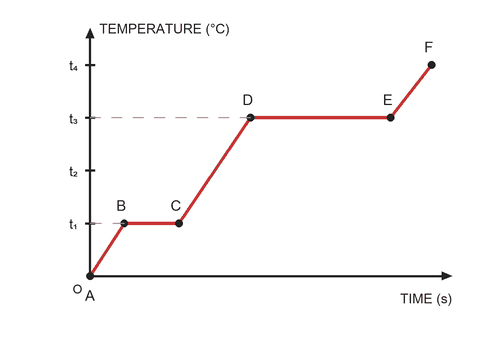
(a) What do the parts AB, BC, CD and DE represent?
(b) What is the melting point of the substance ?
(c) What is the boiling point of the substance ?
Solve with AIWritten solution
Solution:
Concept: On a heating curve drawn at a constant rate of heating, a sloping part means one phase is getting hotter, and a flat part means a change of phase at a constant temperature (the heat goes in as latent heat).
(a)
Step 1 — Read each part of the graph.
Each sloping or flat part of the graph in Fig. 11.8 stands for one stage of the heating.
- AB: the solid is heated, and its temperature rises from 0 °C to t₁ °C.
- BC: melting: the solid changes into liquid at the constant temperature t₁ °C, absorbing the latent heat of fusion.
- CD: the liquid is heated, and its temperature rises from t₁ °C to t₃ °C.
- DE: boiling: the liquid changes into vapour at the constant temperature t₃ °C, absorbing the latent heat of vaporisation (DE is longer than BC because this latent heat is larger).
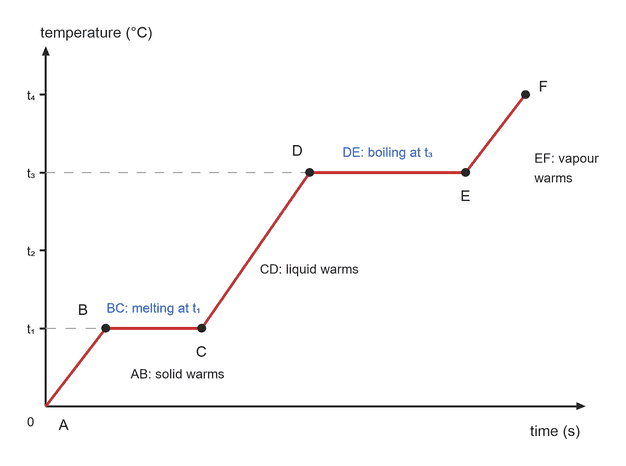
(b)
Step 2 — Melting point.
The melting point is the temperature of the first flat part, BC, which is t₁ °C.
(c)
Step 3 — Boiling point.
The boiling point is the temperature of the second flat part, DE, which is t₃ °C.
Watch out: The melting and boiling points are read from the FLAT parts, not from the ends of the sloping parts.
Therefore, (a) AB: solid warms from 0 °C to t₁ °C, BC: melting at t₁ °C, CD: liquid warms from t₁ °C to t₃ °C, DE: boiling at t₃ °C; (b) the melting point is t₁ °C; (c) the boiling point is t₃ °C.
- 894 marks
Question 89
The melting point of naphthalene is 80°C and the room temperature is 25°. A sample of liquid naphthalene at 90° is cooled down to room temperature. Draw a temperature-time graph to represent this cooling. On the graph mark the region which corresponds to the freezing process.
Solve with AIWritten solution
Solution:
Concept: A cooling liquid gets colder until it reaches its freezing point. It then stays at that temperature while it freezes, because the latent heat it gives out makes up for the heat it loses. After that the solid cools towards room temperature.
Step 1 — Liquid cools.
The liquid naphthalene cools from 90 °C to 80 °C, so the graph falls.
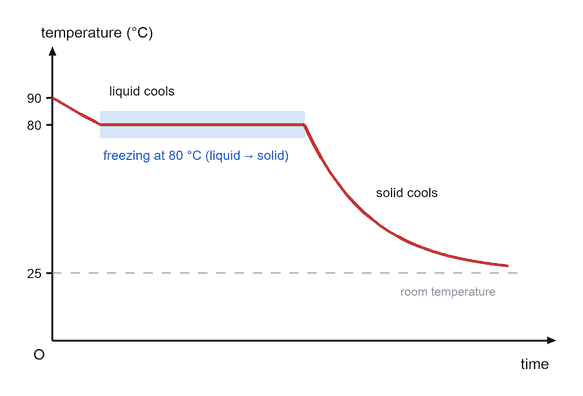
Step 2 — Freezing.
At 80 °C it starts to freeze. The temperature stays constant at 80 °C until all the liquid has become solid, because the latent heat given out makes up for the heat lost to the surroundings. This flat part (shaded) is the freezing region.
Step 3 — Solid cools.
The solid naphthalene then cools from 80 °C towards the room temperature of 25 °C. It cools quickly at first, then more slowly as its temperature gets close to that of the room, so the curve flattens out just above 25 °C.
Step 4 — Why 80 °C.
The melting point and the freezing point of a pure substance are the same, so naphthalene freezes at its melting point, 80 °C.
Watch out: The graph never goes below the room temperature, 25 °C.
Note: the spelling “napthalene” in the printed question has been corrected to “naphthalene”.
Therefore, the graph falls from 90 °C to 80 °C, stays flat at 80 °C while the naphthalene freezes (the freezing region), and then falls slowly towards 25 °C.
- 904 marks
Question 90
1 kg of ice at 0°C is heated at a constant rate and its temperature is recorded after every 30 s till steam is formed at 100°C. Draw a temperature-time graph to represent the change of phases.
Solve with AIWritten solution
Solution:
Concept: Heat is supplied at a constant rate, so the time taken by each part is proportional to the heat it needs. The temperature stays flat while the phase changes, and rises while only the water is heated.
Step 1 — AB: the ice melts at 0 °C.
The temperature stays at 0 °C while the ice absorbs its latent heat of fusion.
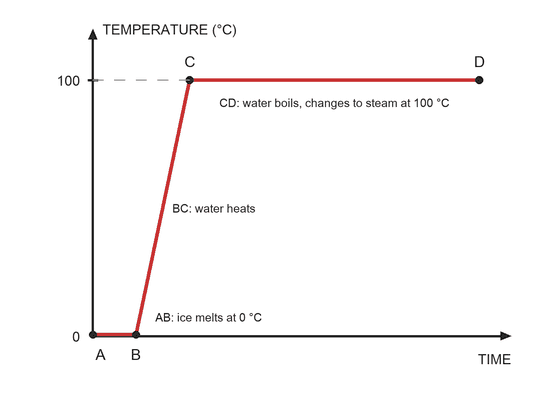
Step 2 — BC: the water warms from 0 °C to 100 °C.
The temperature rises steadily as the water absorbs heat.
Step 3 — CD: the water boils at 100 °C.
The water changes into steam at a constant 100 °C, absorbing the latent heat of vaporisation, about 2260 kJ for 1 kg.
Step 4 — Compare the lengths.
Time is proportional to heat, so BC takes a little longer than AB (420 kJ against 336 kJ), and CD is by far the longest part, nearly 7 times as long as AB (2260 ÷ 336 ≈ 6.7).
Watch out: The flat parts are at 0 °C and 100 °C; the graph rises only between them.
Therefore, the graph is flat at 0 °C (melting, AB), rises steadily to 100 °C (BC), and is flat again at 100 °C for the longest time (boiling, CD).
- 914 marks
Question 91
Explain the terms boiling and boiling point. How is the volume of water affected when it boils at 100°C ?
Solve with AIWritten solution
Solution:
Concept: Boiling is a change of phase from liquid to vapour at a fixed temperature, and it takes place throughout the liquid. The boiling point of a liquid increases when the pressure on it increases, and decreases when the pressure decreases. A dissolved impurity (such as salt) also raises the boiling point. Pure water boils at 100 °C at one atmosphere (760 mm of mercury).
Step 1 — Boiling.
Boiling is the change of a liquid into its vapour, throughout the whole liquid, at a fixed temperature, when heat is supplied. Bubbles of vapour form inside the liquid, rise and escape.
Step 2 — Boiling point.
The boiling point is the constant temperature at which a liquid boils at a given pressure. For pure water at normal atmospheric pressure it is 100 °C.
Step 3 — Change in volume.
When water boils at 100 °C, its volume increases enormously: 1 g of water (about 1 cm³) becomes about 1670 cm³ of steam at 100 °C and one atmosphere.
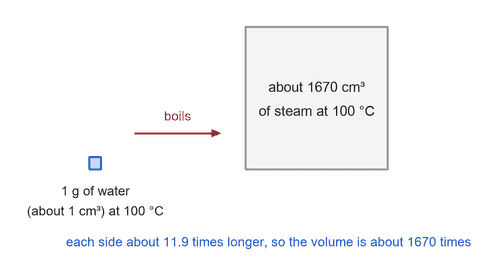
Note: the textbook quotes 1760 cm³ of steam for 1 cm³ of water; the measured value is about 1670 cm³ for 1 g of water.
Therefore, boiling is the change of a liquid into vapour at a fixed temperature (the boiling point, 100 °C for water at 1 atm), and on boiling the volume of water increases about 1670 times.
- 924 marks
Question 92
Explain the following :
(a) The surrounding become pleasantly warm when water in a lake starts freezing in cold countries.
(b) The heat supplied to a substance during its change of state, does not cause any rise in its temperature.
Solve with AIWritten solution
Solution:
Concept: During a change of phase (melting, freezing, boiling, condensation) the temperature stays constant. The heat taken in or given out then is the latent heat, Q = m × L, where L is the specific latent heat. For ice, L = 336 J g⁻¹ (336000 J kg⁻¹, or 80 cal g⁻¹). Temperature measures the average kinetic energy of the molecules. When heat raises the temperature, it increases their average kinetic energy; during a change of phase the temperature is constant, so the heat (latent heat) goes into increasing their potential energy instead, by separating them against their attraction.
(a)
Step 1 — Water gives out latent heat.
When the water in the lake freezes, every gram of water at 0 °C gives out 336 J of latent heat of fusion to the surroundings.
Step 2 — The surroundings warm.
A lake holds a huge mass of water, so this is a very large amount of heat. It warms the air around the lake, so the surroundings become pleasantly warm.
(b)
Step 3 — Where the heat goes.
During a change of state, the heat supplied (the latent heat) is used only to increase the potential energy of the molecules, separating them against their mutual attraction.
Step 4 — Why the temperature stays constant.
The average kinetic energy of the molecules does not increase, and temperature is a measure of the average kinetic energy. So the temperature stays constant until the change of state is complete.
Therefore, (a) freezing water gives out latent heat that warms the surroundings, and (b) the heat supplied during a change of state only increases the potential energy of the molecules, not their kinetic energy, so the temperature does not rise.
- 933 marks
Question 93
20 g of ice at 0°C absorbs 10,920 J of heat energy to melt and change to water at 50°C. Calculate the specific latent heat of fusion of ice. Specific heat capacity of water is 4200 J kg K.
Solve with AIWritten solution
Solution:
Concept: The ice takes heat in two stages: first it melts at 0 °C (latent heat, Q = mL, no change in temperature), then the water formed warms from 0 °C to 50 °C (Q = mcΔt). The two together make up 10920 J.
Given: m = 20 g; total heat = 10920 J; final temperature 50 °C; c = 4200 J kg⁻¹ K⁻¹.
Step 1 — Change c to per gram.
The mass is in grams, so use c per gram.
Step 2 — Heat to warm the water.
The 20 g of water formed from the ice warms from 0 °C to 50 °C.
Step 3 — Heat to melt the ice.
The rest of the 10920 J was used in melting.
Step 4 — Find L.
Melting 20 g took 6720 J, so for 1 g:
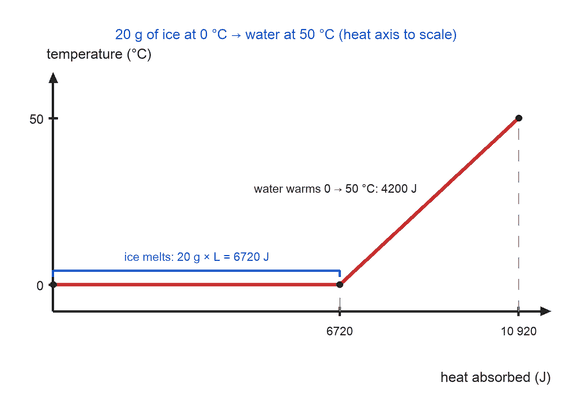
Watch out: The 10920 J is not all latent heat; subtract the heat used to warm the water first.
Therefore, the specific latent heat of fusion of ice is 336 J g⁻¹ (336000 J kg⁻¹).
- 943 marks
Question 94
How much energy is released when 500 g of water at 80°C cools down to 0°C and then completely freezes ? [specific heat capacity of water = 4·2 J g K, specific latent heat of fusion of ice = 336 J g].
Solve with AIWritten solution
Solution:
Concept: The water gives out heat in two stages: first it cools from 80 °C to 0 °C (Q = mcΔt), then it freezes at 0 °C and gives out its latent heat (Q = mL) with no change in temperature.
Given: m = 500 g; temperature falls from 80 °C to 0 °C; c = 4.2 J g⁻¹ K⁻¹; L = 336 J g⁻¹.
Step 1 — Heat released in cooling to 0 °C.
The water falls through 80 °C.
Step 2 — Heat released in freezing.
At 0 °C the whole 500 g freezes, giving out 336 J for each gram.
Step 3 — Add the two.
The total energy released is the sum of the two stages.

Step 4 — Notice.
Freezing alone gives out as much heat as cooling the water all the way from 80 °C to 0 °C.
Watch out: Do not forget the latent heat given out in freezing; it is half the answer here.
Therefore, the energy released is 336 × 10³ J (336 kJ).
- 953 marks
Question 95
A molten metal of mass 150 g is kept at its melting point 800°C. When it is allowed to freeze at the same temperature, it gives out 75,000 J of heat energy.
(a) What is the specific latent heat of the metal ?
(b) If the specific heat capacity of metal is 200 J kg K, how much additional heat energy will the metal give out in cooling to °C ?
Solve with AIWritten solution
Solution:
Concept: While the metal freezes at 800 °C its temperature does not change, so the heat it gives out is latent heat (Q = mL). After it has become solid, it cools and gives out heat Q = mcΔt.
Given: m = 150 g; heat given out in freezing = 75000 J; c = 200 J kg⁻¹ K⁻¹; solid cools from 800 °C to −50 °C.
(a)
Step 1 — Find the specific latent heat.
Divide the heat given out in freezing by the mass.
(b)
Step 2 — Find the fall in temperature.
The solid cools from 800 °C to −50 °C.
Step 3 — Find the extra heat.
Use the mass in kg, since c is per kilogram.

Watch out: The fall from 800 °C to −50 °C is 850 °C, not 750 °C; subtracting a negative number adds it.
Therefore, (a) the specific latent heat of the metal is 500 J g⁻¹ (5 × 10⁵ J kg⁻¹), and (b) it gives out 25500 J more in cooling to −50 °C.
- 963 marks
Question 96
A solid metal of mass 150 g melts at its melting point of 800°C by providing heat at the rate of 100 W. The time taken for it to completely melt at the same temperature is 4 min. What is the specific latent heat of fusion of the metal ?
Solve with AIWritten solution
Solution:
Concept: While the metal melts, its temperature stays at 800 °C, so all the heat supplied goes into latent heat. The heat supplied is power × time, and the specific latent heat is heat ÷ mass.
Given: m = 150 g (0.15 kg); P = 100 W; time = 4 min; melting point 800 °C.
Step 1 — Change the time to seconds.
The power is in joule per second, so the time must be in seconds.
Step 2 — Find the heat supplied.
The heater gives 100 J every second for 240 s.
Step 3 — Find the specific latent heat.
Divide by the mass in kilogram.

Watch out: Change 4 min to 240 s before multiplying by the power in watt.
Therefore, the specific latent heat of fusion of the metal is 1.6 × 10⁵ J kg⁻¹ (160 J g⁻¹).
- 974 marks
Question 97
A refrigerator converts 100 g of water at 20°C to ice at 10°C in 73·5 min. Calculate the average rate of heat extraction in watt. The specific heat capacity of water is 4·2 J g K, specific latent heat of ice is 336 J g and the specific heat capacity of ice is 2·1 J g K.
Solve with AIWritten solution
Solution:
Concept: The refrigerator takes heat out in three stages: the water cools from 20 °C to 0 °C, then freezes at 0 °C (latent heat, no change in temperature), then the ice cools from 0 °C to −10 °C. The rate of heat extraction (power) is the total heat ÷ the time.
Given: m = 100 g; c(water) = 4.2 J g⁻¹ K⁻¹; L = 336 J g⁻¹; c(ice) = 2.1 J g⁻¹ K⁻¹; time = 73.5 min.
Step 1 — Water cools from 20 °C to 0 °C.
Use c of water and a fall of 20 °C.
Step 2 — Water freezes at 0 °C.
Each gram gives out 336 J of latent heat.
Step 3 — Ice cools from 0 °C to −10 °C.
Now use c of ice, 2.1 J g⁻¹ K⁻¹, and a fall of 10 °C.
Step 4 — Total heat extracted.
Add the three stages.
Step 5 — Change the time to seconds.
The rate in watt needs the time in seconds.
Step 6 — Find the rate.
Divide the total heat by the time.

Watch out: Use c of ICE (2.1) for the last stage, not c of water.
Therefore, the average rate of heat extraction is 10 W.
- 984 marks
Question 98
In an experiment, 17 g of ice is used to bring down the temperature of 40 g of water at 34°C to its freezing temperature. The specific heat capacity of water is 4·2 J g K. Calculate the specific latent heat of ice. State one important assumption made in the above calculation.
Solve with AIWritten solution
Solution:
Concept: Principle of method of mixtures (principle of calorimetry): when a hot body and a cold body are mixed and no heat is lost to the surroundings, heat flows from the hot body to the cold body until both reach the same final temperature, and heat lost by the hot body = heat gained by the cold body. The final temperature is 0 °C (the freezing point), so the ice (at 0 °C) only melts and does not warm up.
Given: Ice: 17 g at 0 °C; water: 40 g at 34 °C; final temperature 0 °C; c = 4.2 J g⁻¹ K⁻¹.
Step 1 — Heat lost by the water.
The water cools from 34 °C to 0 °C.
Step 2 — Heat gained by the ice.
The 17 g of ice only melts, so it takes 17 × L joule.
Step 3 — Solve for L.
Divide both sides by 17.
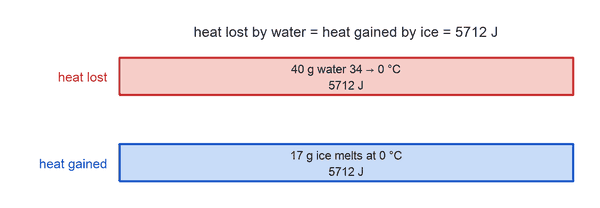
Step 4 — State the assumption.
We assumed that no heat is lost to the container or the surroundings, so all the heat lost by the water goes into the ice (and that the ice is at 0 °C to start with).
Watch out: The water formed from the ice stays at 0 °C here, so there is no warming term for it.
Therefore, the specific latent heat of ice is 336 J g⁻¹, assuming no heat is lost to the surroundings.
- 994 marks
Question 99
The temperature of 170 g of water at 50°C is lowered to 5°C by adding certain amount of ice to it. Find the mass of ice added. Given : Specific heat capacity of water = 4200 J kg °C and specific latent heat of ice = 336000 J kg.
Solve with AIWritten solution
Solution:
Concept: Principle of method of mixtures (principle of calorimetry): when a hot body and a cold body are mixed and no heat is lost to the surroundings, heat flows from the hot body to the cold body until both reach the same final temperature, and heat lost by the hot body = heat gained by the cold body. Here, the ice (taken to be at 0 °C) first melts (Q = mL), then the water formed from it warms from 0 °C to 5 °C (Q = mcΔt).
Given: Water: 170 g = 0.17 kg, cools from 50 °C to 5 °C; c = 4200 J kg⁻¹ °C⁻¹; L = 336000 J kg⁻¹.
Step 1 — Heat lost by the water.
The 0.17 kg of water cools from 50 °C to 5 °C, a fall of 45 °C.
Step 2 — Heat gained by the ice.
Let the mass of ice be m kg. It melts, then the water formed warms by 5 °C.
Step 3 — Equate them.
With no heat lost, heat gained = heat lost.
Step 4 — Solve for m.
Divide both sides by 357000.
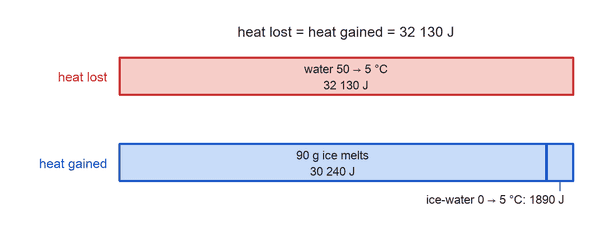
Watch out: The melted ice must also be warmed from 0 °C to 5 °C; leaving out this term gives a wrong mass.
Therefore, the mass of ice added is 0.09 kg, that is 90 g.
- 1004 marks
Question 100
Find the result of mixing 10 g of ice at °C with 10 g of water at 10°C. Specific heat capacity of ice = 2·1 J g K, specific latent heat of ice = 336 J g and specific heat capacity of water = 4·2 J g K.
Solve with AIWritten solution
Solution:
Concept: Before deciding the final temperature, check how much heat each body can give or take. The water can give heat only until it reaches 0 °C. That heat first warms the ice to 0 °C, and whatever is left over melts part of the ice.
Given: Ice: 10 g at −10 °C, c(ice) = 2.1 J g⁻¹ K⁻¹, L = 336 J g⁻¹; water: 10 g at 10 °C, c(water) = 4.2 J g⁻¹ K⁻¹.
Step 1 — Heat needed to warm the ice to 0 °C.
The ice warms from −10 °C to 0 °C (c of ice = 2.1 J g⁻¹ K⁻¹).
Step 2 — Heat the water can give in cooling to 0 °C.
The water cools from 10 °C to 0 °C.
Step 3 — Heat left over at 0 °C.
The water gives more than enough to bring the ice to 0 °C, with some to spare.
Step 4 — Check whether all the ice can melt.
Melting all 10 g would need J, far more than 210 J, so only part of the ice melts.

Step 5 — Final state.
Ice and water can stay together only at 0 °C, so the mixture stays at 0 °C. The ice left and the water now present are:
Watch out: Do not use heat lost = heat gained with an unknown t above 0 °C; first check whether the ice can all melt.
Therefore, 0.625 g of ice melts and the temperature of the mixture remains 0 °C.
- 1014 marks
Question 101
A piece of ice of mass 40 g is added to 200 g of water at 50°C. Calculate the final temperature of water when all the ice has melted. Specific heat capacity of water = 4200 J kg K and specific latent heat of fusion of ice = 336 × 10 J kg.
Solve with AIWritten solution
Solution:
Concept: Principle of method of mixtures (principle of calorimetry): when a hot body and a cold body are mixed and no heat is lost to the surroundings, heat flows from the hot body to the cold body until both reach the same final temperature, and heat lost by the hot body = heat gained by the cold body. All the ice melts, so the final temperature t is above 0 °C: the ice melts at 0 °C and then the water formed warms from 0 °C to t.
Given: Ice: 40 g at 0 °C; water: 200 g at 50 °C; c = 4200 J kg⁻¹ K⁻¹; L = 336 × 10³ J kg⁻¹.
Step 1 — Change to per-gram values.
Working in grams, c = 4.2 J g⁻¹ K⁻¹ and L = 336 J g⁻¹ (from 4200 J kg⁻¹ K⁻¹ and 336 × 10³ J kg⁻¹).
Step 2 — Heat gained by the ice.
The 40 g of ice melts, then warms from 0 °C to t.
Step 3 — Heat lost by the water.
The 200 g of water cools from 50 °C to t.
Step 4 — Equate them.
With no heat lost, heat gained = heat lost.
Step 5 — Collect the terms.
Add 840t and subtract 13440 on both sides.
Step 6 — Solve for t.
Divide by 1008.
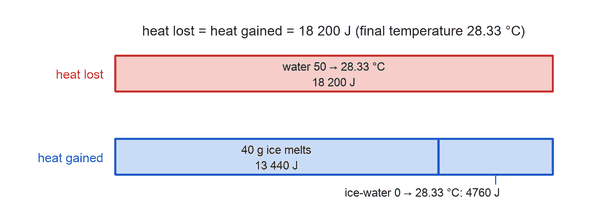
Watch out: The melted ice also warms up to t; include its 168t term.
Therefore, the final temperature of the water is about 28.33 °C.
- 1024 marks
Question 102
Calculate the mass of ice needed to cool 150 g of water contained in a calorimeter of mass 50 g at 32°C such that the final temperature is 5°C. Specific heat capacity of calorimeter = 0·4 J g °C, specific heat capacity of water = 4·2 J g °C, latent heat capacity of ice = 330 J g.
Solve with AIWritten solution
Solution:
Concept: Principle of method of mixtures (principle of calorimetry): when a hot body and a cold body are mixed and no heat is lost to the surroundings, heat flows from the hot body to the cold body until both reach the same final temperature, and heat lost by the hot body = heat gained by the cold body. Here the calorimeter and the water both cool from 32 °C to 5 °C; the ice (taken to be at 0 °C) melts and then warms from 0 °C to 5 °C.
Given: Calorimeter: 50 g, c = 0.4 J g⁻¹ °C⁻¹; water: 150 g, c = 4.2 J g⁻¹ °C⁻¹; both at 32 °C; final temperature 5 °C; L = 330 J g⁻¹.
Step 1 — Read the data.
The question's “latent heat capacity of ice” means its specific latent heat of fusion, L = 330 J g⁻¹. Both the calorimeter and the water fall by °C.
Step 2 — Heat lost by the calorimeter.
Use its mass and specific heat capacity.
Step 3 — Heat lost by the water.
Use the water's mass and specific heat capacity.
Step 4 — Heat gained by the ice.
Let the mass of ice be m grams. It melts, then the water formed warms by 5 °C.
Step 5 — Equate them.
Heat gained by the ice = heat lost by the calorimeter and the water.
Step 6 — Solve for m.
Divide by 351.
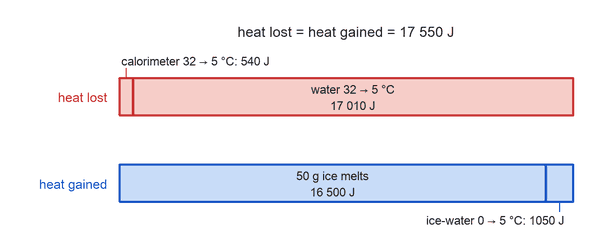
Watch out: Include the heat given out by the calorimeter as well as the water; here L is 330 J g⁻¹ as given, not 336.
Therefore, the mass of ice needed is 50 g.
- 1034 marks
Question 103
250 g of water at 30°C is contained in a copper vessel of mass 50 g. Calculate the mass of ice required to bring down the temperature of the vessel and its contents to 5°C. Given : specific latent heat of fusion of ice = 336 × 10 J kg, specific heat capacity of copper = 400 J kg K, specific heat capacity of water = 4200 J kg K.
Solve with AIWritten solution
Solution:
Concept: Principle of method of mixtures (principle of calorimetry): when a hot body and a cold body are mixed and no heat is lost to the surroundings, heat flows from the hot body to the cold body until both reach the same final temperature, and heat lost by the hot body = heat gained by the cold body. Here the copper vessel and the water both cool from 30 °C to 5 °C; the ice (taken to be at 0 °C) melts and then warms from 0 °C to 5 °C.
Given: Water: 250 g at 30 °C; copper vessel: 50 g; final temperature 5 °C; L = 336 × 10³ J kg⁻¹; c(copper) = 400 J kg⁻¹ K⁻¹; c(water) = 4200 J kg⁻¹ K⁻¹.
Step 1 — Heat lost by the copper vessel.
The 0.05 kg vessel falls by K.
Step 2 — Heat lost by the water.
The 0.25 kg of water also falls by 25 K.
Step 3 — Heat gained by the ice.
Let the mass of ice be m kg. It melts, then the water formed warms by 5 °C.
Step 4 — Equate them.
Heat gained by the ice = heat lost by the vessel and the water.
Step 5 — Solve for m.
Divide by 357000 and change to grams.

Step 6 — Notice.
The copper vessel gives only 500 J; almost all the heat comes from the water, whose specific heat capacity is more than 10 times that of copper.
Watch out: Include the copper vessel's heat; it is small but part of the heat lost.
Therefore, the mass of ice required is about 74.93 g.
- 1043 marks
Question 104
2 kg of ice melts when water at 100°C is poured in a hole drilled in a block of ice. What mass of water was used ? Given : specific heat capacity of water = 4200 J kg K, specific latent heat of ice = 336 × 10 J kg.
Solve with AIWritten solution
Solution:
Concept: Principle of method of mixtures (principle of calorimetry): when a hot body and a cold body are mixed and no heat is lost to the surroundings, heat flows from the hot body to the cold body until both reach the same final temperature, and heat lost by the hot body = heat gained by the cold body. The hot water cools to 0 °C and gives its heat to the ice, which stays at 0 °C and only melts.
Given: Ice melted = 2 kg; water at 100 °C; c = 4200 J kg⁻¹ K⁻¹; L = 336 × 10³ J kg⁻¹.
Step 1 — Heat lost by the water.
Let the mass of water be m kg. It cools from 100 °C to 0 °C.
Step 2 — Heat gained by the ice.
2 kg of ice melts at 0 °C.
Step 3 — Equate them.
With no heat lost, heat lost = heat gained.
Step 4 — Solve for m.
Divide both sides by 420000.
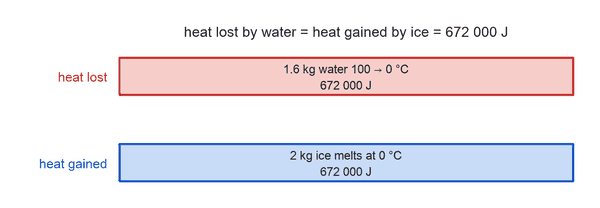
Step 5 — Notice.
Even boiling water melts only a little more than its own mass of ice, because the latent heat of ice is so large.
Watch out: The water ends at 0 °C (it all becomes part of the melt), so its fall is 100 °C.
Therefore, the mass of water used was 1.6 kg.
- 1053 marks
Question 105
Calculate the total amount of heat energy required to convert 100 g of ice at °C completely into water at 100°C. Specific heat capacity of ice = 2·1 J g K, specific heat capacity of water = 4·2 J g K, specific latent heat of ice = 336 J g.
Solve with AIWritten solution
Solution:
Concept: The ice goes through three stages: it warms from −10 °C to 0 °C (Q = mcΔt with c of ice), it melts at 0 °C (Q = mL), and the water then warms from 0 °C to 100 °C (Q = mcΔt with c of water). The total heat is the sum of the three.
Given: m = 100 g; c(ice) = 2.1 J g⁻¹ K⁻¹; c(water) = 4.2 J g⁻¹ K⁻¹; L = 336 J g⁻¹.
Step 1 — Ice warms from −10 °C to 0 °C.
Use c of ice and a rise of 10 °C.
Step 2 — Ice melts at 0 °C.
Each gram needs 336 J.
Step 3 — Water warms from 0 °C to 100 °C.
Use c of water and a rise of 100 °C.
Step 4 — Add the three.
The total heat is the sum of the three stages.

Watch out: Use c of ice (2.1) below 0 °C and c of water (4.2) above it.
Therefore, the total heat required is 7.77 × 10⁴ J.
- 1063 marks
Question 106
The amount of heat energy required to convert 1 kg of ice at °C to water at 100°C is 7,77,000 J. Calculate the specific latent heat of ice. Specific heat capacity of ice = 2100 J kg K, specific heat capacity of water = 4200 J kg K.
Solve with AIWritten solution
Solution:
Concept: The 777000 J is spent in three stages: warming the ice from −10 °C to 0 °C, melting it at 0 °C (Q = mL), and warming the water from 0 °C to 100 °C. Find the two warming parts; what is left is the latent heat.
Given: m = 1 kg; total heat = 777000 J; c(ice) = 2100 J kg⁻¹ K⁻¹; c(water) = 4200 J kg⁻¹ K⁻¹.
Step 1 — Ice warms from −10 °C to 0 °C.
Use c of ice and a rise of 10 °C.
Step 2 — Water warms from 0 °C to 100 °C.
Use c of water and a rise of 100 °C.
Step 3 — Heat used in melting.
The rest of the 777000 J melts the 1 kg of ice, so it equals 1 × L.
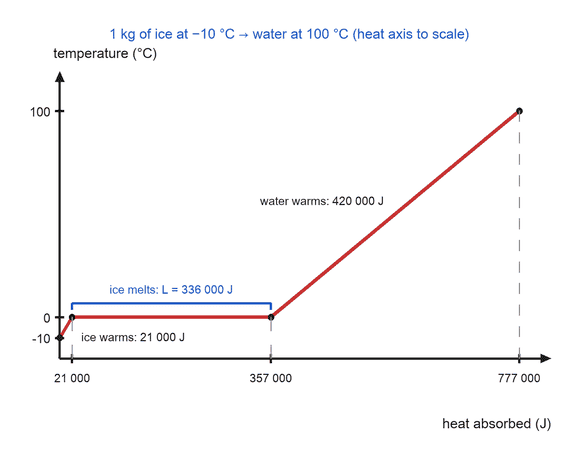
Watch out: Subtract BOTH warming stages from the total before calling the rest latent heat.
Therefore, the specific latent heat of ice is 336000 J kg⁻¹ (336 J g⁻¹).
- 1073 marks
Question 107
200 g of ice at 0°C converts into water at 0°C in 1 minute when heat is supplied to it at a constant rate. In how much time 200 g of water at 0°C will change to 20°C ? Take specific latent heat of ice = 336 J g.
Solve with AIWritten solution
Solution:
Concept: The heat is supplied at a constant rate. Melting the ice tells us that rate, and then the time for any heating is the heat needed ÷ the rate.
Given: m = 200 g; ice melts in 1 min; L = 336 J g⁻¹; c(water) = 4.2 J g⁻¹ K⁻¹ (book value).
Step 1 — Heat to melt the ice.
200 g of ice melts at 0 °C, taking 336 J for each gram.
Step 2 — Rate of heating.
This heat was supplied in 1 min = 60 s.
Step 3 — Heat to warm the water.
The question does not give c of water, so use the book's value, 4.2 J g⁻¹ K⁻¹.
Step 4 — Time taken.
Divide this heat by the same rate.
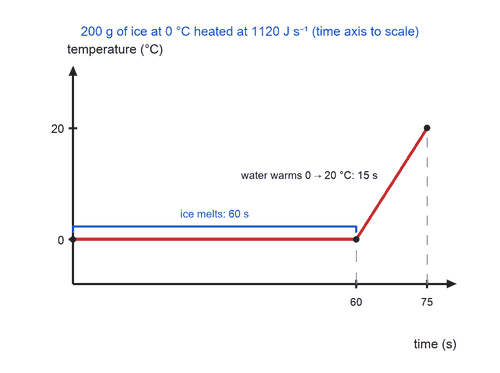
Step 5 — Notice.
The ice took 4 times as long just to melt (60 s) as the water takes to warm by 20 °C (15 s).
Watch out: Change 1 minute to 60 s when finding the rate.
Therefore, the water takes 15 s to warm from 0 °C to 20 °C.
- 1083 marks
Question 108
During exercise, the body loses heat through evaporation of sweat. If a person loses 1 kg of sweat during exercise, how much energy does the body lose through evaporation ? How does the cooling effect of evaporation compare to heat loss due to specific heat capacity ? [Latent heat of vaporization = 2268 × 10 J kg, specific heat capacity of water = 4·2 × 10 J kgK]
Solve with AIWritten solution
Solution:
Concept: Evaporating sweat takes its latent heat of vaporisation from the body (Q = mL); compare this with the heat 1 kg of water gives out for each 1 °C fall (Q = mcΔt).
Given: m = 1 kg; L = 2268 × 10³ J kg⁻¹; c = 4.2 × 10³ J kg⁻¹ K⁻¹.
Step 1 — Energy lost by evaporation.
1 kg of sweat evaporates, taking its latent heat of vaporisation.
Step 2 — Heat lost through specific heat capacity.
By specific heat capacity alone, 1 kg of water gives out 4200 J for each 1 °C fall in its temperature.
Step 3 — Compare the two.
Divide the first by the second.

Step 4 — Interpret.
Evaporating 1 kg of sweat removes as much heat as cooling 1 kg of water through 540 °C, so evaporation is a far more effective way for the body to lose heat.
Note: a spelling slip in the printed question (“loose”) has been corrected to “lose”.
Therefore, the body loses 2268 × 10³ J, which is 540 times the heat lost per degree through specific heat capacity.
What Class 10 Physics Ch 11 covers
The sections of the chapter, in the order the book takes them. Every question above comes from one of these.
- 01Concept of Heat
- 02Concept of Temperature
- 03Thermal (or Heat) Capacity
- 04Specific Heat Capacity
- 05Principle of Method of Mixtures
- 06Consequences of High Specific Heat Capacity of Water
More ways to study this chapter
The same chapter asked three other ways. Practise it, revise it, and see what the board has set on Ch 11 before.
- Competency-Based Questions (CBQ)Case study questions: a situation, and the part of the chapter that answers it.40questionsOpen
- Previous Year QuestionsQuestions that have actually appeared in board papers, each tagged with its year.67questionsOpen
- Practice QuestionsExtra questions per chapter, for when one attempt at a method is not enough.43questionsOpen
Ch 11 in past ICSE papers
The same chapter as the board has actually asked it. These are worded differently from the textbook exercise, which is the point of reading them.
- 12 marks
Board paper question 1
Calculate the mass of ice required to lower the temperature of 300 g of water at 40°C to water at 0°C. (Specific latent heat of ice = 336 , Specific heat capacity of water = 4.2 )
Solve with AIWritten solution
Solution:
Concept: Principle of method of mixtures (principle of calorimetry): when a hot body and a cold body are mixed and no heat is lost to the surroundings, heat flows from the hot body to the cold body until both reach the same final temperature, and heat lost by the hot body = heat gained by the cold body. During a change of phase (melting, freezing, boiling, condensation) the temperature stays constant. The heat taken in or given out then is the latent heat, Q = m × L, where L is the specific latent heat. For ice, L = 336 J g⁻¹ (336000 J kg⁻¹, or 80 cal g⁻¹).
Given: Water 300 g at 40 °C, cooled to 0 °C; L = 336 J g⁻¹; c(water) = 4.2 J g⁻¹ °C⁻¹.
Step 1 — Decide what each body does.
The water cools from 40 °C to 0 °C and gives out heat. The final temperature is 0 °C, so the ice (taken at 0 °C) only melts: the water formed from it does not warm up at all.
Step 2 — Heat lost by the water.
We use Q = m × c × Δt; the water falls from 40 °C to 0 °C, a fall of 40 °C.
Step 3 — Heat gained by the ice.
Let the mass of ice be m grams. It only melts, so it takes the latent heat.
Step 4 — Equate heat lost and heat gained.
No heat is lost to the surroundings, so the two amounts are equal.
Step 5 — Solve for m.
We divide both sides by 336.
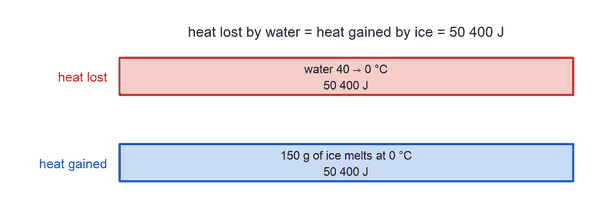
Watch out: Since the final temperature is 0 °C, do not add a term for the melted ice warming up.
Therefore, the mass of ice required is 150 g.
- 22 marks
Board paper question 2
What do you understand by the following statements :
(i) The heat capacity of the body is 60 .
(ii) The specific heat capacity of lead is 130
Solve with AIWritten solution
Solution:
Concept: The heat capacity C′ of a body is the heat needed to raise the temperature of the whole body by 1 K. It is linked to the specific heat capacity c of its substance by C′ = m × c, and its S.I. unit is J K⁻¹. The specific heat capacity c of a substance is the heat needed to raise the temperature of unit mass (1 kg) of it by 1 K (or 1 °C). Its S.I. unit is J kg⁻¹ K⁻¹; for water it is about 4200 J kg⁻¹ K⁻¹, which is the same as 4.2 J g⁻¹ K⁻¹.
(i)
Step 1 — Read the heat capacity.
A heat capacity of 60 J K⁻¹ is for the whole body. It means the body needs 60 J of heat to raise its temperature by 1 K (that is, by 1 °C), and it gives out 60 J when it cools by 1 K.
(ii)
Step 2 — Read the specific heat capacity.
A specific heat capacity of 130 J kg⁻¹ K⁻¹ is for unit mass of the substance. It means 1 kg of lead needs 130 J of heat to raise its temperature by 1 K (1 °C).
Step 3 — Compare with water.
This is a small value: 1 kg of water needs about 4200 J for the same rise, so lead warms up much more for the same heat.
Watch out: Heat capacity is for the WHOLE body (J K⁻¹); specific heat capacity is for 1 kg of the substance (J kg⁻¹ K⁻¹).
Therefore, (i) the body needs 60 J of heat to raise its temperature by 1 K; (ii) 1 kg of lead needs 130 J of heat to raise its temperature by 1 K.
- 32 marks
Board paper question 3
State two factors upon which the heat absorbed by a body depends.
Solve with AIWritten solution
Solution:
Concept: The heat taken in (or given out) by a body of mass m, made of a substance of specific heat capacity c, when its temperature rises (or falls) by Δt is Q = m × c × Δt.
Step 1 — Look at the formula.
The heat absorbed is the product of three quantities, so it grows with each of them.
Step 2 — First factor: the mass.
Q is directly proportional to the mass m: twice the mass needs twice the heat for the same rise in temperature.
Step 3 — Second factor: the rise in temperature.
Q is directly proportional to the rise in temperature Δt: a rise of 20 °C needs twice the heat of a rise of 10 °C.
Step 4 — A third factor.
Q also depends on the material of the body, through its specific heat capacity c: the same mass of water needs far more heat than copper for the same rise.
Therefore, the heat absorbed by a body depends on its mass and on the rise in its temperature (and also on its material, that is, its specific heat capacity).
- 43 marks
Board paper question 4
(i) What is the principle of method of mixtures?
(ii) What is the other name given to it?
(iii) Name the law on which the principle is based.
Solve with AIWritten solution
Solution:
Concept: When bodies at different temperatures are in contact, heat flows from the hotter body to the colder one until they reach the same temperature.
(i)
Step 1 — State the principle.
When a hot body is mixed with (or kept in contact with) a cold body, heat flows from the hot body to the cold body until both reach the same final temperature. If no heat is lost to the surroundings, the heat energy lost by the hot body is equal to the heat energy gained by the cold body.

(ii)
Step 2 — Give its other name.
It is also called the principle of calorimetry.
(iii)
Step 3 — Name the law.
It is based on the law of conservation of energy: energy can neither be created nor destroyed, so all the heat that leaves the hot body must appear in the cold body.
Watch out: The equality holds only when no heat is lost to the surroundings.
Therefore, (i) heat lost by the hot body = heat gained by the cold body (no heat lost to the surroundings); (ii) it is the principle of calorimetry; (iii) it is based on the law of conservation of energy.
- 53 marks
Board paper question 5
Some ice is heated at a constant rate, and its temperature is recorded after every few seconds, till steam is formed at 100°C. Draw a temperature time graph to represent the change. Label the two phase changes in your graph.
Solve with AIWritten solution
Solution:
Concept: During a change of phase (melting, freezing, boiling, condensation) the temperature stays constant. The heat taken in or given out then is the latent heat, Q = m × L, where L is the specific latent heat. For ice, L = 336 J g⁻¹ (336000 J kg⁻¹, or 80 cal g⁻¹). At a constant rate of heating, the temperature rises while one phase warms up, and stays constant during each change of phase.
Step 1 — Ice warms.
If the ice starts below 0 °C, its temperature first rises to 0 °C, so the graph slopes upwards.
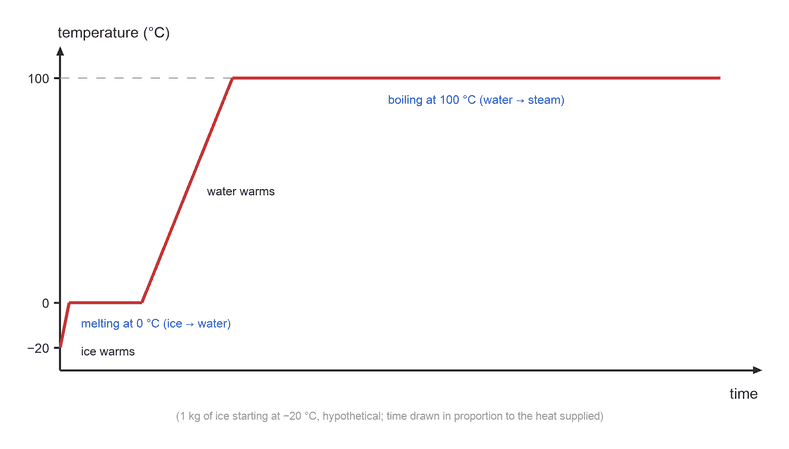
Step 2 — First phase change: melting at 0 °C.
The temperature stays at 0 °C while the ice changes into water, so the graph is flat. The heat taken in is the latent heat of fusion (336 J for each gram).
Step 3 — Water warms.
Once all the ice has melted, the temperature of the water rises steadily from 0 °C to 100 °C.
Step 4 — Second phase change: boiling at 100 °C.
The temperature stays at 100 °C while the water changes into steam, so the graph is flat again. The heat taken in is the latent heat of vaporisation (about 2260 J for each gram).
Step 5 — Compare the lengths.
At a constant rate of heating, time is proportional to heat. Boiling needs about 2260 J g⁻¹, far more than melting (336 J g⁻¹) or warming the water through 100 °C (420 J g⁻¹), so the flat part at 100 °C is the longest. The ice part is steeper than the water part, because ice has about half the specific heat capacity of water (2100 against 4200 J kg⁻¹ K⁻¹).
Watch out: The two flat parts must be labelled as the phase changes (melting at 0 °C, boiling at 100 °C); a sloping line straight from 0 °C to 100 °C misses them.
Therefore, the graph rises to 0 °C, stays flat at 0 °C (melting), rises to 100 °C, and stays flat at 100 °C (boiling); the two flat parts are the two phase changes.
- 64 marks
Board paper question 6
A copper vessel of mass 100 g contains 150 g of water at 50 °C. How much ice is needed to cool it to 5 °C?
Given : Specific heat capacity of copper = 0.4
Specific heat capacity of water = 4.2
Specific latent heat of fusion of ice = 336
Solve with AIWritten solution
Solution:
Concept: Principle of method of mixtures (principle of calorimetry): when a hot body and a cold body are mixed and no heat is lost to the surroundings, heat flows from the hot body to the cold body until both reach the same final temperature, and heat lost by the hot body = heat gained by the cold body. Ice at 0 °C takes in heat in two stages. First it melts at 0 °C, with no change in temperature, taking Q = m × L. Then the water formed from it warms from 0 °C to the final temperature, taking Q = m × c × Δt.
Given: Copper vessel 100 g, c = 0.4 J g⁻¹ °C⁻¹; water 150 g at 50 °C; final temperature 5 °C; c(water) = 4.2 J g⁻¹ °C⁻¹; L = 336 J g⁻¹.
Step 1 — Decide what each body does.
The copper vessel and the water both cool from 50 °C to 5 °C (a fall of 45 °C). The ice is taken at 0 °C, since no other temperature is given: it melts and then warms from 0 °C to 5 °C.
Step 2 — Heat lost by the copper vessel.
We use Q = m × c × Δt for the vessel.
Step 3 — Heat lost by the water.
We use the same formula for the water.
Step 4 — Total heat lost.
We add the two amounts.
Step 5 — Heat gained by the ice.
Let the mass of ice be m grams. It takes latent heat to melt, and then the melted ice warms by 5 °C.
Step 6 — Equate heat gained and heat lost.
No heat is lost to the surroundings, so the two are equal.
Step 7 — Solve for m.
We divide both sides by 357.
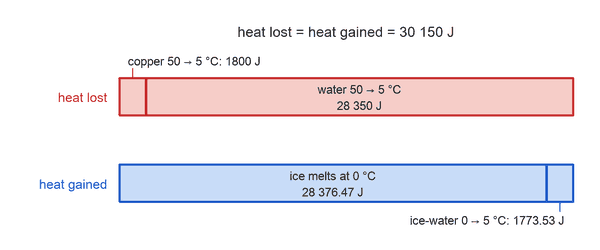
Watch out: The melted ice must also be warmed from 0 °C to 5 °C; leaving out the 21m term gives 89.7 g.
Therefore, about 84.45 g of ice is needed.
All 67 board paper questions for this chapter, solved the same way.
Class 10 Physics Ch 11 questions students ask
How many questions are there in Class 10 Physics Ch 11?
108 questions. Every one is solved step by step on this page.
Are these Class 10 Physics solutions free?
Yes. Every question and its full working is free to read, with no account needed.
Can I download the Class 10 Physics Ch 11 solutions as a PDF?
There is no PDF to download. Every solution is on this page instead, which means it is searchable, always the current syllabus, and readable on a phone. Use your browser's print option if you want it on paper.