
Question 1043 marksEasy
2 kg of ice melts when water at 100°C is poured in a hole drilled in a block of ice. What mass of water was used ? Given : specific heat capacity of water = 4200 J kg K, specific latent heat of ice = 336 × 10 J kg.
Confirming your payment
Sign up now and get 250 free tokens.
Calorimetry · Question 104 of 108
2 kg of ice melts when water at 100°C is poured in a hole drilled in a block of ice. What mass of water was used ? Given : specific heat capacity of water = 4200 J kg K, specific latent heat of ice = 336 × 10 J kg.
Solution:
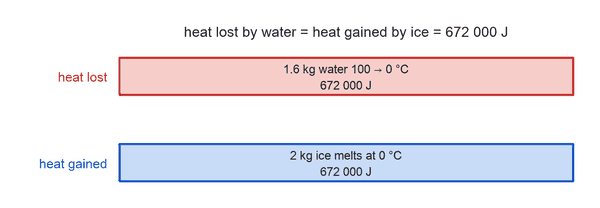
Concept: Principle of method of mixtures (principle of calorimetry): when a hot body and a cold body are mixed and no heat is lost to the surroundings, heat flows from the hot body to the cold body until both reach the same final temperature, and heat lost by the hot body = heat gained by the cold body. The hot water cools to 0 °C and gives its heat to the ice, which stays at 0 °C and only melts.
Given: Ice melted = 2 kg; water at 100 °C; c = 4200 J kg⁻¹ K⁻¹; L = 336 × 10³ J kg⁻¹.
Step 1 — Heat lost by the water.
Let the mass of water be m kg. It cools from 100 °C to 0 °C.
Step 2 — Heat gained by the ice.
2 kg of ice melts at 0 °C.
Step 3 — Equate them.
With no heat lost, heat lost = heat gained.
Step 4 — Solve for m.
Divide both sides by 420000.
Step 5 — Notice.
Even boiling water melts only a little more than its own mass of ice, because the latent heat of ice is so large.
Watch out: The water ends at 0 °C (it all becomes part of the melt), so its fall is 100 °C.
Therefore, the mass of water used was 1.6 kg.