Solution:
Concept: A calorimeter should take up as little heat as possible from its contents and let as little heat escape as possible, so that heat lost = heat gained holds closely.
(a)
Step 1 — Say what a calorimeter is.
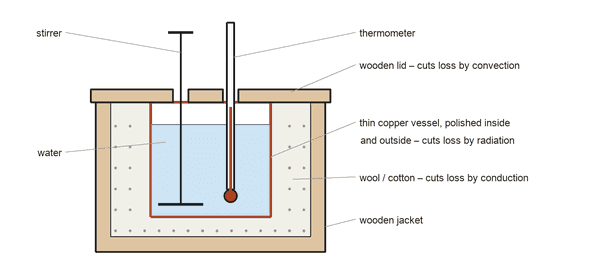
A calorimeter is a cylindrical vessel (with a stirrer and a lid) used to measure the amount of heat gained or lost by a body when it is mixed with another body, using the principle of calorimetry.
(b)
Step 2 — Name the material.
It is usually made of thin copper, for two reasons.
- Copper is a good conductor of heat, so the vessel quickly reaches the same temperature as its contents.
- Copper has a low specific heat capacity, so a thin copper vessel has a small heat capacity and itself takes up very little of the heat being measured.
(c)
Step 3 — Choose the metal.
The best metal is the one with the lowest specific heat capacity, since for the same mass it takes up the least heat from the contents. Of 900, 380 and 460 J kg⁻¹ °C⁻¹, the lowest is 380, metal B.
(d)
Step 4 — Reduce the loss by radiation.
The inner and outer surfaces of the calorimeter are highly polished, because a shiny surface is a poor radiator (and absorber) of heat. It is also kept in a wooden jacket with wool or cotton packed around it, which cuts the loss by conduction and convection.
Therefore, (a) a calorimeter is a vessel for measuring heat by the method of mixtures; (b) it is made of copper, a good conductor with a low specific heat capacity; (c) metal B is preferred, as it has the lowest specific heat capacity; (d) loss by radiation is cut by polishing its surfaces.
