
Question 414 marksEasy
Discuss the role of high specific heat capacity of water with reference to climate in coastal areas.
Confirming your payment
Sign up now and get 250 free tokens.
Calorimetry · Question 41 of 108
Discuss the role of high specific heat capacity of water with reference to climate in coastal areas.
Solution:
Concept: Water has a very high specific heat capacity (4200 J kg⁻¹ K⁻¹). So a given mass of water takes in a large amount of heat for only a small rise in its temperature, and gives out a large amount of heat for only a small fall. Land (sand and soil) has a much lower specific heat capacity, roughly 800 J kg⁻¹ K⁻¹, so for the same sunshine the sea warms up, and later cools down, much more slowly than the land.
Step 1 — During the day.
The sun heats both land and sea. The land heats up quickly, but the sea warms only slightly. The air over the hot land becomes warm, gets lighter and rises, and cooler air from the sea blows in to take its place. This sea breeze keeps days at the coast from becoming very hot.
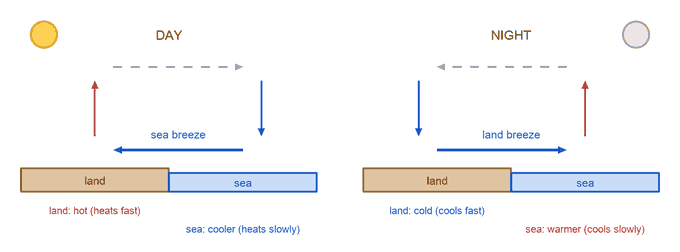
Step 2 — At night.
The land cools quickly, but the sea gives out its stored heat slowly and stays warmer than the land. Now the air over the sea rises, and air from the land blows towards the sea (the land breeze). The warm sea also warms the coast, so the nights do not become very cold.
Step 3 — Over the year.
In the same way, the sea warms slowly in summer and cools slowly in winter, so it acts as a heat reservoir for the coast.
Therefore, because of the high specific heat capacity of water, the climate of coastal areas is moderate: the difference between day and night (and summer and winter) temperatures is much smaller than far from the sea.