Solution:
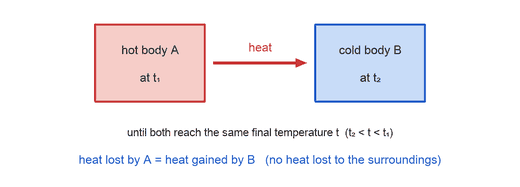
Concept: Principle of method of mixtures (principle of calorimetry): when a hot body and a cold body are mixed and no heat is lost to the surroundings, heat flows from the hot body to the cold body until both reach the same final temperature, and heat lost by the hot body = heat gained by the cold body. Here t₂ < t < t₁.
Step 1 — Heat lost by the hot substance.
The first substance cools from t₁ to t, so the heat it loses is:
Q1=m1c1(t1−t)
Step 2 — Heat gained by the cold substance.
The second substance warms from t₂ to t, so the heat it gains is:
Q2=m2c2(t−t2)
Step 3 — Equate them.
With no heat lost, heat lost = heat gained.
m1c1(t1−t)=m2c2(t−t2)
Step 4 — Expand both sides.
Multiply out the brackets.
m1c1t1−m1c1t=m2c2t−m2c2t2
Step 5 — Collect the terms in t.
Move every term with t to one side and the rest to the other.
m1c1t1+m2c2t2=(m1c1+m2c2)t
Step 6 — Solve for t.
Divide by the bracket.
t=m1c1+m2c2m1c1t1+m2c2t2
Step 7 — State the assumption.
We assumed that there is no loss of heat to the surroundings or to the container, so all the heat lost by the hot substance is gained by the cold one.
Step 8 — Read the result.
t is a weighted average of t₁ and t₂, weighted by the heat capacities m₁c₁ and m₂c₂, so the final temperature lies nearer the starting temperature of the substance with the larger heat capacity.
Watch out: Write each temperature change as (higher − lower), so that both heats come out positive.
Therefore, t = (m₁c₁t₁ + m₂c₂t₂) ÷ (m₁c₁ + m₂c₂), assuming no heat is lost to the surroundings.
