
Question 91 markMCQEasy
The principle of calorimetry is based on :
Confirming your payment
Sign up now and get 250 free tokens.
Calorimetry · Question 9 of 108
The principle of calorimetry is based on :
(A) law of conservation of heat
(B) law of conservation of energy
(C) both (a) and (b)
(D) conservation of momentum
Answer: (C) both (a) and (b)
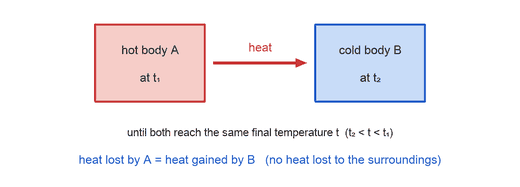
Concept: Principle of method of mixtures (principle of calorimetry): when a hot body and a cold body are mixed and no heat is lost to the surroundings, heat flows from the hot body to the cold body until both reach the same final temperature, and heat lost by the hot body = heat gained by the cold body.
Step 1 — Read the principle as a conservation law.
Heat lost = heat gained says no heat is created or destroyed during the mixing. That is the conservation of heat, so (a) applies.
Step 2 — See the wider law.
Heat is a form of energy, so the conservation of heat is a particular case of the law of conservation of energy. So (b) applies too.
Step 3 — Choose the option.
Since both laws describe the principle, the option naming both is correct.
Why the other options are wrong:
Therefore, the principle of calorimetry is based on both the conservation of heat and the conservation of energy, option (C).