Solution:
Concept: Principle of method of mixtures (principle of calorimetry): when a hot body and a cold body are mixed and no heat is lost to the surroundings, heat flows from the hot body to the cold body until both reach the same final temperature, and heat lost by the hot body = heat gained by the cold body. Here, the ice (taken to be at 0 °C) first melts (Q = mL), then the water formed from it warms from 0 °C to 5 °C (Q = mcΔt).
Given: Water: 170 g = 0.17 kg, cools from 50 °C to 5 °C; c = 4200 J kg⁻¹ °C⁻¹; L = 336000 J kg⁻¹.
Step 1 — Heat lost by the water.
The 0.17 kg of water cools from 50 °C to 5 °C, a fall of 45 °C.
Q1=0.17×4200×45 J=32130 J
Step 2 — Heat gained by the ice.
Let the mass of ice be m kg. It melts, then the water formed warms by 5 °C.
Q2=m×336000+m×4200×5=357000m
Step 3 — Equate them.
With no heat lost, heat gained = heat lost.
357000m=32130
Step 4 — Solve for m.
Divide both sides by 357000.
m=35700032130 kg=0.09 kg
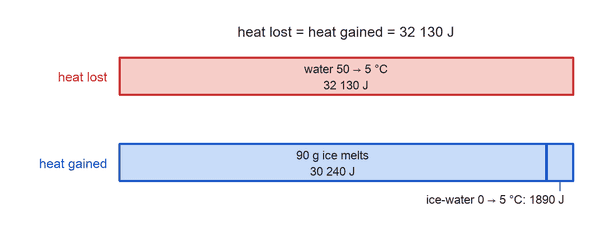
Watch out: The melted ice must also be warmed from 0 °C to 5 °C; leaving out this term gives a wrong mass.
Therefore, the mass of ice added is 0.09 kg, that is 90 g.
