Solution:
Concept: Principle of method of mixtures (principle of calorimetry): when a hot body and a cold body are mixed and no heat is lost to the surroundings, heat flows from the hot body to the cold body until both reach the same final temperature, and heat lost by the hot body = heat gained by the cold body. The final temperature is 0 °C (the freezing point), so the ice (at 0 °C) only melts and does not warm up.
Given: Ice: 17 g at 0 °C; water: 40 g at 34 °C; final temperature 0 °C; c = 4.2 J g⁻¹ K⁻¹.
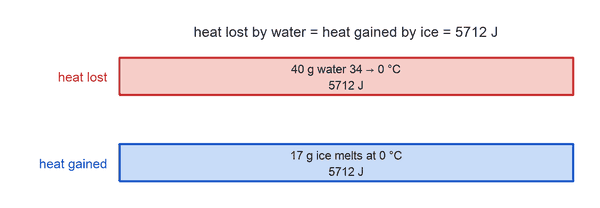
Step 1 — Heat lost by the water.
The water cools from 34 °C to 0 °C.
Q=40×4.2×34 J=5712 J
Step 2 — Heat gained by the ice.
The 17 g of ice only melts, so it takes 17 × L joule.
17L=5712
Step 3 — Solve for L.
Divide both sides by 17.
L=17 g5712 J=336 J g−1
Step 4 — State the assumption.
We assumed that no heat is lost to the container or the surroundings, so all the heat lost by the water goes into the ice (and that the ice is at 0 °C to start with).
Watch out: The water formed from the ice stays at 0 °C here, so there is no warming term for it.
Therefore, the specific latent heat of ice is 336 J g⁻¹, assuming no heat is lost to the surroundings.
