Solution:
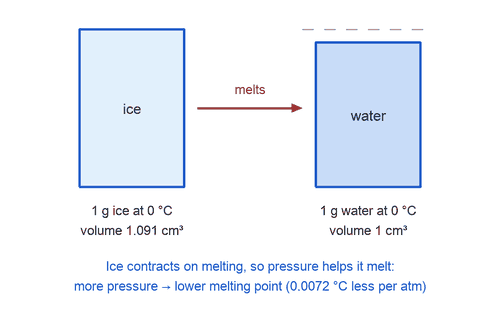
Concept: Ice contracts on melting, so pressure lowers its melting point. Pressure raises the boiling point of water.
(a)
Step 1 — Volume on melting.
1 g of ice of volume 1.091 cm³ becomes 1 g of water of volume 1 cm³, so the volume decreases.
(b)
Step 2 — Lower pressure on ice.
An increase in pressure lowers the melting point of ice, so a decrease in pressure increases it.
(c)
Step 3 — Pressure and boiling.
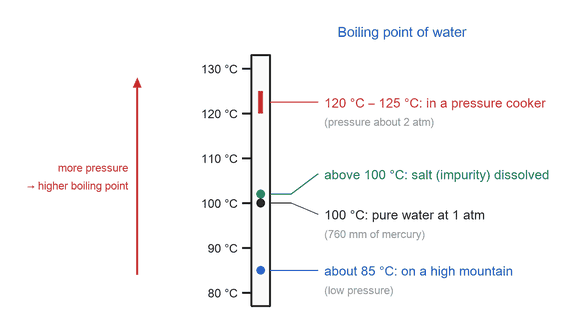
An increase in pressure increases the boiling point of water.
(d)
Step 4 — Principle of the pressure cooker.
The cooker keeps the steam in, so the pressure inside rises (to about 2 atmospheres) and water boils at about 120 °C. It works because the boiling point increases with the increase in pressure.
(e)
Step 5 — Boiling point.
The boiling point of water is the constant temperature at which water changes into steam; at normal atmospheric pressure it is 100 °C.
(f)
Step 6 — Boiling at 115 °C.
115 °C is above 100 °C, so the pressure over the water must be more than one atmosphere; water boils at 115 °C by increasing the pressure.
Therefore, the blanks are: (a) decreases; (b) increases; (c) increases; (d) increase in pressure; (e) the constant temperature at which water changes into steam; (f) increasing.
