
Question 682 marksEasy
A substance on heating, undergoes (i) a rise in its temperature, (ii) a change in its phase without change in its temperature. In each case, state the change in energy of molecules of the substance.
Confirming your payment
Sign up now and get 250 free tokens.
Calorimetry · Question 68 of 108
A substance on heating, undergoes (i) a rise in its temperature, (ii) a change in its phase without change in its temperature. In each case, state the change in energy of molecules of the substance.
Solution:
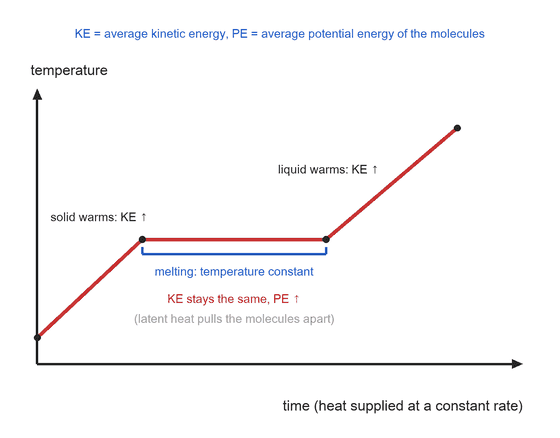
Concept: Temperature measures the average kinetic energy of the molecules. When heat raises the temperature, it increases their average kinetic energy; during a change of phase the temperature is constant, so the heat (latent heat) goes into increasing their potential energy instead, by separating them against their attraction.
(i)
Step 1 — Rise in temperature.
Temperature measures the average kinetic energy of the molecules, so when the temperature rises, the average kinetic energy of the molecules increases.
(ii)
Step 2 — Change of phase at constant temperature.
The temperature does not change, so the average kinetic energy stays the same. The heat pulls the molecules farther apart against their attraction, so their average potential energy increases.
Therefore, (i) the average kinetic energy of the molecules increases, and (ii) their average potential energy increases (kinetic energy unchanged).