
Question 181 markEasy
Same amount of heat is supplied to two liquids A and B. The liquid A shows a greater rise in temperature. What can you say about the heat capacity of A as compared to that of B ?
Confirming your payment
Sign up now and get 250 free tokens.
Calorimetry · Question 18 of 108
Same amount of heat is supplied to two liquids A and B. The liquid A shows a greater rise in temperature. What can you say about the heat capacity of A as compared to that of B ?
Solution:
Concept: The heat capacity C′ of a body is the heat needed to raise the temperature of the whole body by 1 K. It is linked to the specific heat capacity c of its substance by C′ = m × c, and its S.I. unit is J K⁻¹. So C′ = Q ÷ Δt.
Step 1 — Use the same heat for both.
Both liquids get the same heat Q, and heat capacity is C′ = Q ÷ Δt, so the liquid with the greater rise Δt has the smaller heat capacity.
Step 2 — Apply it to A.
Liquid A shows the greater rise in temperature, so its heat capacity is the smaller one.
Step 3 — Check with numbers.
For example, if 1000 J warms A by 10 °C and B by 5 °C, then the heat capacity of A is 100 J K⁻¹ and that of B is 200 J K⁻¹.
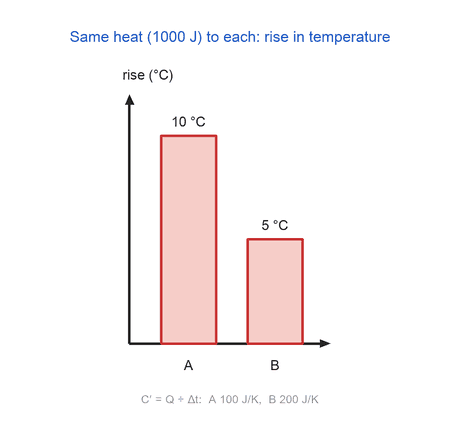
Watch out: A bigger rise in temperature for the same heat means a SMALLER heat capacity, not a bigger one.
Therefore, the heat capacity of A is less than that of B.