Solution:
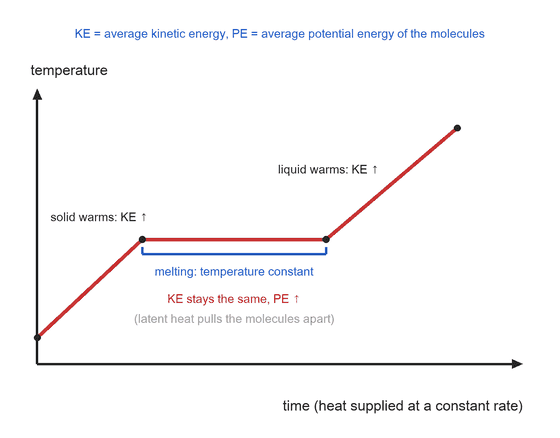
Concept: During a change of phase (melting, freezing, boiling, condensation) the temperature stays constant. The heat taken in or given out then is the latent heat, Q = m × L, where L is the specific latent heat. For ice, L = 336 J g⁻¹ (336000 J kg⁻¹, or 80 cal g⁻¹). Temperature measures the average kinetic energy of the molecules. When heat raises the temperature, it increases their average kinetic energy; during a change of phase the temperature is constant, so the heat (latent heat) goes into increasing their potential energy instead, by separating them against their attraction.
(a)
Step 1 — Name the process.
The change from solid to liquid on heating is called melting (fusion).
(b)
Step 2 — Name the heat.
The heat absorbed is the latent heat of fusion; for unit mass it is the specific latent heat of fusion.
(c)
Step 3 — Kinetic energy of the molecules.
The temperature stays constant during melting, so the average kinetic energy of the molecules does not change; the heat only increases their potential energy.
Note: a spelling slip in the printed question (“substnace”) has been corrected to “substance”.
Therefore, (a) the process is melting; (b) the heat is the latent heat of fusion; (c) the average kinetic energy of the molecules does not change.
