
Question 591 markMCQEasy
An increase in pressure results in ........... in melting point of ice :
Confirming your payment
Sign up now and get 250 free tokens.
Calorimetry · Question 59 of 108
An increase in pressure results in ........... in melting point of ice :
(A) increase
(B) no change
(C) decrease
(D) none of the above
Answer: (C) decrease
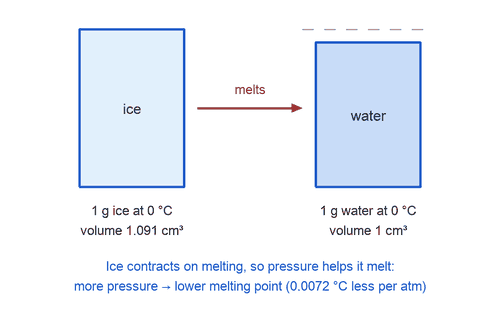
Concept: Ice contracts when it melts (1 g of ice of volume 1.091 cm³ becomes 1 g of water of volume 1 cm³). So an increase in pressure lowers the melting point of ice (by about 0.0072 °C for each extra atmosphere), and a decrease in pressure raises it. An impurity such as salt also lowers the melting point.
Step 1 — See how the volume changes.
Ice contracts when it melts: 1 g of ice (1.091 cm³) becomes 1 g of water of only 1 cm³.
Step 2 — See what pressure does.
Extra pressure favours the smaller volume, so it helps ice to melt. Ice can then melt below 0 °C, so its melting point decreases (by about 0.0072 °C for each extra atmosphere).
Watch out: The rule depends on the substance: wax and most solids expand on melting, and for them pressure RAISES the melting point; ice is the exception.
Why the other options are wrong:
Therefore, an increase in pressure decreases the melting point of ice, option (C).