
Question 601 markMCQEasy
At high altitudes, water boils at a temperature of :
Confirming your payment
Sign up now and get 250 free tokens.
Calorimetry · Question 60 of 108
At high altitudes, water boils at a temperature of :
(A) 100°C
(B) more than 100°C
(C) less than 100°C
(D) 150°C
Answer: (C) less than 100°C
Concept: The boiling point of a liquid increases when the pressure on it increases, and decreases when the pressure decreases. A dissolved impurity (such as salt) also raises the boiling point. Pure water boils at 100 °C at one atmosphere (760 mm of mercury).
Step 1 — Pressure at a height.
At high altitudes, on hills and mountains, the atmospheric pressure is low, less than one atmosphere.
Step 2 — Effect on the boiling point.
A lower pressure lowers the boiling point, so water boils below 100 °C, for example at about 85 °C at a height of about 4500 m.
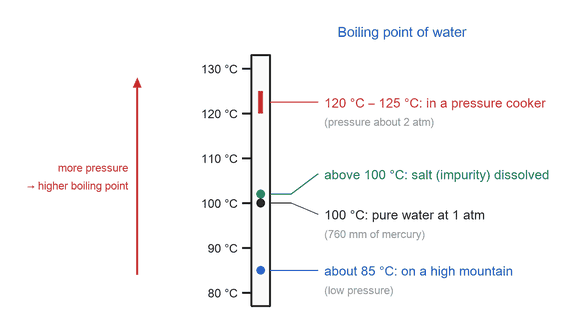
Why the other options are wrong:
Therefore, at high altitudes water boils at a temperature less than 100 °C, option (C).