
Question 611 markMCQEasy
If common salt is added to water, it boils at a temperature of :
Confirming your payment
Sign up now and get 250 free tokens.
Calorimetry · Question 61 of 108
If common salt is added to water, it boils at a temperature of :
(A) 100°C
(B) lower than 100°C
(C) higher than 100°C
(D) cannot say
Answer: (C) higher than 100°C
Concept: The boiling point of a liquid increases when the pressure on it increases, and decreases when the pressure decreases. A dissolved impurity (such as salt) also raises the boiling point. Pure water boils at 100 °C at one atmosphere (760 mm of mercury).
Step 1 — Identify the impurity.
Common salt dissolved in water is an impurity in it.
Step 2 — Effect on the boiling point.
A dissolved impurity raises the boiling point, so the salt solution boils above 100 °C. This is why salt added while cooking helps vegetables and pulses cook at a higher temperature.
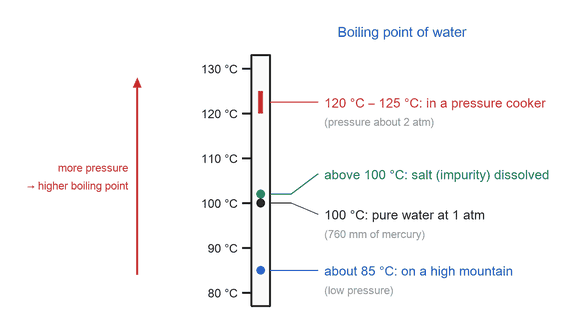
Why the other options are wrong:
Therefore, salt water boils at a temperature higher than 100 °C, option (C).