
Question 914 marksEasy
Explain the terms boiling and boiling point. How is the volume of water affected when it boils at 100°C ?
Confirming your payment
Sign up now and get 250 free tokens.
Calorimetry · Question 91 of 108
Explain the terms boiling and boiling point. How is the volume of water affected when it boils at 100°C ?
Solution:
Concept: Boiling is a change of phase from liquid to vapour at a fixed temperature, and it takes place throughout the liquid. The boiling point of a liquid increases when the pressure on it increases, and decreases when the pressure decreases. A dissolved impurity (such as salt) also raises the boiling point. Pure water boils at 100 °C at one atmosphere (760 mm of mercury).
Step 1 — Boiling.
Boiling is the change of a liquid into its vapour, throughout the whole liquid, at a fixed temperature, when heat is supplied. Bubbles of vapour form inside the liquid, rise and escape.
Step 2 — Boiling point.
The boiling point is the constant temperature at which a liquid boils at a given pressure. For pure water at normal atmospheric pressure it is 100 °C.
Step 3 — Change in volume.
When water boils at 100 °C, its volume increases enormously: 1 g of water (about 1 cm³) becomes about 1670 cm³ of steam at 100 °C and one atmosphere.
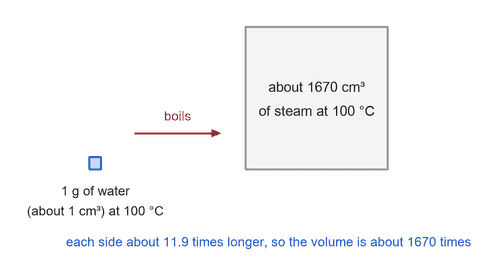
Note: the textbook quotes 1760 cm³ of steam for 1 cm³ of water; the measured value is about 1670 cm³ for 1 g of water.
Therefore, boiling is the change of a liquid into vapour at a fixed temperature (the boiling point, 100 °C for water at 1 atm), and on boiling the volume of water increases about 1670 times.