Solution:
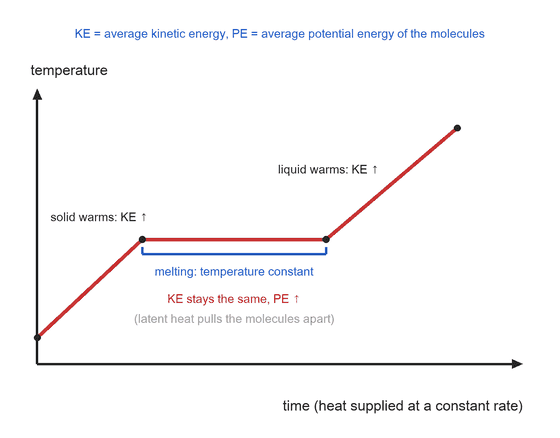
Concept: During a change of phase (melting, freezing, boiling, condensation) the temperature stays constant. The heat taken in or given out then is the latent heat, Q = m × L, where L is the specific latent heat. For ice, L = 336 J g⁻¹ (336000 J kg⁻¹, or 80 cal g⁻¹). Temperature measures the average kinetic energy of the molecules. When heat raises the temperature, it increases their average kinetic energy; during a change of phase the temperature is constant, so the heat (latent heat) goes into increasing their potential energy instead, by separating them against their attraction.
(a)
Step 1 — Water gives out latent heat.
When the water in the lake freezes, every gram of water at 0 °C gives out 336 J of latent heat of fusion to the surroundings.

Step 2 — The surroundings warm.
A lake holds a huge mass of water, so this is a very large amount of heat. It warms the air around the lake, so the surroundings become pleasantly warm.
(b)
Step 3 — Where the heat goes.
During a change of state, the heat supplied (the latent heat) is used only to increase the potential energy of the molecules, separating them against their mutual attraction.
Step 4 — Why the temperature stays constant.
The average kinetic energy of the molecules does not increase, and temperature is a measure of the average kinetic energy. So the temperature stays constant until the change of state is complete.
Therefore, (a) freezing water gives out latent heat that warms the surroundings, and (b) the heat supplied during a change of state only increases the potential energy of the molecules, not their kinetic energy, so the temperature does not rise.
