
Question 731 markEasy
What is the effect of increase in pressure on the boiling point of a liquid ?
Confirming your payment
Sign up now and get 250 free tokens.
Calorimetry · Question 73 of 108
What is the effect of increase in pressure on the boiling point of a liquid ?
Solution:
Concept: The boiling point of a liquid increases when the pressure on it increases, and decreases when the pressure decreases. A dissolved impurity (such as salt) also raises the boiling point. Pure water boils at 100 °C at one atmosphere (760 mm of mercury). A liquid boils when its vapour can push back against the pressure above it, so a higher pressure needs a higher temperature.
Step 1 — State the effect.
An increase in pressure increases the boiling point of a liquid. For water near 100 °C, the boiling point rises by about 1 °C for each increase of about 27 mm of mercury in pressure.
Step 2 — Give examples.
Water boils at about 120–125 °C in a pressure cooker, where the pressure is about 2 atmospheres, but below 100 °C on a mountain, where the pressure is low.
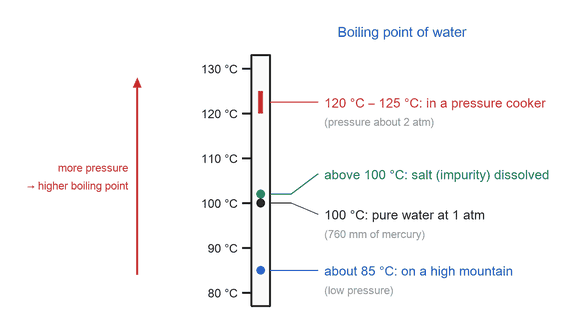
Therefore, an increase in pressure increases the boiling point of a liquid.