
Opening your dashboard
Class 10 Physics Chapter 11 Calorimetry: Previous Year Questions
67 questions on Chapter 11, each solved step by step. Class 10 Physics, ICSE 2026-27.
67 questions with solutions
1–4 marks · Mixed difficulty
- 12 marks
Question 1
Calculate the mass of ice required to lower the temperature of 300 g of water at 40°C to water at 0°C. (Specific latent heat of ice = 336 , Specific heat capacity of water = 4.2 )
Solve with AIWritten solution
Solution:
Concept: Principle of method of mixtures (principle of calorimetry): when a hot body and a cold body are mixed and no heat is lost to the surroundings, heat flows from the hot body to the cold body until both reach the same final temperature, and heat lost by the hot body = heat gained by the cold body. During a change of phase (melting, freezing, boiling, condensation) the temperature stays constant. The heat taken in or given out then is the latent heat, Q = m × L, where L is the specific latent heat. For ice, L = 336 J g⁻¹ (336000 J kg⁻¹, or 80 cal g⁻¹).
Given: Water 300 g at 40 °C, cooled to 0 °C; L = 336 J g⁻¹; c(water) = 4.2 J g⁻¹ °C⁻¹.
Step 1 — Decide what each body does.
The water cools from 40 °C to 0 °C and gives out heat. The final temperature is 0 °C, so the ice (taken at 0 °C) only melts: the water formed from it does not warm up at all.
Step 2 — Heat lost by the water.
We use Q = m × c × Δt; the water falls from 40 °C to 0 °C, a fall of 40 °C.
Step 3 — Heat gained by the ice.
Let the mass of ice be m grams. It only melts, so it takes the latent heat.
Step 4 — Equate heat lost and heat gained.
No heat is lost to the surroundings, so the two amounts are equal.
Step 5 — Solve for m.
We divide both sides by 336.
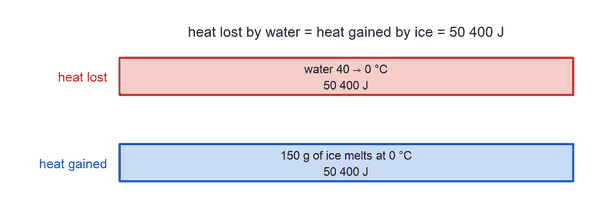
Watch out: Since the final temperature is 0 °C, do not add a term for the melted ice warming up.
Therefore, the mass of ice required is 150 g.
- 22 marks
Question 2
What do you understand by the following statements :
(i) The heat capacity of the body is 60 .
(ii) The specific heat capacity of lead is 130
Solve with AIWritten solution
Solution:
Concept: The heat capacity C′ of a body is the heat needed to raise the temperature of the whole body by 1 K. It is linked to the specific heat capacity c of its substance by C′ = m × c, and its S.I. unit is J K⁻¹. The specific heat capacity c of a substance is the heat needed to raise the temperature of unit mass (1 kg) of it by 1 K (or 1 °C). Its S.I. unit is J kg⁻¹ K⁻¹; for water it is about 4200 J kg⁻¹ K⁻¹, which is the same as 4.2 J g⁻¹ K⁻¹.
(i)
Step 1 — Read the heat capacity.
A heat capacity of 60 J K⁻¹ is for the whole body. It means the body needs 60 J of heat to raise its temperature by 1 K (that is, by 1 °C), and it gives out 60 J when it cools by 1 K.
(ii)
Step 2 — Read the specific heat capacity.
A specific heat capacity of 130 J kg⁻¹ K⁻¹ is for unit mass of the substance. It means 1 kg of lead needs 130 J of heat to raise its temperature by 1 K (1 °C).
Step 3 — Compare with water.
This is a small value: 1 kg of water needs about 4200 J for the same rise, so lead warms up much more for the same heat.
Watch out: Heat capacity is for the WHOLE body (J K⁻¹); specific heat capacity is for 1 kg of the substance (J kg⁻¹ K⁻¹).
Therefore, (i) the body needs 60 J of heat to raise its temperature by 1 K; (ii) 1 kg of lead needs 130 J of heat to raise its temperature by 1 K.
- 32 marks
Question 3
State two factors upon which the heat absorbed by a body depends.
Solve with AIWritten solution
Solution:
Concept: The heat taken in (or given out) by a body of mass m, made of a substance of specific heat capacity c, when its temperature rises (or falls) by Δt is Q = m × c × Δt.
Step 1 — Look at the formula.
The heat absorbed is the product of three quantities, so it grows with each of them.
Step 2 — First factor: the mass.
Q is directly proportional to the mass m: twice the mass needs twice the heat for the same rise in temperature.
Step 3 — Second factor: the rise in temperature.
Q is directly proportional to the rise in temperature Δt: a rise of 20 °C needs twice the heat of a rise of 10 °C.
Step 4 — A third factor.
Q also depends on the material of the body, through its specific heat capacity c: the same mass of water needs far more heat than copper for the same rise.
Therefore, the heat absorbed by a body depends on its mass and on the rise in its temperature (and also on its material, that is, its specific heat capacity).
- 43 marks
Question 4
(i) What is the principle of method of mixtures?
(ii) What is the other name given to it?
(iii) Name the law on which the principle is based.
Solve with AIWritten solution
Solution:
Concept: When bodies at different temperatures are in contact, heat flows from the hotter body to the colder one until they reach the same temperature.
(i)
Step 1 — State the principle.
When a hot body is mixed with (or kept in contact with) a cold body, heat flows from the hot body to the cold body until both reach the same final temperature. If no heat is lost to the surroundings, the heat energy lost by the hot body is equal to the heat energy gained by the cold body.

(ii)
Step 2 — Give its other name.
It is also called the principle of calorimetry.
(iii)
Step 3 — Name the law.
It is based on the law of conservation of energy: energy can neither be created nor destroyed, so all the heat that leaves the hot body must appear in the cold body.
Watch out: The equality holds only when no heat is lost to the surroundings.
Therefore, (i) heat lost by the hot body = heat gained by the cold body (no heat lost to the surroundings); (ii) it is the principle of calorimetry; (iii) it is based on the law of conservation of energy.
- 53 marks
Question 5
Some ice is heated at a constant rate, and its temperature is recorded after every few seconds, till steam is formed at 100°C. Draw a temperature time graph to represent the change. Label the two phase changes in your graph.
Solve with AIWritten solution
Solution:
Concept: During a change of phase (melting, freezing, boiling, condensation) the temperature stays constant. The heat taken in or given out then is the latent heat, Q = m × L, where L is the specific latent heat. For ice, L = 336 J g⁻¹ (336000 J kg⁻¹, or 80 cal g⁻¹). At a constant rate of heating, the temperature rises while one phase warms up, and stays constant during each change of phase.
Step 1 — Ice warms.
If the ice starts below 0 °C, its temperature first rises to 0 °C, so the graph slopes upwards.
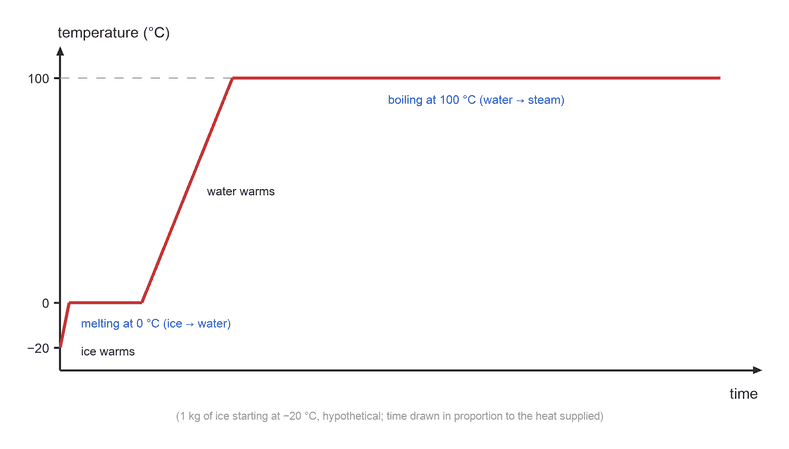
Step 2 — First phase change: melting at 0 °C.
The temperature stays at 0 °C while the ice changes into water, so the graph is flat. The heat taken in is the latent heat of fusion (336 J for each gram).
Step 3 — Water warms.
Once all the ice has melted, the temperature of the water rises steadily from 0 °C to 100 °C.
Step 4 — Second phase change: boiling at 100 °C.
The temperature stays at 100 °C while the water changes into steam, so the graph is flat again. The heat taken in is the latent heat of vaporisation (about 2260 J for each gram).
Step 5 — Compare the lengths.
At a constant rate of heating, time is proportional to heat. Boiling needs about 2260 J g⁻¹, far more than melting (336 J g⁻¹) or warming the water through 100 °C (420 J g⁻¹), so the flat part at 100 °C is the longest. The ice part is steeper than the water part, because ice has about half the specific heat capacity of water (2100 against 4200 J kg⁻¹ K⁻¹).
Watch out: The two flat parts must be labelled as the phase changes (melting at 0 °C, boiling at 100 °C); a sloping line straight from 0 °C to 100 °C misses them.
Therefore, the graph rises to 0 °C, stays flat at 0 °C (melting), rises to 100 °C, and stays flat at 100 °C (boiling); the two flat parts are the two phase changes.
- 64 marks
Question 6
A copper vessel of mass 100 g contains 150 g of water at 50 °C. How much ice is needed to cool it to 5 °C?
Given : Specific heat capacity of copper = 0.4
Specific heat capacity of water = 4.2
Specific latent heat of fusion of ice = 336
Solve with AIWritten solution
Solution:
Concept: Principle of method of mixtures (principle of calorimetry): when a hot body and a cold body are mixed and no heat is lost to the surroundings, heat flows from the hot body to the cold body until both reach the same final temperature, and heat lost by the hot body = heat gained by the cold body. Ice at 0 °C takes in heat in two stages. First it melts at 0 °C, with no change in temperature, taking Q = m × L. Then the water formed from it warms from 0 °C to the final temperature, taking Q = m × c × Δt.
Given: Copper vessel 100 g, c = 0.4 J g⁻¹ °C⁻¹; water 150 g at 50 °C; final temperature 5 °C; c(water) = 4.2 J g⁻¹ °C⁻¹; L = 336 J g⁻¹.
Step 1 — Decide what each body does.
The copper vessel and the water both cool from 50 °C to 5 °C (a fall of 45 °C). The ice is taken at 0 °C, since no other temperature is given: it melts and then warms from 0 °C to 5 °C.
Step 2 — Heat lost by the copper vessel.
We use Q = m × c × Δt for the vessel.
Step 3 — Heat lost by the water.
We use the same formula for the water.
Step 4 — Total heat lost.
We add the two amounts.
Step 5 — Heat gained by the ice.
Let the mass of ice be m grams. It takes latent heat to melt, and then the melted ice warms by 5 °C.
Step 6 — Equate heat gained and heat lost.
No heat is lost to the surroundings, so the two are equal.
Step 7 — Solve for m.
We divide both sides by 357.
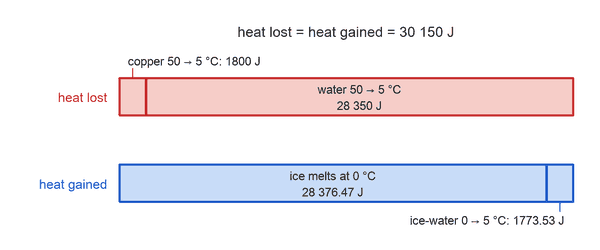
Watch out: The melted ice must also be warmed from 0 °C to 5 °C; leaving out the 21m term gives 89.7 g.
Therefore, about 84.45 g of ice is needed.
- 72 marks
Question 7
Define heat capacity and state its S.I. unit.
Solve with AIWritten solution
Solution:
Concept: The heat capacity C′ of a body is the heat needed to raise the temperature of the whole body by 1 K. It is linked to the specific heat capacity c of its substance by C′ = m × c, and its S.I. unit is J K⁻¹.
Step 1 — Define heat capacity.
The heat capacity (thermal capacity) of a body is the amount of heat energy needed to raise the temperature of the whole body by 1 °C (or 1 K). If a heat Q raises its temperature by Δt, then:
Step 2 — State its S.I. unit.
Heat is in joule and the rise in temperature in kelvin, so the S.I. unit is the joule per kelvin (J K⁻¹). J °C⁻¹ is also used, since a rise of 1 °C equals a rise of 1 K.
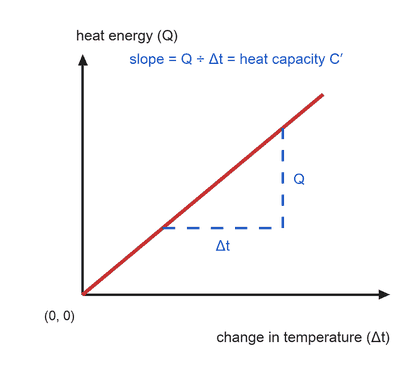
Step 3 — Read the graph.
On a graph of heat supplied against rise in temperature, the slope Q ÷ Δt is the heat capacity. A body with a large heat capacity warms up slowly and also cools slowly.
Watch out: Do not give J kg⁻¹ K⁻¹; that is the unit of SPECIFIC heat capacity.
Therefore, heat capacity is the heat needed to raise the temperature of a body by 1 K (or 1 °C), and its S.I. unit is J K⁻¹.
- 82 marks
Question 8
Why is the base of a cooking pan generally made thick?
Solve with AIWritten solution
Solution:
Concept: The heat capacity of a body is C′ = m × c, so for the same material a heavier (thicker) part has a larger heat capacity.
Step 1 — Effect of a thick base.
A thick base has a large mass, so its heat capacity is large.
Step 2 — It gives heat steadily.
A body of large heat capacity warms up slowly and passes heat on at a slow, steady rate. So the food is heated evenly, and it is less likely to burn or stick at hot spots.
Step 3 — It keeps the food warm.
The thick base stores a large amount of heat, so it stays hot for a long time and keeps the food warm even after the flame is turned off.
Therefore, the base is made thick to give it a large heat capacity, so that it heats the food slowly and evenly and keeps it warm for a long time.
- 92 marks
Question 9
A solid of mass 50 g at 150°C is placed in 100 g of water at 11°C, when the final temperature recorded is 20°C. Find the specific heat capacity of the solid. (Specific heat capacity of water = 4.2 J/g°C).
Solve with AIWritten solution
Solution:
Concept: Principle of method of mixtures (principle of calorimetry): when a hot body and a cold body are mixed and no heat is lost to the surroundings, heat flows from the hot body to the cold body until both reach the same final temperature, and heat lost by the hot body = heat gained by the cold body. The heat taken in (or given out) by a body of mass m, made of a substance of specific heat capacity c, when its temperature rises (or falls) by Δt is Q = m × c × Δt.
Given: Solid 50 g at 150 °C; water 100 g at 11 °C; final temperature 20 °C; c(water) = 4.2 J g⁻¹ °C⁻¹.
Step 1 — Decide what each body does.
The solid cools from 150 °C to 20 °C (a fall of 130 °C), and the water warms from 11 °C to 20 °C (a rise of 9 °C).
Step 2 — Heat gained by the water.
We use Q = m × c × Δt for the water.
Step 3 — Heat lost by the solid.
Let the specific heat capacity of the solid be c (in J g⁻¹ °C⁻¹).
Step 4 — Equate heat lost and heat gained.
No heat is lost to the surroundings, so the two are equal.
Step 5 — Solve for c.
We divide both sides by 6500.
In S.I. units this is about 581.5 J kg⁻¹ °C⁻¹.
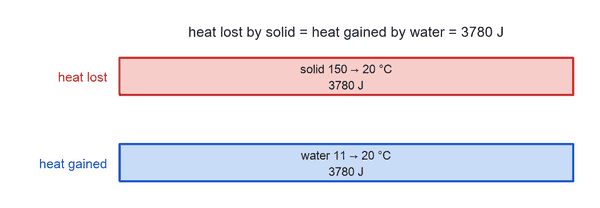
Watch out: The fall for the solid is 150 − 20 = 130 °C, and the rise for the water is 20 − 11 = 9 °C; do not mix them up.
Therefore, the specific heat capacity of the solid is about 0.58 J g⁻¹ °C⁻¹ (about 581.5 J kg⁻¹ °C⁻¹).
- 103 marks
Question 10
(i) How is the transference of heat energy by radiation prevented in a calorimeter?
(ii) You have a choice of three metals A, B and C, of specific heat capacities 900 , 380 and 460 respectively, to make a calorimeter. Which material will you select? Justify your answer.
Solve with AIWritten solution
Solution:
Concept: A calorimeter is a vessel in which hot and cold bodies are mixed to measure heat by the principle of mixtures. It should take as little of the heat as possible for itself, and lose as little as possible to the surroundings, so it is made of a thin sheet of a metal of low specific heat capacity (usually copper) and kept in an insulated jacket.
(i)
Step 1 — Stop radiation.
The inner and outer surfaces of the calorimeter are highly polished. A shiny surface is a poor radiator (and a poor absorber) of heat, so very little heat is lost by radiation.

Step 2 — The other losses.
In the same set-up, the wool or cotton packing cuts the loss by conduction, and the wooden lid cuts the loss by convection.
(ii)
Step 3 — Compare the metals.
A calorimeter should have a low heat capacity, so that it takes very little heat from its contents. For the same mass, the metal with the lowest specific heat capacity gives the lowest heat capacity. B has 380 J kg⁻¹ °C⁻¹, less than C (460) and A (900).
Step 4 — Choose.
So metal B is the best choice: the calorimeter made of it takes only a negligible amount of heat, and the heat measured belongs almost entirely to the substances being mixed.
Watch out: Choose the LOWEST specific heat capacity for a calorimeter; a high value would let the vessel soak up the heat being measured.
Therefore, (i) radiation is prevented by polishing the inner and outer surfaces; (ii) metal B is chosen, because it has the lowest specific heat capacity (380 J kg⁻¹ °C⁻¹).
- 113 marks
Question 11
Calculate the mass of ice needed to cool 150 g of water contained in a calorimeter of mass 50 g at 32°C such that the final temperature is 5°C.
Specific heat capacity of calorimeter = 0.4
Specific heat capacity of water = 4.2
Latent heat capacity of ice = 330
Solve with AIWritten solution
Solution:
Concept: Principle of method of mixtures (principle of calorimetry): when a hot body and a cold body are mixed and no heat is lost to the surroundings, heat flows from the hot body to the cold body until both reach the same final temperature, and heat lost by the hot body = heat gained by the cold body. Ice at 0 °C takes in heat in two stages. First it melts at 0 °C, with no change in temperature, taking Q = m × L. Then the water formed from it warms from 0 °C to the final temperature, taking Q = m × c × Δt.
Given: Calorimeter 50 g, c = 0.4 J g⁻¹ °C⁻¹; water 150 g; both at 32 °C; final temperature 5 °C; c(water) = 4.2 J g⁻¹ °C⁻¹; L = 330 J g⁻¹.
Step 1 — Decide what each body does.
The calorimeter and the water both cool from 32 °C to 5 °C (a fall of 27 °C). The ice is taken at 0 °C: it melts and then warms from 0 °C to 5 °C. The paper's 'latent heat capacity of ice' means its specific latent heat of fusion, here 330 J g⁻¹.
Step 2 — Heat lost by the calorimeter.
We use Q = m × c × Δt for the calorimeter.
Step 3 — Heat lost by the water.
We use the same formula for the water.
Step 4 — Total heat lost.
We add the two amounts.
Step 5 — Heat gained by the ice.
Let the mass of ice be m grams. It melts, and then the melted ice warms by 5 °C.
Step 6 — Equate heat gained and heat lost.
No heat is lost to the surroundings, so the two are equal.
Step 7 — Solve for m.
We divide both sides by 351.
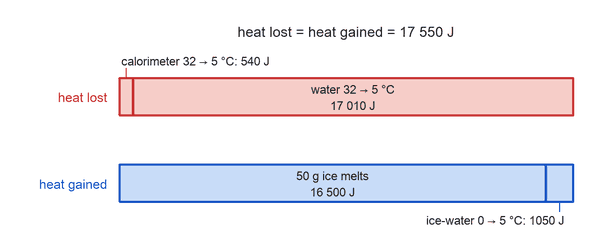
Watch out: Use the value of L given in this question (330 J g⁻¹), not the usual 336 J g⁻¹.
Therefore, the mass of ice needed is 50 g.
- 122 marks
Question 12
(i) How can a temperature in degree Celsius be converted into S.I. unit of temperature?
(ii) A liquid X has the maximum specific heat capacity and is used as a coolant in Car radiators. Name the liquid X.
Solve with AIWritten solution
Solution:
Concept: The S.I. unit of temperature is the kelvin (K). A step of 1 K is the same size as a step of 1 °C; the Kelvin scale only starts lower, at absolute zero (−273 °C).
(i)
Step 1 — Convert °C to kelvin.
To change a temperature in degree Celsius into kelvin, add 273 to it.
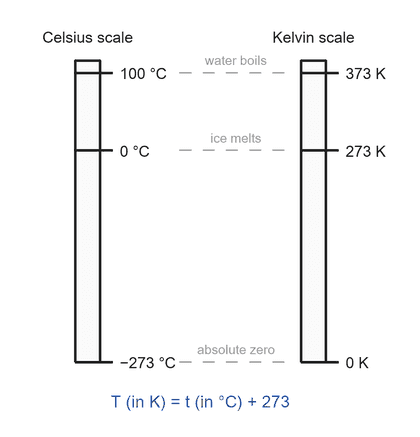
Step 2 — Example.
For example, a room at 27 °C is at the temperature below.
(ii)
Step 3 — Name the liquid.
Liquid X is water. Its specific heat capacity (about 4200 J kg⁻¹ K⁻¹) is the highest of common liquids, so it can take a large amount of heat from the engine with only a small rise in its own temperature.
Watch out: Add 273 to go from °C to K; subtract 273 to go back.
Therefore, (i) add 273 to the temperature in °C to get it in kelvin; (ii) liquid X is water.
- 132 marks
Question 13
A solid metal weighing 150 g melts at its melting point of 800 °C by providing heat at the rate of 100 W. The time taken for it to completely melt at the same temperature is 4 min. What is the specific latent heat of fusion of the metal?
Solve with AIWritten solution
Solution:
Concept: While a solid melts at its melting point its temperature stays constant, so all the heat supplied goes in as latent heat, Q = m × L; and a heater of power P supplies heat Q = P × t in time t.
Given: m = 150 g; melting point 800 °C; power 100 W; time to melt 4 min.
Step 1 — Change to S.I. units.
The mass and the time must be in kilograms and seconds.
Step 2 — Heat supplied.
A power of 100 W means 100 J of heat every second.
Step 3 — Specific latent heat.
All this heat melts the metal at 800 °C, so we divide it by the mass.

Step 4 — Read the result.
So each kilogram of this metal at 800 °C needs 160000 J (160 J g⁻¹) to change completely into liquid at 800 °C.
Watch out: Change 4 min into 240 s before multiplying by the power in watt (J s⁻¹).
Therefore, the specific latent heat of fusion of the metal is 160000 J kg⁻¹ (160 J g⁻¹).
- 143 marks
Question 14
(i) Heat supplied to a solid change it into liquid. What is this change in phase called?
(ii) During the phase change does the average kinetic energy of the molecules of the substance increase?
(iii) What is the energy absorbed during the phase change called?
Solve with AIWritten solution
Solution:
Concept: Temperature measures the average kinetic energy of the molecules. When heat raises the temperature, it increases their average kinetic energy; during a change of phase the temperature is constant, so the heat (latent heat) goes into increasing their potential energy instead, by separating them against their attraction.
(i)
Step 1 — Name the change.
The change of a solid into a liquid on heating is called melting (fusion).
(ii)
Step 2 — Look at the temperature.
Melting takes place at a constant temperature (the melting point). Temperature measures the average kinetic energy of the molecules, so this does not increase.
Step 3 — Where the heat goes.
The heat supplied increases the potential energy of the molecules instead, by moving them farther apart against their attraction.
(iii)
Step 4 — Name the energy.
The energy absorbed during the change of phase is called the latent heat, here the latent heat of fusion. 'Latent' means hidden: it does not show up as a rise in temperature.
Watch out: During a change of phase the heat goes into potential energy, not kinetic energy.
Therefore, (i) the change is melting (fusion); (ii) no, the average kinetic energy does not increase; (iii) the energy absorbed is the latent heat (of fusion).
- 153 marks
Question 15
(i) State two differences between "Heat Capacity" and "Specific Heat Capacity".
(ii) Give a mathematical relation between Heat Capacity and Specific Heat Capacity.
Solve with AIWritten solution
Solution:
Concept: Heat capacity belongs to a particular body; specific heat capacity belongs to the substance it is made of.
(i)
Step 1 — Compare the two quantities.
The table gives three differences; any two answer the question.
Heat capacity Specific heat capacity Heat needed to raise the temperature of the whole body by 1 K Heat needed to raise the temperature of unit mass (1 kg) of the substance by 1 K Depends on the mass (and material) of the body Does not depend on the mass; it is a property of the substance S.I. unit J K⁻¹ S.I. unit J kg⁻¹ K⁻¹ (ii)
Step 2 — Link them.
A body of mass m needs m times the heat needed by 1 kg, so its heat capacity is its mass times its specific heat capacity.
Step 3 — Example.
For example, 2 kg of water (c = 4200 J kg⁻¹ K⁻¹) has the heat capacity below.
Therefore, (i) heat capacity is for the whole body, depends on its mass and is in J K⁻¹, while specific heat capacity is for 1 kg, does not depend on mass and is in J kg⁻¹ K⁻¹; (ii) C′ = m × c.
- 164 marks
Question 16
The temperature of 170 g of water at 50°C is lowered to 5°C by adding a certain amount of ice to it. Find the mass of ice added.
Given: Specific heat capacity of water = 4200 and Specific latent heat of ice = 336000
Solve with AIWritten solution
Solution:
Concept: Principle of method of mixtures (principle of calorimetry): when a hot body and a cold body are mixed and no heat is lost to the surroundings, heat flows from the hot body to the cold body until both reach the same final temperature, and heat lost by the hot body = heat gained by the cold body. Ice at 0 °C takes in heat in two stages. First it melts at 0 °C, with no change in temperature, taking Q = m × L. Then the water formed from it warms from 0 °C to the final temperature, taking Q = m × c × Δt.
Given: Water 170 g at 50 °C, cooled to 5 °C; c(water) = 4200 J kg⁻¹ °C⁻¹; L = 336000 J kg⁻¹.
Step 1 — Decide what each body does.
The water cools from 50 °C to 5 °C (a fall of 45 °C). The ice is taken at 0 °C: it melts and then warms from 0 °C to 5 °C. The data are per kilogram, so we work in kilograms: 170 g = 0.17 kg.
Step 2 — Heat lost by the water.
We use Q = m × c × Δt for the water.
Step 3 — Heat gained by the ice.
Let the mass of ice be m kilograms. It melts, and then the melted ice warms by 5 °C.
Step 4 — Equate heat gained and heat lost.
No heat is lost to the surroundings, so the two are equal.
Step 5 — Solve for m.
We divide both sides by 357000.
That is 90 g.
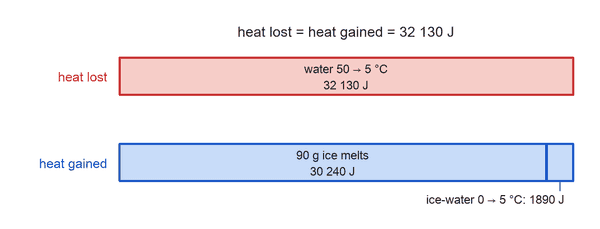
Watch out: Keep all masses in kg when c and L are given per kg; 170 g must be written as 0.17 kg.
Therefore, the mass of ice added is 0.09 kg (90 g).
- 172 marks
Question 17
(i) Name the physical quantity which is measured in calories.
(ii) How is calorie related to the S.I. unit of that quantity?
Solve with AIWritten solution
Solution:
Concept: Heat is a form of energy, so its S.I. unit is the joule. The calorie is an older unit of heat: one calorie is the heat needed to raise the temperature of 1 g of water by 1 °C (from 14.5 °C to 15.5 °C).
(i)
Step 1 — Name the quantity.
The physical quantity measured in calories is heat (heat energy).
(ii)
Step 2 — Relate the units.
The S.I. unit of heat is the joule, and one calorie is a little more than 4 J.
This is usually rounded to 1 cal ≈ 4.2 J, so 1 kilocalorie (1000 cal) is 4186 J.
Therefore, (i) heat is measured in calories; (ii) 1 calorie = 4.186 J (about 4.2 J).
- 182 marks
Question 18
The specific heat capacity of a substance A is 3,800 and that of a substance B is 400 . Which of the two substances is a good conductor of heat? Give a reason for your answer.
Solve with AIWritten solution
Solution:
Concept: For the same mass and the same heat, the rise in temperature is Δt = Q ÷ (m × c), so a substance with a low specific heat capacity shows a large rise in temperature. Metals, which are good conductors of heat, have low specific heat capacities.
Step 1 — Compare the two values.
B's specific heat capacity (400 J kg⁻¹ K⁻¹) is much lower than A's (3800 J kg⁻¹ K⁻¹).
Step 2 — Compare the rises in temperature.
Give 1 kg of each 3800 J (a hypothetical example). A rises by 1 K, while B rises by the amount below.

Step 3 — Decide.
B warms up quickly for little heat and passes it on readily, as metals do, so B is the good conductor of heat.
Note: Strictly, conduction is a separate property (thermal conductivity) from specific heat capacity; the expected answer links a low specific heat capacity with metals, which are good conductors.
Therefore, substance B is the good conductor of heat, because its specific heat capacity is low, so it warms up quickly and passes on heat readily.
- 192 marks
Question 19
(i) State whether the specific heat capacity of a substance remains the same when its state changes from solid to liquid.
(ii) Give one example to support your answer.
Solve with AIWritten solution
Solution:
Concept: Specific heat capacity is a property of a substance in a particular phase: the same substance has different values as a solid, a liquid and a gas.
(i)
Step 1 — Answer the question.
No. The specific heat capacity of a substance changes when its state changes from solid to liquid.
(ii)
Step 2 — Give an example.
Ice (solid water) has a specific heat capacity of about 2100 J kg⁻¹ K⁻¹, while water (liquid) has about 4200 J kg⁻¹ K⁻¹, twice as much.
Step 3 — Read the example.
So 1 kg of ice warms by 1 K with 2100 J, but 1 kg of water needs 4200 J for the same rise.
Therefore, (i) no, it changes; (ii) for example, ice has 2100 J kg⁻¹ K⁻¹ but water has 4200 J kg⁻¹ K⁻¹.
- 203 marks
Question 20
(i) Define Calorimetry.
(ii) Name the material used for making a Calorimeter.
(iii) Why is a Calorimeter made-up of thin sheets of the above material answered in (ii) ?
Solve with AIWritten solution
Solution:
Concept: A calorimeter is a vessel in which hot and cold bodies are mixed to measure heat by the principle of mixtures. It should take as little of the heat as possible for itself, and lose as little as possible to the surroundings, so it is made of a thin sheet of a metal of low specific heat capacity (usually copper) and kept in an insulated jacket.
(i)
Step 1 — Define calorimetry.
Calorimetry is the measurement of the quantity of heat: the heat gained or lost by a body when it is mixed with another body at a different temperature, using heat lost = heat gained.
(ii)
Step 2 — Name the material.
A calorimeter is usually made of copper.
(iii)
Step 3 — Why thin sheets.
A thin sheet keeps the mass of the calorimeter small. Its heat capacity C′ = m × c is then low (copper's specific heat capacity is also low), so the calorimeter takes only a negligible amount of heat from its contents.
Step 4 — A second advantage.
Copper is a good conductor, so a thin copper vessel quickly reaches the temperature of its contents.
Therefore, (i) calorimetry is the measurement of heat; (ii) copper; (iii) thin sheets keep its mass, and so its heat capacity, low, so it takes very little heat from its contents.
- 213 marks
Question 21
The melting point of naphthalene is 80°C and the room temperature is 30°C. A sample of liquid naphthalene at 100°C is cooled down to the room temperature. Draw a temperature time graph to represent this cooling. In the graph, mark the region which corresponds to the freezing process.
Solve with AIWritten solution
Solution:
Concept: A liquid cools until it reaches its freezing point, which equals its melting point (80 °C for naphthalene). The temperature then stays constant while it freezes, because the latent heat given out makes up for the heat lost to the room. After it has all frozen, the solid cools to room temperature.
Step 1 — Liquid cools.
The liquid naphthalene cools from 100 °C to 80 °C, so the graph falls.
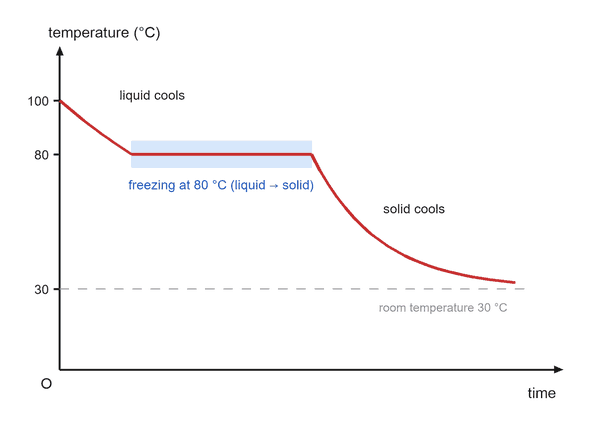
Step 2 — Freezing (the marked region).
At 80 °C the liquid changes into solid at a constant temperature, giving out its latent heat of fusion. This flat part of the graph is the freezing process.
Step 3 — Solid cools.
The solid then cools from 80 °C, quickly at first and then more slowly, and levels off at the room temperature of 30 °C.
Watch out: The graph never goes below the room temperature, 30 °C; a body cannot cool below its surroundings.
Therefore, the graph falls from 100 °C to 80 °C, stays flat at 80 °C (the freezing region), and then falls more and more slowly to 30 °C.
- 224 marks
Question 22
104 g of water at 30°C is taken in a calorimeter made of copper of mass 42 g. When a certain mass of ice at 0°C is added to it, the final steady temperature of the mixture after the ice has melted, was found to be 10°C. Find the mass of ice added. [Specific heat capacity of water = 4.2 ; Specific latent heat of fusion of ice = 336 ; Specific heat capacity of copper = 0.4 ]
Solve with AIWritten solution
Solution:
Concept: Principle of method of mixtures (principle of calorimetry): when a hot body and a cold body are mixed and no heat is lost to the surroundings, heat flows from the hot body to the cold body until both reach the same final temperature, and heat lost by the hot body = heat gained by the cold body. Ice at 0 °C takes in heat in two stages. First it melts at 0 °C, with no change in temperature, taking Q = m × L. Then the water formed from it warms from 0 °C to the final temperature, taking Q = m × c × Δt.
Given: Water 104 g at 30 °C in a copper calorimeter of 42 g; ice at 0 °C; final temperature 10 °C; c(water) = 4.2 J g⁻¹ °C⁻¹; L = 336 J g⁻¹; c(copper) = 0.4 J g⁻¹ °C⁻¹.
Step 1 — Decide what each body does.
The water and the copper calorimeter both cool from 30 °C to 10 °C (a fall of 20 °C). The ice at 0 °C melts and then warms from 0 °C to 10 °C.
Step 2 — Heat lost by the water.
We use Q = m × c × Δt for the water.
Step 3 — Heat lost by the calorimeter.
We use the same formula for the copper.
Step 4 — Total heat lost.
We add the two amounts.
Step 5 — Heat gained by the ice.
Let the mass of ice be m grams. It melts, and then the melted ice warms by 10 °C.
Step 6 — Equate heat gained and heat lost.
No heat is lost to the surroundings, so the two are equal.
Step 7 — Solve for m.
We divide both sides by 378.

Watch out: Include the heat given out by the calorimeter as well as by the water.
Therefore, the mass of ice added is 24 g.
- 232 marks
Question 23
Why does stone lying in the sun get heated up much more than water lying for the same duration of time?
Solve with AIWritten solution
Solution:
Concept: For the same heat received, the rise in temperature is Δt = Q ÷ (m × c). A substance with a low specific heat capacity therefore shows a large rise in temperature.
Step 1 — Compare the specific heat capacities.
Stone has a much lower specific heat capacity (about 800–900 J kg⁻¹ K⁻¹) than water (about 4200 J kg⁻¹ K⁻¹), roughly one-fifth as much.
Step 2 — Compare the rises in temperature.
In the same time, a stone and an equal mass of water receive about the same heat from the sun. The stone needs far less heat for each degree of rise, so its temperature rises much more, while the water warms only a little.
Step 3 — Link to daily life.
The same idea explains why land heats up faster than the sea during the day.
Therefore, stone gets much hotter than water in the same time because its specific heat capacity is much lower than that of water.
- 242 marks
Question 24
Two metallic blocks P and Q having masses in ratio 2 : 1 are supplied with the same amount of heat. If their temperatures rise by same degree, compare their specific heat capacities.
Solve with AIWritten solution
Solution:
Concept: The heat taken in (or given out) by a body of mass m, made of a substance of specific heat capacity c, when its temperature rises (or falls) by Δt is Q = m × c × Δt.
Given: m_P : m_Q = 2 : 1; same heat supplied; same rise in temperature.
Step 1 — Write the heat for each block.
Each block takes the same heat Q for the same rise Δt.
Step 2 — Equate them.
The two heats are equal, and Δt is the same on both sides, so it cancels.
Step 3 — Find the ratio.
We divide both sides by m_P × c_Q and put in m_P : m_Q = 2 : 1.
Step 4 — Read the result.
Block P has twice the mass, so its specific heat capacity is half that of Q; both then have the same heat capacity.
Watch out: The ratio of specific heat capacities is the INVERSE of the mass ratio here, so it is 1 : 2, not 2 : 1.
Therefore, c_P : c_Q = 1 : 2.
- 253 marks
Question 25
(i) Define heat capacity of a substance.
(ii) Write the SI unit of heat capacity.
(iii) What is the relationship between heat capacity and specific heat capacity of a substance?
Solve with AIWritten solution
Solution:
Concept: The heat capacity C′ of a body is the heat needed to raise the temperature of the whole body by 1 K. It is linked to the specific heat capacity c of its substance by C′ = m × c, and its S.I. unit is J K⁻¹.
(i)
Step 1 — Define heat capacity.
The heat capacity of a body is the amount of heat energy needed to raise its temperature by 1 °C (or 1 K). If a heat Q raises its temperature by Δt, then:
(ii)
Step 2 — State the S.I. unit.
The S.I. unit of heat capacity is the joule per kelvin (J K⁻¹).
(iii)
Step 3 — Link to specific heat capacity.
Heat capacity is the mass times the specific heat capacity.
Step 4 — Example.
For example, a 0.5 kg copper vessel (c = 400 J kg⁻¹ K⁻¹) has the heat capacity below.
Therefore, (i) heat capacity is the heat needed to raise the temperature of a body by 1 K; (ii) its S.I. unit is J K⁻¹; (iii) heat capacity = mass × specific heat capacity, C′ = m × c.
- 263 marks
Question 26
The diagram below shows the change of phases of a substance on a temperature vs time graph on heating the substance at a constant rate.

(i) Why is the slope of CD less than slope of AB?
(ii) What is the boiling and melting point of the substance?
Solve with AIWritten solution
Solution:
Concept: At a constant rate of heating the same heat goes in every second. On a sloping part, a gentler slope means the temperature rises more slowly, that is, a higher specific heat capacity. Each flat part is a change of phase at a constant temperature.
(i)
Step 1 — Name the parts.
AB is the solid warming up, BC is melting, CD is the liquid warming up and DE is boiling.
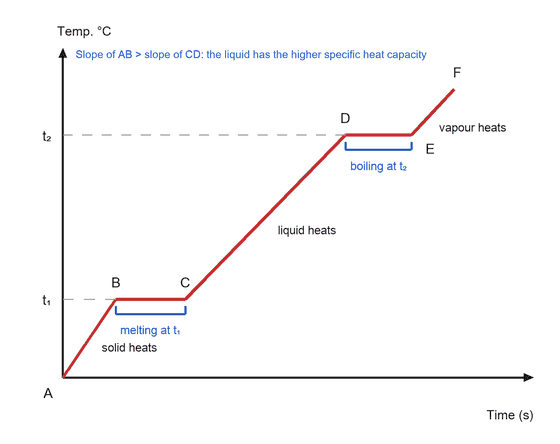
Step 2 — Explain the slopes.
The substance has a higher specific heat capacity as a liquid than as a solid. So the liquid needs more heat for each degree, and with the same heat supplied each second its temperature rises more slowly. Hence the slope of CD is less than that of AB.
(ii)
Step 3 — Read the flat parts.
The melting point is the temperature of the first flat part BC, which is t₁. The boiling point is the temperature of the second flat part DE, which is t₂.
Therefore, (i) the slope of CD is less because the liquid has a higher specific heat capacity than the solid; (ii) the melting point is t₁ (flat part BC) and the boiling point is t₂ (flat part DE).
- 274 marks
Question 27
A piece of ice of mass 60 g is dropped into 140 g of water at 50 °C. Calculate the final temperature of water when all the ice has melted. (Assume no heat is lost to the surrounding).
Specific heat capacity of water (c) = ,
Specific latent heat of fusion of ice (L) =
Solve with AIWritten solution
Solution:
Concept: Principle of method of mixtures (principle of calorimetry): when a hot body and a cold body are mixed and no heat is lost to the surroundings, heat flows from the hot body to the cold body until both reach the same final temperature, and heat lost by the hot body = heat gained by the cold body. Ice at 0 °C takes in heat in two stages. First it melts at 0 °C, with no change in temperature, taking Q = m × L. Then the water formed from it warms from 0 °C to the final temperature, taking Q = m × c × Δt.
Given: Ice 60 g at 0 °C; water 140 g at 50 °C; c = 4.2 J g⁻¹ K⁻¹; L = 336 J g⁻¹.
Step 1 — Decide what each body does.
Let the final temperature be t °C. The water cools from 50 °C to t. The ice, taken at 0 °C, melts and then warms from 0 °C to t.
Step 2 — Heat gained by the ice.
It takes latent heat to melt, and then the melted ice warms by t degrees.
Step 3 — Heat lost by the water.
The water falls by (50 − t) degrees.
Step 4 — Equate heat gained and heat lost.
No heat is lost to the surroundings, so the two are equal.
Step 5 — Collect the t terms.
We add 588t to both sides and take 20160 from both sides.
Step 6 — Solve for t.
We divide both sides by 840.
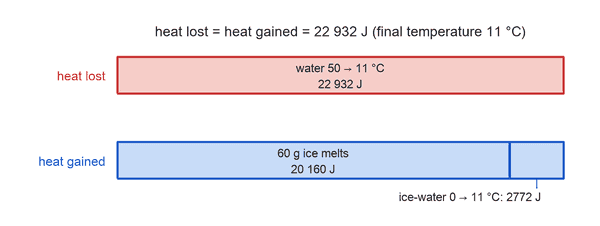
Check: We put t = 11 back into both sides.
Watch out: The melted ice warms from 0 °C to t, so its term is 60 × 4.2 × t, not 60 × 4.2 × 50.
Therefore, the final temperature is 11 °C.
- 281 mark
Question 28
If water absorbs 4000 joule heat to increase the temperature of 1 kg water through 1°C then the specific heat capacity of water is :
Solve with AIAnswer
(A)
(B)
- Correct
(C)
(D)
Answer: (C)
Concept: The specific heat capacity c of a substance is the heat needed to raise the temperature of unit mass (1 kg) of it by 1 K (or 1 °C). Its S.I. unit is J kg⁻¹ K⁻¹; for water it is about 4200 J kg⁻¹ K⁻¹, which is the same as 4.2 J g⁻¹ K⁻¹.
Step 1 — Use the definition.
Specific heat capacity is the heat for unit mass and unit rise in temperature.
Step 2 — Change to per gram.
Since 1 kg = 1000 g, the heat for each gram is one-thousandth of this.
Step 3 — Match the options.
Option (C) gives 4 J g⁻¹ °C⁻¹, the value with its matching unit.
Watch out: Use the data in the question (4000 J), not the usual value of 4.2 J g⁻¹ °C⁻¹ for water.
Why the other options are wrong:
- (A) : 4 J kg⁻¹ °C⁻¹ is 1000 times too small: 1 kg of water needs 4000 J, not 4 J, for a 1 °C rise.
- (B) : 400 J g⁻¹ °C⁻¹ is 100 times too large: 4000 J for 1000 g is 4 J per gram.
- (D) : 4.2 J g⁻¹ °C⁻¹ is the usual value for water, but the data given (4000 J for 1 kg) give 4.
Therefore, the specific heat capacity is 4 J g⁻¹ °C⁻¹, option (C).
- 291 mark
Question 29
Water is used in car radiators because :
Solve with AIAnswer
(A) it is a good conductor of heat.
(B) it conducts heat faster as compared to the other substances and cools the engine quickly.
(C) its specific heat capacity is very low.
- Correct
(D) its specific heat capacity is very high so it can cool the engine without a greater increase in its own temperature.
Answer: (D) its specific heat capacity is very high so it can cool the engine without a greater increase in its own temperature.
Concept: Water has a very high specific heat capacity (4200 J kg⁻¹ K⁻¹). So a given mass of water takes in a large amount of heat for only a small rise in its temperature, and gives out a large amount of heat for only a small fall.
Step 1 — Recall the property of water.
Water has a very high specific heat capacity, about 4200 J kg⁻¹ K⁻¹.
Step 2 — Apply it to the engine.
From Q = m × c × Δt, a given mass of water takes a large amount of heat from the engine for only a small rise in its own temperature. It carries this heat to the radiator and gives it out to the air.
Step 3 — Match the options.
Option (D) states exactly this reason.
Watch out: Water is not chosen because it conducts well; it carries heat away because it stores a lot of heat per degree.
Why the other options are wrong:
- (A) it is a good conductor of heat: water is a poor conductor of heat; it cools the engine by taking in heat as it flows past.
- (B) it conducts heat faster as compared to the other substances and cools the engine quickly: water does not conduct heat faster than other substances; metals conduct heat far better.
- (C) its specific heat capacity is very low: a low specific heat capacity would make the water heat up quickly and soon stop cooling the engine; water's value is high.
Therefore, water is used because its specific heat capacity is very high, option (D).
- 303 marks
Question 30
(a) Give an important reason for copper to be used as a material for a calorimeter.
(b) Calculate the thermal capacity of 40 g of water.
[Specific heat capacity of water = ]
Solve with AIWritten solution
Solution:
Concept: A calorimeter is a vessel in which hot and cold bodies are mixed to measure heat by the principle of mixtures. It should take as little of the heat as possible for itself, and lose as little as possible to the surroundings, so it is made of a thin sheet of a metal of low specific heat capacity (usually copper) and kept in an insulated jacket. The heat capacity C′ of a body is the heat needed to raise the temperature of the whole body by 1 K. It is linked to the specific heat capacity c of its substance by C′ = m × c, and its S.I. unit is J K⁻¹.
Given: m = 40 g; c(water) = 4200 J kg⁻¹ °C⁻¹.
(a)
Step 1 — Reason for copper.
Copper has a low specific heat capacity, so a calorimeter made of thin copper has a low heat capacity and takes only a negligible amount of heat from its contents. (Copper is also a good conductor, so the vessel quickly reaches the temperature of its contents.)
(b)
Step 2 — Change the mass to kilograms.
The specific heat capacity is per kilogram, so the mass must be in kilograms.
Step 3 — Find the thermal capacity.
Thermal capacity is the mass times the specific heat capacity.
Step 4 — Read the result.
So 40 g of water needs 168 J of heat for every 1 °C rise in its temperature.
Watch out: Write 40 g as 0.04 kg; using 40 with 4200 gives an answer 1000 times too large.
Therefore, (a) copper is used because its specific heat capacity is low; (b) the thermal capacity of 40 g of water is 168 J °C⁻¹ (168 J K⁻¹).
- 313 marks
Question 31
(a) Why does it become colder after a hailstorm than during or before the hailstorm?
(b) 'If two bodies have the same specific heat capacities, then they will always absorb the same amount of heat if their temperature increases by the same amount.' State whether the given statement is true or false.
Solve with AIWritten solution
Solution:
Concept: During a change of phase (melting, freezing, boiling, condensation) the temperature stays constant. The heat taken in or given out then is the latent heat, Q = m × L, where L is the specific latent heat. For ice, L = 336 J g⁻¹ (336000 J kg⁻¹, or 80 cal g⁻¹). The heat taken in (or given out) by a body of mass m, made of a substance of specific heat capacity c, when its temperature rises (or falls) by Δt is Q = m × c × Δt.
(a)
Step 1 — What happens after a hailstorm.
After the storm the hailstones (ice) start to melt.
Step 2 — Where the heat comes from.
To melt, each gram of ice takes about 336 J of latent heat from its surroundings, the air and the ground. Losing this heat lowers their temperature, so it feels colder after the hailstorm than during or before it.
(b)
Step 3 — Judge the statement.
The heat absorbed is Q = m × c × Δt. Even with the same c and the same Δt, two bodies of different masses absorb different amounts of heat: a 2 kg block needs twice the heat of a 1 kg block of the same material.
Step 4 — Conclude.
They absorb the same heat only if their masses are also equal, so the word 'always' makes the statement false.
Therefore, (a) it becomes colder because the melting hail takes its latent heat from the surroundings; (b) the statement is false.
- 324 marks
Question 32
A metal piece of mass 420 g present at 80°C is dropped in 80 g of water present at 20°C in a calorimeter of mass 84 g. If the final temperature of the mixture is 30°C, then calculate the specific heat capacity of the metal piece.
[Specific heat capacity of water = , Specific heat capacity of the calorimeter = ]
Solve with AIWritten solution
Solution:
Concept: Principle of method of mixtures (principle of calorimetry): when a hot body and a cold body are mixed and no heat is lost to the surroundings, heat flows from the hot body to the cold body until both reach the same final temperature, and heat lost by the hot body = heat gained by the cold body. The heat taken in (or given out) by a body of mass m, made of a substance of specific heat capacity c, when its temperature rises (or falls) by Δt is Q = m × c × Δt.
Given: Metal 420 g at 80 °C; water 80 g and calorimeter 84 g at 20 °C; final temperature 30 °C; c(water) = 4.2 J g⁻¹ °C⁻¹; c(calorimeter) = 200 J kg⁻¹ °C⁻¹.
Step 1 — Decide what each body does.
The metal cools from 80 °C to 30 °C (a fall of 50 °C). The water and the calorimeter both warm from 20 °C to 30 °C (a rise of 10 °C). The calorimeter's value per gram is 200 J kg⁻¹ °C⁻¹ = 0.2 J g⁻¹ °C⁻¹.
Step 2 — Heat gained by the water.
We use Q = m × c × Δt for the water.
Step 3 — Heat gained by the calorimeter.
We use the same formula for the calorimeter.
Step 4 — Total heat gained.
We add the two amounts.
Step 5 — Heat lost by the metal.
Let the specific heat capacity of the metal be c (in J g⁻¹ °C⁻¹).
Step 6 — Equate heat lost and heat gained.
No heat is lost to the surroundings, so the two are equal.
Step 7 — Solve for c.
We divide both sides by 21000.
In S.I. units this is 168 J kg⁻¹ °C⁻¹.
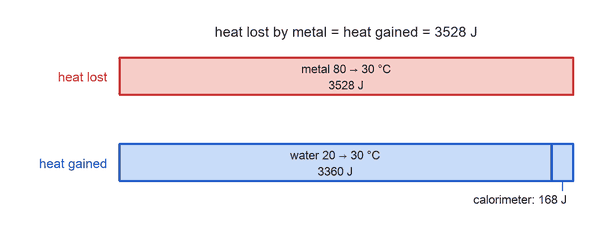
Watch out: Change 200 J kg⁻¹ °C⁻¹ to 0.2 J g⁻¹ °C⁻¹ before using it with masses in grams.
Therefore, the specific heat capacity of the metal is 0.168 J g⁻¹ °C⁻¹ (168 J kg⁻¹ °C⁻¹).
- 334 marks
Question 33
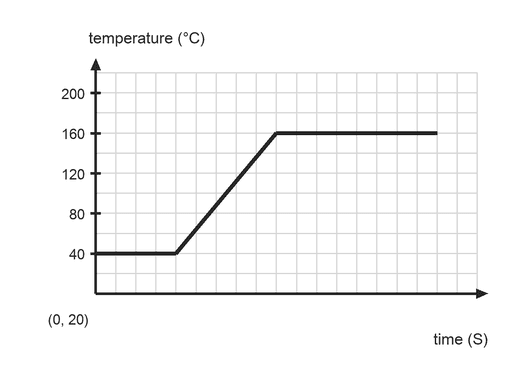
(a) From the graph of heating curve given below state the melting point and boiling point of the substance.
(b) Complete and rewrite the following nuclear reaction by filling in the blanks.
Solve with AIWritten solution
Solution:
Concept: On a heating curve the flat parts are changes of phase: the lower one is melting and the higher one is boiling. In a nuclear reaction the mass numbers (top) and the atomic numbers (bottom) balance on the two sides.
(a)
Step 1 — Read the first flat part.
The first flat part is at 40 °C, where the solid melts at a constant temperature. So the melting point is 40 °C.

Step 2 — Read the second flat part.
The second flat part is at 160 °C, where the liquid boils at a constant temperature. So the boiling point is 160 °C. (The origin of the printed graph is labelled (0, 20); the two readings come straight from the marked 40 and 160 lines, so this does not change them.)
(b)
Step 3 — Balance the atomic numbers.
The uranium nucleus gives out an alpha particle (a helium nucleus), so this is alpha decay. The bottom numbers must add up on the right.
Step 4 — Balance the mass numbers.
The top numbers must also balance.
Step 5 — Write the reaction.
Putting in both numbers gives the completed equation.
Therefore, (a) the melting point is 40 °C and the boiling point is 160 °C; (b) the blanks are 92 (atomic number of U) and 231 (mass number of Th).
- 341 mark
Question 34
Specific latent heat of a substance:
Solve with AIAnswer
(A) is directly proportional to the mass
(B) is directly proportional to the change in the temperature
- Correct
(C) depends on the material
(D) is inversely proportional to the mass
Answer: (C) depends on the material
Concept: The specific latent heat L of a substance is the heat absorbed (or given out) by unit mass of it during a change of phase, at a constant temperature: L = Q ÷ m.
Step 1 — Check the effect of mass.
For a given substance, doubling the mass doubles the heat Q, so Q ÷ m stays the same. L does not depend on the mass.
Step 2 — Check what it does depend on.
L is a property of the substance: melting ice needs 336 J g⁻¹, while melting lead needs only about 23 J g⁻¹. So it depends on the material.
Watch out: The TOTAL latent heat Q = mL grows with mass; the SPECIFIC latent heat L does not.
Why the other options are wrong:
- (A) is directly proportional to the mass: the total heat Q = mL is proportional to the mass, but the specific latent heat L is for unit mass and does not change with mass.
- (B) is directly proportional to the change in the temperature: there is no change in temperature during a change of phase, so L has nothing to do with a change in temperature.
- (D) is inversely proportional to the mass: L does not depend on the mass at all, so it cannot be inversely proportional to it.
Therefore, the specific latent heat depends on the material, option (C).
- 351 mark
Question 35
Specific heat capacity of a substance X is means:
Solve with AIAnswer
(A) Substance X absorbs 1900 J for 1°C rise in temperature
- Correct
(B) 1 kg of substance X absorbs 1900 J heat for 1°C rise in temperature
(C) 1 kg of substance X absorbs 1900 J heat to increase the temperature
(D) 1 kg of substance X absorbs 1900 J heat to cool down by 1°C
Answer: (B) 1 kg of substance X absorbs 1900 J heat for 1°C rise in temperature
Concept: The specific heat capacity c of a substance is the heat needed to raise the temperature of unit mass (1 kg) of it by 1 K (or 1 °C). Its S.I. unit is J kg⁻¹ K⁻¹; for water it is about 4200 J kg⁻¹ K⁻¹, which is the same as 4.2 J g⁻¹ K⁻¹.
Step 1 — Read the unit.
The unit J kg⁻¹ °C⁻¹ reads 'joule for each kilogram for each degree Celsius'. So the meaning must name 1 kg, 1900 J and a rise of 1 °C.
Step 2 — Check each option.
Only option (B) names all three parts: 1 kg of X absorbs 1900 J for a 1 °C rise in temperature.
Watch out: A specific heat capacity always refers to unit mass AND a rise of one degree; leaving out either changes the meaning.
Why the other options are wrong:
- (A) Substance X absorbs 1900 J for 1°C rise in temperature: it leaves out the mass: 1900 J raises 1 kg of X by 1 °C, not any amount of X.
- (C) 1 kg of substance X absorbs 1900 J heat to increase the temperature: it leaves out by how much the temperature rises; the 1900 J is for a rise of 1 °C.
- (D) 1 kg of substance X absorbs 1900 J heat to cool down by 1°C: a substance gives out heat when it cools; it does not absorb heat to cool down.
Therefore, it means that 1 kg of X absorbs 1900 J of heat for a 1 °C rise in temperature, option (B).
- 362 marks
Question 36
Thermal capacities of substances A and B are same. If mass of A is more than mass of B then:
(a) Which substance will have more specific heat capacity?
(b) Which substance will show greater rise in temperature if the same amount of heat is supplied to both?
Solve with AIWritten solution
Solution:
Concept: The heat capacity C′ of a body is the heat needed to raise the temperature of the whole body by 1 K. It is linked to the specific heat capacity c of its substance by C′ = m × c, and its S.I. unit is J K⁻¹. For a heat Q, the rise in temperature is Δt = Q ÷ C′.
(a)
Step 1 — Write c from the thermal capacity.
Dividing the thermal capacity by the mass gives the specific heat capacity.
Step 2 — Compare A and B.
C′ is the same for both, so the substance with the smaller mass has the larger specific heat capacity. B has less mass than A, so B has more specific heat capacity.
(b)
Step 3 — Write the rise in temperature.
The rise depends only on the heat supplied and the thermal capacity.
Step 4 — Compare A and B.
The same Q is given to both and their C′ are equal, so their rises in temperature are equal. Mass and specific heat capacity matter only through their product, which is the same.
Watch out: Do not say A rises more because it is heavier; equal thermal capacities give equal rises.
Therefore, (a) substance B has more specific heat capacity; (b) neither: both show the same rise in temperature.
- 373 marks
Question 37
Calculate the total amount of heat energy required to melt 200 g of ice at 0°C to water at 100°C.
(Specific latent heat of ice = , specific heat capacity of water = )
Solve with AIWritten solution
Solution:
Concept: Ice at 0 °C takes in heat in two stages. First it melts at 0 °C, with no change in temperature, taking Q = m × L. Then the water formed from it warms from 0 °C to the final temperature, taking Q = m × c × Δt.
Given: Ice 200 g at 0 °C, to become water at 100 °C; L = 336 J g⁻¹; c(water) = 4.2 J g⁻¹ °C⁻¹.
Step 1 — Plan the two stages.
The ice first melts at 0 °C (latent heat, no change in temperature), and then the water formed warms from 0 °C to 100 °C, a rise of 100 °C.
Step 2 — Heat to melt the ice.
We use Q = m × L.
Step 3 — Heat to warm the water.
We use Q = m × c × Δt.
Step 4 — Total heat.
We add the two stages.
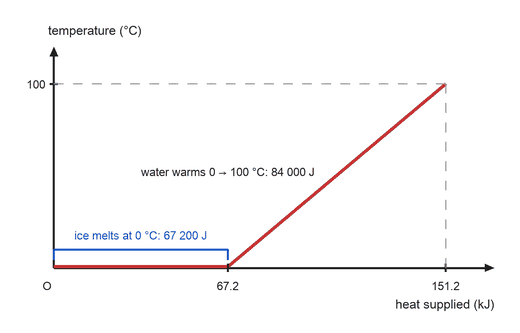
Step 5 — Notice.
Melting the ice at 0 °C takes nearly as much heat as warming the water through the whole 100 °C.
Watch out: Do not forget the melting stage; Q = m × c × Δt alone gives only 84000 J.
Therefore, the total heat required is 151200 J (151.2 kJ).
- 383 marks
Question 38
(a) State the principle of calorimetry.
(b) Name the material used for making a calorimeter.
(c) Write one characteristic property of the material chosen for making a calorimeter.
Solve with AIWritten solution
Solution:
Concept: A calorimeter is a vessel in which hot and cold bodies are mixed to measure heat by the principle of mixtures. It should take as little of the heat as possible for itself, and lose as little as possible to the surroundings, so it is made of a thin sheet of a metal of low specific heat capacity (usually copper) and kept in an insulated jacket.
(a)
Step 1 — State the principle.
When a hot body is mixed with (or kept in contact with) a cold body, and no heat is lost to the surroundings, the heat energy lost by the hot body is equal to the heat energy gained by the cold body. It follows from the law of conservation of energy.
(b)
Step 2 — Name the material.
A calorimeter is made of copper.
(c)
Step 3 — Give its property.
Copper has a low specific heat capacity, so the calorimeter takes only a negligible amount of heat from its contents. (It is also a good conductor of heat, so it quickly reaches the temperature of its contents.)
Therefore, (a) heat lost by the hot body = heat gained by the cold body; (b) copper; (c) copper has a low specific heat capacity.
- 391 mark
Question 39
During melting of ice at 0°C the :
Solve with AIAnswer
(A) energy is released and temperature remains constant.
- Correct
(B) energy is absorbed and temperature remains constant.
(C) energy is released and temperature decreases.
(D) energy is absorbed and temperature increases.
Answer: (B) energy is absorbed and temperature remains constant.
Concept: During a change of phase (melting, freezing, boiling, condensation) the temperature stays constant. The heat taken in or given out then is the latent heat, Q = m × L, where L is the specific latent heat. For ice, L = 336 J g⁻¹ (336000 J kg⁻¹, or 80 cal g⁻¹).
Step 1 — Energy during melting.
To melt, ice absorbs latent heat of fusion, 336 J for each gram.
Step 2 — Temperature during melting.
This heat increases the potential energy of the molecules (separating them), not their kinetic energy, so the temperature stays at 0 °C until all the ice has melted.
Watch out: Melting ABSORBS energy; freezing releases it.
Why the other options are wrong:
- (A) energy is released and temperature remains constant: energy is released when water freezes, not when ice melts.
- (C) energy is released and temperature decreases: energy is released and the temperature falls when a substance cools, not when ice melts.
- (D) energy is absorbed and temperature increases: energy is absorbed, but the temperature does not increase during melting; it rises only after all the ice has turned to water.
Therefore, during melting energy is absorbed and the temperature remains constant, option (B).
- 401 mark
Question 40
The graph given below shows heat energy supplied against change in temperature when no energy is lost to the surrounding. The slope of this graph will give :
 Solve with AI
Answer
(A) Specific heat capacity
(B) Latent heat of fusion
(C) Latent heat of vaporization
- Correct
(D) Heat capacity
Answer: (D) Heat capacity
Concept: The heat capacity C′ of a body is the heat needed to raise the temperature of the whole body by 1 K. It is linked to the specific heat capacity c of its substance by C′ = m × c, and its S.I. unit is J K⁻¹.
Step 1 — Find the slope.
The slope of a graph is the change in the y-quantity divided by the change in the x-quantity. Here y is the heat energy Q and x is the change in temperature Δt.
Step 2 — Name the quantity.
Heat per degree rise for the whole body, Q ÷ Δt, is the definition of heat capacity C′.
Watch out: Specific heat capacity needs a further division by the mass; this graph does not give the mass.
Why the other options are wrong:
- (A) Specific heat capacity: specific heat capacity is Q ÷ (m Δt); the slope would have to be divided by the mass to give it.
- (B) Latent heat of fusion: the latent heat of fusion is absorbed with no change in temperature, so it cannot be the slope of a graph against change in temperature.
- (C) Latent heat of vaporization: the latent heat of vaporisation also involves no change in temperature, for the same reason.
Therefore, the slope gives the heat capacity, option (D).
- 412 marks
Question 41
How much heat is required to convert 500 g of ice at 0°C to water at 0°C? The latent heat of fusion of ice is .
Solve with AIWritten solution
Solution:
Concept: During a change of phase (melting, freezing, boiling, condensation) the temperature stays constant. The heat taken in or given out then is the latent heat, Q = m × L, where L is the specific latent heat. For ice, L = 336 J g⁻¹ (336000 J kg⁻¹, or 80 cal g⁻¹).
Given: m = 500 g of ice at 0 °C → water at 0 °C; L = 330 J g⁻¹.
Step 1 — Decide what kind of heat is needed.
Ice at 0 °C becomes water at 0 °C, so there is no change in temperature and only latent heat is needed.
Step 2 — Use Q = m × L.
We multiply the mass by the latent heat given in the question.
Step 3 — Read the result.
All this heat separates the molecules; a thermometer would read 0 °C throughout.
Watch out: Use the value given here, 330 J g⁻¹, not the usual 336 J g⁻¹.
Therefore, 165000 J (165 kJ) of heat is required.
- 423 marks
Question 42
85 g of water at 30°C is cooled to 5°C by adding certain mass of ice. Find the mass of ice required.
[Specific heat capacity of water = , Specific latent heat of fusion = ]
Solve with AIWritten solution
Solution:
Concept: Principle of method of mixtures (principle of calorimetry): when a hot body and a cold body are mixed and no heat is lost to the surroundings, heat flows from the hot body to the cold body until both reach the same final temperature, and heat lost by the hot body = heat gained by the cold body. Ice at 0 °C takes in heat in two stages. First it melts at 0 °C, with no change in temperature, taking Q = m × L. Then the water formed from it warms from 0 °C to the final temperature, taking Q = m × c × Δt.
Given: Water 85 g at 30 °C, cooled to 5 °C; c(water) = 4.2 J g⁻¹ °C⁻¹; L = 336 J g⁻¹.
Step 1 — Decide what each body does.
The water cools from 30 °C to 5 °C (a fall of 25 °C). The ice is taken at 0 °C: it melts and then warms from 0 °C to 5 °C.
Step 2 — Heat lost by the water.
We use Q = m × c × Δt for the water.
Step 3 — Heat gained by the ice.
Let the mass of ice be m grams. It melts, and then the melted ice warms by 5 °C.
Step 4 — Equate heat gained and heat lost.
No heat is lost to the surroundings, so the two are equal.
Step 5 — Solve for m.
We divide both sides by 357.
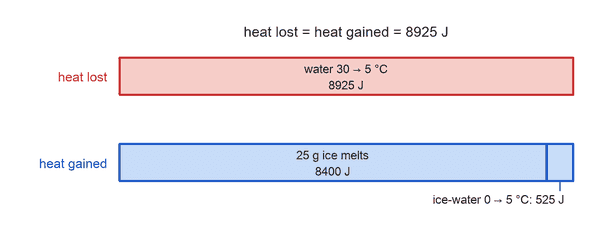
Watch out: The melted ice must also warm from 0 °C to 5 °C; leaving out the 21m term gives about 26.6 g.
Therefore, the mass of ice required is 25 g.
- 433 marks
Question 43
(a) Why does it become pleasantly warm when the lakes start freezing?
(b) Water freezes to form ice. What change would you expect in the average kinetic energy of the molecules?
(c) Which will contain more heat energy 1 g of ice at 0°C or 1 g water at 0°C ?
Solve with AIWritten solution
Solution:
Concept: During a change of phase (melting, freezing, boiling, condensation) the temperature stays constant. The heat taken in or given out then is the latent heat, Q = m × L, where L is the specific latent heat. For ice, L = 336 J g⁻¹ (336000 J kg⁻¹, or 80 cal g⁻¹). Temperature measures the average kinetic energy of the molecules. When heat raises the temperature, it increases their average kinetic energy; during a change of phase the temperature is constant, so the heat (latent heat) goes into increasing their potential energy instead, by separating them against their attraction.
(a)
Step 1 — What freezing water does.
To freeze, every gram of lake water at 0 °C must give out 336 J of latent heat of fusion.
Step 2 — Where the heat goes.
This large amount of heat goes into the surrounding air and warms it, so the weather becomes pleasantly warm.
(b)
Step 3 — Kinetic energy during freezing.
Freezing takes place at a constant temperature (0 °C), and temperature measures the average kinetic energy of the molecules, so this does not change. The heat given out comes from a decrease in the potential energy of the molecules as they settle into the solid.
(c)
Step 4 — Compare ice and water at 0 °C.
Ice at 0 °C must absorb 336 J for each gram to become water at the same temperature. So 1 g of water at 0 °C holds 336 J more heat energy than 1 g of ice at 0 °C.
Therefore, (a) freezing water gives out its latent heat to the surroundings; (b) the average kinetic energy does not change; (c) 1 g of water at 0 °C contains more heat energy (336 J more).
- 441 mark
Question 44
A metal piece of mass 5 g has thermal capacity 2.5 J K⁻¹. If the mass of the metal is tripled, then its specific heat capacity will be :
Solve with AIAnswer
(A) 7.5 J K⁻¹
(B) 2.5 J K⁻¹
(C) 1.5 J g⁻¹ K⁻¹
- Correct
(D) 0.5 J g⁻¹ K⁻¹
Answer: (D) 0.5 J g⁻¹ K⁻¹
Concept: The heat capacity C′ of a body is the heat needed to raise the temperature of the whole body by 1 K. It is linked to the specific heat capacity c of its substance by C′ = m × c, and its S.I. unit is J K⁻¹. Specific heat capacity belongs to the material, so it does not change with the mass.
Step 1 — Find c from the given piece.
The specific heat capacity is the thermal capacity divided by the mass.
Step 2 — Triple the mass.
Tripling the mass triples the thermal capacity to 7.5 J K⁻¹, but the ratio stays the same.
Watch out: The thermal capacity changes with mass; the specific heat capacity does not.
Why the other options are wrong:
- (A) 7.5 J K⁻¹: 7.5 J K⁻¹ is the new thermal capacity (3 × 2.5), and J K⁻¹ is not a unit of specific heat capacity.
- (B) 2.5 J K⁻¹: 2.5 J K⁻¹ is the thermal capacity of the original 5 g piece, not a specific heat capacity.
- (C) 1.5 J g⁻¹ K⁻¹: 1.5 J g⁻¹ K⁻¹ comes from dividing the new thermal capacity 7.5 J K⁻¹ by the old mass 5 g; with the new mass 15 g the value is 0.5.
Therefore, the specific heat capacity stays 0.5 J g⁻¹ K⁻¹, option (D).
- 451 mark
Question 45
Each of the substances given below is supplied with same amount of heat. Which one will attain the highest temperature?
Substance Specific heat capacity (cal/g°C) Lead 0.031 Aluminium 0.21 Copper 0.095 Iron 0.115 Solve with AIAnswer
(A) Aluminium
(B) Copper
(C) Iron
- Correct
(D) Lead
Answer: (D) Lead
Concept: For the same heat Q, the rise in temperature is Δt = Q ÷ (m × c). Taking equal masses at the same starting temperature (as the question intends), the substance with the lowest specific heat capacity shows the largest rise and reaches the highest temperature.
Step 1 — Find the lowest value.
In the table, lead has the lowest specific heat capacity, 0.031 cal g⁻¹ °C⁻¹.
Step 2 — Work out the rises.
Give 1 cal to 1 g of each (a hypothetical example). For lead:
In the same way, copper rises by about 10.5 °C, iron by about 8.7 °C and aluminium by about 4.8 °C.

Watch out: The LOWEST specific heat capacity gives the HIGHEST temperature for the same heat.
Why the other options are wrong:
- (A) Aluminium: aluminium has the highest specific heat capacity here (0.21), so it shows the smallest rise.
- (B) Copper: copper's 0.095 is about three times lead's value, so copper rises about one-third as much as lead.
- (C) Iron: iron's 0.115 is nearly four times lead's value, so iron rises much less than lead.
Therefore, lead reaches the highest temperature, option (D).
- 461 mark
Question 46
Complete the following by choosing the correct answers from the bracket:
Heat absorbed during change of phase depends on ............... [mass/change in temperature/specific heat capacity] of the substance.
Solve with AIWritten solution
Solution:
Concept: During a change of phase (melting, freezing, boiling, condensation) the temperature stays constant. The heat taken in or given out then is the latent heat, Q = m × L, where L is the specific latent heat. For ice, L = 336 J g⁻¹ (336000 J kg⁻¹, or 80 cal g⁻¹).
Step 1 — Look at the formula.
During a change of phase the heat absorbed is Q = m × L, with no change in temperature.
Step 2 — Rule out the other choices.
There is no change in temperature during a change of phase, and the specific heat capacity decides the heat for a rise in temperature, not for a change of phase.
Step 3 — Choose.
For a given substance (fixed L), the heat absorbed is directly proportional to its mass.
Therefore, heat absorbed during change of phase depends on mass of the substance.
- 472 marks
Question 47
Calculate the amount of heat absorbed by 200 g of paraffin wax to melt completely at its melting point.
[Specific latent heat of fusion of paraffin wax = 146 Jg⁻¹]
Solve with AIWritten solution
Solution:
Concept: During a change of phase (melting, freezing, boiling, condensation) the temperature stays constant. The heat taken in or given out then is the latent heat, Q = m × L, where L is the specific latent heat. For ice, L = 336 J g⁻¹ (336000 J kg⁻¹, or 80 cal g⁻¹).
Given: m = 200 g of paraffin wax at its melting point; L = 146 J g⁻¹.
Step 1 — Decide what kind of heat is needed.
The wax is already at its melting point, so it melts at a constant temperature and absorbs only latent heat.
Step 2 — Use Q = m × L.
We multiply the mass by the specific latent heat of fusion.
Step 3 — Read the result.
The temperature of the wax stays at its melting point while it absorbs this heat.
Therefore, the heat absorbed is 29200 J (29.2 kJ).
- 483 marks
Question 48
30 g of ice at 0°C is used to bring down the temperature of a certain mass of water at 70°C to 20°C. Find the mass of water.
[Specific heat capacity of water = 4.2 J g⁻¹ °C⁻¹ and specific latent heat of ice = 336 J g⁻¹]
Solve with AIWritten solution
Solution:
Concept: Principle of method of mixtures (principle of calorimetry): when a hot body and a cold body are mixed and no heat is lost to the surroundings, heat flows from the hot body to the cold body until both reach the same final temperature, and heat lost by the hot body = heat gained by the cold body. Ice at 0 °C takes in heat in two stages. First it melts at 0 °C, with no change in temperature, taking Q = m × L. Then the water formed from it warms from 0 °C to the final temperature, taking Q = m × c × Δt.
Given: Ice 30 g at 0 °C; water at 70 °C cooled to 20 °C; c(water) = 4.2 J g⁻¹ °C⁻¹; L = 336 J g⁻¹.
Step 1 — Decide what each body does.
The ice (30 g at 0 °C) melts and then warms from 0 °C to 20 °C. The warm water cools from 70 °C to 20 °C, a fall of 50 °C. Here the mass of the warm water is unknown.
Step 2 — Heat to melt the ice.
We use Q = m × L.
Step 3 — Heat to warm the melted ice.
We use Q = m × c × Δt for a rise of 20 °C.
Step 4 — Total heat gained.
We add the two stages.
Step 5 — Heat lost by the water.
Let the mass of the warm water be M grams.
Step 6 — Equate heat lost and heat gained.
No heat is lost to the surroundings, so the two are equal.
Step 7 — Solve for M.
We divide both sides by 210.

Watch out: The fall for the warm water is 70 − 20 = 50 °C, and the rise for the melted ice is 20 − 0 = 20 °C.
Therefore, the mass of water is 60 g.
- 493 marks
Question 49
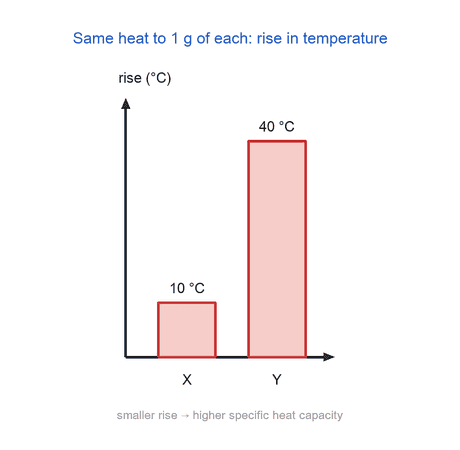
(a) A certain amount of heat will warm 1 g of material X by 10°C and 1 g of material Y by 40°C. Which material has higher specific heat capacity?
(b) Which material, X or Y, would you select to make a calorimeter?
(c) The specific heat capacity of a substance remains the same when it changes its state from solid to liquid. State True or False.
Solve with AIWritten solution
Solution:
Concept: For the same heat and the same mass, c = Q ÷ (m Δt): the smaller the rise in temperature, the higher the specific heat capacity.
(a)
Step 1 — Compare the rises.
The same heat warms 1 g of X by 10 °C but 1 g of Y by 40 °C, so the specific heat capacities are in the inverse ratio of the rises.
Step 2 — Decide.
So X has the higher specific heat capacity, 4 times that of Y.
(b)
Step 3 — Choose for a calorimeter.
A calorimeter should take very little heat from its contents, so it needs a material of low specific heat capacity. That is material Y.
(c)
Step 4 — Judge the statement.
The specific heat capacity changes with the state: ice has about 2100 J kg⁻¹ K⁻¹ while water has about 4200 J kg⁻¹ K⁻¹. So the statement is false.
Therefore, (a) X has the higher specific heat capacity; (b) Y would be selected for a calorimeter; (c) False.
- 501 mark
Question 50
For a body of mass m the relationship between the heat capacity (C') and specific heat capacity (c) is:
Solve with AIAnswer
- Correct
(A)
(B)
(C)
(D)
Answer: (A)
Concept: The heat capacity C′ of a body is the heat needed to raise the temperature of the whole body by 1 K. It is linked to the specific heat capacity c of its substance by C′ = m × c, and its S.I. unit is J K⁻¹.
Step 1 — Build the relation.
Specific heat capacity is the heat needed for 1 kg to rise by 1 K. A body of mass m needs m times as much for the same rise, and that is its heat capacity.
Step 2 — Check the units.
kg × J kg⁻¹ K⁻¹ gives J K⁻¹, the unit of heat capacity.
Why the other options are wrong:
- (B) : dividing by the mass would make a heavier body's heat capacity smaller, but a heavier body needs more heat; the unit would be J kg⁻² K⁻¹.
- (C) : c is not squared; the unit would be J² kg⁻¹ K⁻², not J K⁻¹.
- (D) : this is upside down; its unit, kg² K J⁻¹, is not the unit of heat capacity.
Therefore, C′ = mc, option (A).
- 511 mark
Question 51
A piece of a cake and a watermelon of the same mass are taken out of the freezer at the same time. Which of the following statement is correct?
Solve with AIAnswer
(A) Cake and watermelon will attain the room temperature at the same time.
(B) Watermelon will attain the room temperature faster.
- Correct
(C) Cake will attain the room temperature faster.
(D) Which one comes to the room temperature first, depends on the atmospheric pressure at that time.
Answer: (C) Cake will attain the room temperature faster.
Concept: Water has a very high specific heat capacity (4200 J kg⁻¹ K⁻¹). So a given mass of water takes in a large amount of heat for only a small rise in its temperature, and gives out a large amount of heat for only a small fall. Frozen water must also take in latent heat (336 J for each gram) to melt.
Step 1 — Compare what they are made of.
A watermelon is mostly water, so for the same mass it needs much more heat for each degree rise in temperature than the cake.
Step 2 — Add the melting.
The ice in the frozen watermelon must also melt, taking a large latent heat.
Step 3 — Compare the times.
Both take heat from the room at a similar rate, so the watermelon takes longer to warm up, and the cake reaches room temperature first.
Watch out: The same mass does not mean the same heat needed; the material (and its water content) decides it.
Why the other options are wrong:
- (A) Cake and watermelon will attain the room temperature at the same time: they have the same mass but very different specific heat capacities and water contents, so they need different amounts of heat and do not warm at the same rate.
- (B) Watermelon will attain the room temperature faster: the watermelon needs more heat, so it warms more slowly, not faster.
- (D) Which one comes to the room temperature first, depends on the atmospheric pressure at that time: which one warms first is decided by specific heat capacity and water content; ordinary changes in atmospheric pressure do not decide it.
Therefore, the cake will attain room temperature faster, option (C).
- 521 mark
Question 52
Complete the following by choosing the correct answers from the bracket:
1 joule equals to ............... [0.24 / 0.48 / 4.2] calorie.
Solve with AIWritten solution
Solution:
Concept: One calorie is 4.186 J (about 4.2 J), so one joule is the reciprocal of this in calories.
Step 1 — Invert the relation.
We divide 1 J by the number of joules in one calorie.
Step 2 — Rule out the other choices.
4.2 is the number of joules in one calorie, not calories in one joule, and 0.48 is twice the correct value.
Therefore, 1 joule equals to 0.24 calorie.
- 532 marks
Question 53
The heat capacity of a milk cooker is 450 . Calculate the rise in the temperature when it absorbs 9000 J of heat.
Solve with AIWritten solution
Solution:
Concept: The heat capacity C′ of a body is the heat needed to raise the temperature of the whole body by 1 K. It is linked to the specific heat capacity c of its substance by C′ = m × c, and its S.I. unit is J K⁻¹. So the rise in temperature is the heat absorbed divided by the heat capacity.
Given: C′ = 450 J K⁻¹; Q = 9000 J.
Step 1 — Write the formula.
We rearrange C′ = Q ÷ Δt to make Δt the subject.
Step 2 — Put in the values.
The cooker absorbs 9000 J and its heat capacity is 450 J K⁻¹.
Step 3 — Read the result.
Every 450 J raises the cooker by 1 K, and 9000 J contains 20 such amounts. A rise of 20 K is the same as a rise of 20 °C.
Therefore, the rise in temperature is 20 K (20 °C).
- 543 marks
Question 54
A spirit lamp supplying heat at a rate of 50 W is used to melt 0.025 kg of ice at 0 °C taken in a container. If all the ice in the container is melted in 168 s, then what is the specific latent heat of fusion of ice?
(The heat capacity of the container is negligible.)
Solve with AIWritten solution
Solution:
Concept: The ice melts at 0 °C, so all the heat supplied goes in as latent heat (the container takes none), so Q = m × L; and a lamp of power P supplies heat Q = P × t in time t.
Given: Power 50 W; m = 0.025 kg of ice at 0 °C; time to melt 168 s; container's heat capacity negligible.
Step 1 — Heat supplied.
A power of 50 W means 50 J of heat every second.
Step 2 — Specific latent heat.
All this heat melts the ice, so we divide it by the mass of ice.
Step 3 — Read the result.
This is 336 J g⁻¹, the accepted value for ice.
Therefore, the specific latent heat of fusion of ice is 336000 J kg⁻¹ (336 J g⁻¹).
- 553 marks
Question 55
(a) State the principle of calorimetry.
(b) Why should the surface of the calorimeter be polished?
(c) Why should the calorimeter be made of a material of low specific heat capacity?
Solve with AIWritten solution
Solution:
Concept: A calorimeter is a vessel in which hot and cold bodies are mixed to measure heat by the principle of mixtures. It should take as little of the heat as possible for itself, and lose as little as possible to the surroundings, so it is made of a thin sheet of a metal of low specific heat capacity (usually copper) and kept in an insulated jacket.
(a)
Step 1 — State the principle.
When a hot body is mixed with (or kept in contact with) a cold body, and no heat is lost to the surroundings, the heat energy lost by the hot body is equal to the heat energy gained by the cold body.
(b)
Step 2 — Why polish the surface.
A polished, shiny surface is a poor radiator of heat. Polishing the inner and outer surfaces reduces the loss of heat by radiation.
(c)
Step 3 — Why a low specific heat capacity.
A material of low specific heat capacity gives the calorimeter a low heat capacity. It then takes only a negligible amount of heat from its contents to reach their temperature, so almost all the heat lost by the hot body goes to the cold body and the measurement is accurate.
Therefore, (a) heat lost by the hot body = heat gained by the cold body; (b) polishing reduces the heat lost by radiation; (c) a low specific heat capacity makes the calorimeter take very little of the heat.
- 561 mark
Question 56
A metallic wire is stretched in such a way that its new length becomes twice the original length. How does its specific heat capacity change?
Solve with AIAnswer
(A) becomes double
(B) becomes 4 times
(C) becomes times
- Correct
(D) remains the same
Answer: (D) remains the same
Concept: The specific heat capacity c of a substance is the heat needed to raise the temperature of unit mass (1 kg) of it by 1 K (or 1 °C). Its S.I. unit is J kg⁻¹ K⁻¹; for water it is about 4200 J kg⁻¹ K⁻¹, which is the same as 4.2 J g⁻¹ K⁻¹. It is a property of the material, so it does not depend on the size, shape or mass of the body.
Step 1 — See what stretching changes.
Stretching the wire changes its length and its thickness, but it is still the same metal with the same mass.
Step 2 — Decide.
The material is unchanged, so its specific heat capacity does not change.
Watch out: Do not mix this up with resistance, which does change when a wire is stretched.
Why the other options are wrong:
- (A) becomes double: doubling the length does not change the material, and specific heat capacity does not depend on length.
- (B) becomes 4 times: a factor of 4 is how the resistance of a wire changes when it is stretched to twice its length, not its specific heat capacity.
- (C) becomes times: the specific heat capacity does not fall either; it stays the same for the same material.
Therefore, the specific heat capacity remains the same, option (D).
- 571 mark
Question 57
Three substances A, B and C of same mass are present at their respective melting points. On heating, if they melt completely in 5 minutes, 7 minutes and 3 minutes respectively, then which substance has the highest specific latent heat?
(Assume heat is absorbed at the same rate)
Solve with AIAnswer
(A) Substance A
- Correct
(B) Substance B
(C) Substance C
(D) All the substances have same specific latent heat
Answer: (B) Substance B
Concept: At the same rate of heating, the heat absorbed is rate × time. The specific latent heat is L = Q ÷ m, and the masses are equal, so L is proportional to the time taken to melt.
Step 1 — Compare the heats.
B takes the longest time (7 minutes), so it absorbs the most heat while melting.
Step 2 — Compare the latent heats.
With equal masses, the most heat means the highest specific latent heat. The order is B > A > C.
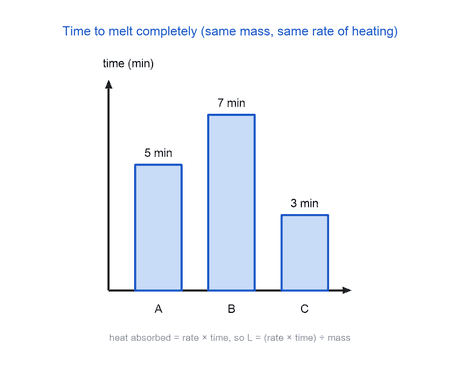
Why the other options are wrong:
- (A) Substance A: A takes 5 minutes, less than B's 7, so it absorbs less heat and has a smaller L than B.
- (C) Substance C: C takes the shortest time (3 minutes), so it has the lowest specific latent heat.
- (D) All the substances have same specific latent heat: equal specific latent heats would need equal melting times, but the times are different.
Therefore, substance B has the highest specific latent heat, option (B).
- 581 mark
Question 58
Complete the following by choosing the correct answers from the bracket:
The lid of a calorimeter minimises heat loss by ............... [convection / radiation].
Solve with AIWritten solution
Solution:
Concept: A calorimeter is a vessel in which hot and cold bodies are mixed to measure heat by the principle of mixtures. It should take as little of the heat as possible for itself, and lose as little as possible to the surroundings, so it is made of a thin sheet of a metal of low specific heat capacity (usually copper) and kept in an insulated jacket.
Step 1 — See what the lid does.
The wooden lid stops warm air (and vapour) above the contents from rising away and being replaced by cooler air, so it cuts the loss of heat by convection.
Step 2 — The other losses.
Loss by radiation is reduced by polishing the surfaces of the vessel, and loss by conduction by the wool or cotton packing.
Therefore, the lid of a calorimeter minimises heat loss by convection.
- 592 marks
Question 59
A metal piece of thermal capacity 40 , absorbs 800 J of heat. Calculate the rise in the temperature of this metal piece.
Solve with AIWritten solution
Solution:
Concept: The heat capacity C′ of a body is the heat needed to raise the temperature of the whole body by 1 K. It is linked to the specific heat capacity c of its substance by C′ = m × c, and its S.I. unit is J K⁻¹. So the rise in temperature is the heat absorbed divided by the thermal capacity.
Given: C′ = 40 J K⁻¹; Q = 800 J.
Step 1 — Write the formula.
We rearrange C′ = Q ÷ Δt to make Δt the subject.
Step 2 — Put in the values.
The metal absorbs 800 J and its thermal capacity is 40 J K⁻¹.
Step 3 — Read the result.
Each 40 J raises the metal piece by 1 K, and 800 J is 20 times 40 J. A rise of 20 K is the same as a rise of 20 °C.
Therefore, the rise in temperature is 20 K (20 °C).
- 603 marks
Question 60
(a) Atmospheric temperature after a hailstorm is greater than the temperature during the hailstorm. State True or False.
(b) Which thermal physical quantity of a frying pan changes by making its base heavier?
(c) State the principle of Calorimetry.
Solve with AIWritten solution
Solution:
Concept: During a change of phase (melting, freezing, boiling, condensation) the temperature stays constant. The heat taken in or given out then is the latent heat, Q = m × L, where L is the specific latent heat. For ice, L = 336 J g⁻¹ (336000 J kg⁻¹, or 80 cal g⁻¹). The heat capacity C′ of a body is the heat needed to raise the temperature of the whole body by 1 K. It is linked to the specific heat capacity c of its substance by C′ = m × c, and its S.I. unit is J K⁻¹.
(a)
Step 1 — Judge the statement.
After a hailstorm the hailstones melt, and each gram takes about 336 J of latent heat from the surroundings. The air loses this heat, so it is colder after the hailstorm than during it. The statement is false.
(b)
Step 2 — Name the quantity.
Heat capacity is C′ = m × c. A heavier base has a larger mass m of the same material (same c), so its heat capacity (thermal capacity) becomes larger. The pan then heats up slowly, cooks evenly and keeps food warm longer.
(c)
Step 3 — State the principle.
When a hot body is mixed with (or kept in contact with) a cold body, and no heat is lost to the surroundings, the heat energy lost by the hot body is equal to the heat energy gained by the cold body.
Watch out: The specific heat capacity of the pan does NOT change with a heavier base; only its heat capacity does.
Therefore, (a) False; (b) its heat capacity (thermal capacity) increases; (c) heat lost by the hot body = heat gained by the cold body, when no heat is lost to the surroundings.
- 614 marks
Question 61
The given graph represents the cooling curve of a liquid.

(a) State the freezing temperature of the liquid.
(b) Name the phase change happening at the region QR.
(c) In which state (solid / liquid) does the above substance liberate heat at a faster rate? Justify.
Solve with AIWritten solution
Solution:
Concept: On a cooling curve, a flat part is a change of phase at a constant temperature, and the steeper a sloping part, the faster the temperature falls.
(a)
Step 1 — Read the flat part.
The graph is flat along QR at 20 °C, so the liquid freezes at 20 °C.
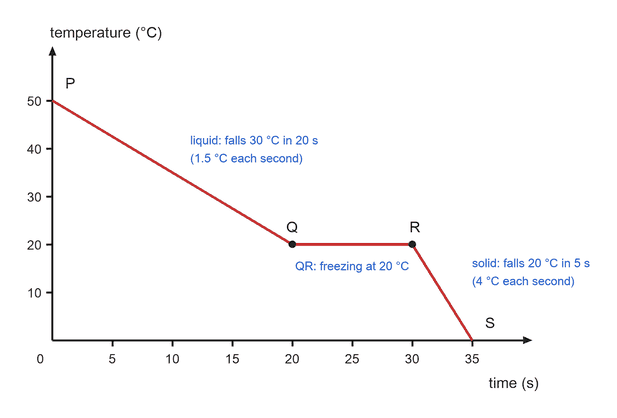
(b)
Step 2 — Name the change at QR.
Along QR the liquid changes into solid at a constant 20 °C, giving out its latent heat of fusion. This is freezing (solidification).
(c)
Step 3 — Rate of cooling of the liquid.
Along PQ the temperature falls from 50 °C to 20 °C in 20 s.
Step 4 — Rate of cooling of the solid.
Along RS it falls from 20 °C to 0 °C in 35 − 30 = 5 s.
Step 5 — Decide.
The slope of RS is much steeper than that of PQ, so the substance cools, and gives out its heat, faster in the solid state.
Watch out: Read the times from the graph: the solid part RS lasts only 5 s (30 s to 35 s).
Note: Strictly, the rate of heat loss is mass × specific heat capacity × rate of fall of temperature; the graph gives only the rate of fall, which is what the question expects you to compare.
Therefore, (a) the freezing temperature is 20 °C; (b) freezing (solidification) at QR; (c) in the solid state, because its temperature falls faster (4 °C s⁻¹ against 1.5 °C s⁻¹ for the liquid).
- 621 mark
Question 62
Identify the correct statement with respect to the change of phase of a substance.
Solve with AIAnswer
- Correct
(A) Kinetic energy of the molecules remains the same.
(B) Potential energy of the molecules remains the same.
(C) Both potential and kinetic energies of the molecules increase.
(D) Both potential and kinetic energies of the molecules remain the same.
Answer: (A) Kinetic energy of the molecules remains the same.
Concept: Temperature measures the average kinetic energy of the molecules. When heat raises the temperature, it increases their average kinetic energy; during a change of phase the temperature is constant, so the heat (latent heat) goes into increasing their potential energy instead, by separating them against their attraction.
Step 1 — Kinetic energy.
A change of phase takes place at a constant temperature, so the average kinetic energy of the molecules stays the same.
Step 2 — Potential energy.
The latent heat absorbed (or given out) changes the potential energy of the molecules, as they move apart (melting, boiling) or come closer (freezing, condensation).
Watch out: The heat during a change of phase changes the potential energy, not the kinetic energy.
Why the other options are wrong:
- (B) Potential energy of the molecules remains the same: the potential energy does change: it increases during melting and boiling and decreases during freezing and condensation.
- (C) Both potential and kinetic energies of the molecules increase: the kinetic energy does not increase, because the temperature stays constant.
- (D) Both potential and kinetic energies of the molecules remain the same: the potential energy changes, so both cannot stay the same; the latent heat has to go somewhere.
Therefore, the kinetic energy of the molecules remains the same, option (A).
- 631 mark
Question 63
1 calorie is the amount of heat required to raise the temperature of:
Solve with AIAnswer
(A) 1 kg of water through 1 K
- Correct
(B) 1 g of water through 1 K
(C) 1 kg of water through 1°C
(D) 1 g of water through 10°C
Answer: (B) 1 g of water through 1 K
Concept: One calorie is the heat needed to raise the temperature of 1 g of water by 1 °C (from 14.5 °C to 15.5 °C); 1 cal = 4.186 J.
Step 1 — Compare the step sizes.
A rise of 1 °C is the same as a rise of 1 K, because the two scales have steps of the same size.
Step 2 — Match the definition.
So '1 g of water through 1 K' is the definition of one calorie.
Watch out: 1 kg of water through 1 °C needs 1000 cal, which is one kilocalorie, not one calorie.
Why the other options are wrong:
- (A) 1 kg of water through 1 K: heating 1 kg of water through 1 K needs 1000 cal, that is 1 kilocalorie.
- (C) 1 kg of water through 1°C: 1 kg of water through 1 °C also needs 1 kilocalorie (1000 cal), not 1 calorie.
- (D) 1 g of water through 10°C: 1 g of water through 10 °C needs 10 calories.
Therefore, one calorie raises 1 g of water through 1 K, option (B).
- 641 mark
Question 64
Complete the following by choosing the correct answers from the bracket:
No negative temperature is possible on the ............... [Kelvin scale / Fahrenheit scale].
Solve with AIWritten solution
Solution:
Concept: The Kelvin scale starts at absolute zero (0 K, which is −273 °C), the lowest temperature possible, so no temperature on it can be below zero.
Step 1 — Look at the Kelvin scale.
The zero of the Kelvin scale is absolute zero, so every temperature on it is zero or positive.
Step 2 — Look at the Fahrenheit scale.
The Fahrenheit scale does have negative temperatures; for example, −40 °F is the same as −40 °C.
Therefore, no negative temperature is possible on the Kelvin scale.
- 652 marks
Question 65
The temperatures of two liquids are 80°C and 20°C. When they are mixed in the mass ratio of 8:5, the temperature of the mixture becomes 60°C. Calculate the ratio of their specific heat capacities. (Neglecting heat lost to the surroundings)
Solve with AIWritten solution
Solution:
Concept: Principle of method of mixtures (principle of calorimetry): when a hot body and a cold body are mixed and no heat is lost to the surroundings, heat flows from the hot body to the cold body until both reach the same final temperature, and heat lost by the hot body = heat gained by the cold body. The heat taken in (or given out) by a body of mass m, made of a substance of specific heat capacity c, when its temperature rises (or falls) by Δt is Q = m × c × Δt.
Given: Liquids at 80 °C and 20 °C; masses in the ratio 8 : 5; final temperature 60 °C.
Step 1 — Decide what each liquid does.
The hot liquid (80 °C) cools to 60 °C, a fall of 20 °C. The cold liquid (20 °C) warms to 60 °C, a rise of 40 °C. The mass ratio 8 : 5 is taken in the order the liquids are named, so the masses are 8k (hot) and 5k (cold).
Step 2 — Equate heat lost and heat gained.
No heat is lost to the surroundings, so the two heats are equal.
Step 3 — Simplify.
We multiply out both sides; k cancels.
Step 4 — Find the ratio.
We divide both sides by 160 c₂.
Step 5 — Read the result.
The hot liquid has more mass but cools by only half as many degrees as the cold liquid warms, so its specific heat capacity must be larger.
Watch out: Pair each mass with its own change in temperature: 8 with the fall of 20 °C, 5 with the rise of 40 °C.
Therefore, the ratio of the specific heat capacities (hot liquid : cold liquid) is 5 : 4.
- 663 marks
Question 66
The graph given below shows the change in temperature with time, when a substance is cooled.
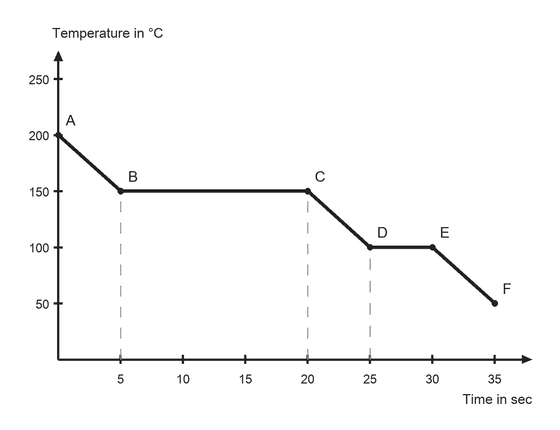
(a) State the boiling point of the substance.
(b) What is the phase change occurring in the region DE?
(c) State the range of temperature during which the substance is in liquid state.
Solve with AIWritten solution
Solution:
Concept: On a cooling curve the substance starts as a gas. The first flat part is condensation (gas → liquid), at the boiling point; the second flat part is freezing (liquid → solid), at the melting point.
(a)
Step 1 — Read the first flat part.
The graph is flat along BC at 150 °C, where the vapour condenses into liquid. A substance condenses at the same temperature at which it boils, so the boiling point is 150 °C.
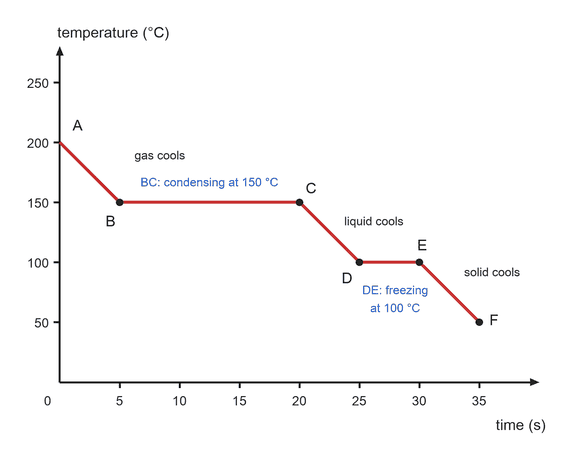
(b)
Step 2 — Name the change at DE.
Along DE the temperature stays at 100 °C while the liquid changes into solid, giving out its latent heat of fusion. This is freezing (solidification).
(c)
Step 3 — Find the liquid range.
The substance is liquid between its boiling point and its freezing point, that is, from 150 °C down to 100 °C (part CD, with liquid also present along BC and DE while the phase changes).
Watch out: On a COOLING curve the first flat part is condensation, not melting.
Therefore, (a) the boiling point is 150 °C; (b) freezing (solidification); (c) the substance is liquid from 150 °C down to 100 °C.
- 674 marks
Question 67
280 g of ice at 0°C is mixed with 600 g of water at 50°C present in a metal container of mass 300 g.
If the final temperature of the mixture is 10°C. Assuming no loss of heat to the atmosphere, calculate the specific heat capacity of the metal container.
(Specific latent heat of ice is 336 ,
Specific heat capacity of water is 4.2 )
Solve with AIWritten solution
Solution:
Concept: Principle of method of mixtures (principle of calorimetry): when a hot body and a cold body are mixed and no heat is lost to the surroundings, heat flows from the hot body to the cold body until both reach the same final temperature, and heat lost by the hot body = heat gained by the cold body. Ice at 0 °C takes in heat in two stages. First it melts at 0 °C, with no change in temperature, taking Q = m × L. Then the water formed from it warms from 0 °C to the final temperature, taking Q = m × c × Δt.
Given: Ice 280 g at 0 °C; water 600 g at 50 °C in a metal container of 300 g; final temperature 10 °C; L = 336 J g⁻¹; c(water) = 4.2 J g⁻¹ K⁻¹.
Step 1 — Decide what each body does.
The water and the metal container both cool from 50 °C to 10 °C (a fall of 40 K). The ice at 0 °C melts and then warms from 0 °C to 10 °C (a rise of 10 K).
Step 2 — Heat gained by the ice.
It takes latent heat to melt, and then the melted ice warms by 10 K.
Step 3 — Heat lost by the water.
We use Q = m × c × Δt for the water.
Step 4 — Heat lost by the container.
Let the specific heat capacity of the container be c (in J g⁻¹ K⁻¹).
Step 5 — Equate heat lost and heat gained.
No heat is lost to the atmosphere, so the heat lost by the water and the container equals the heat gained by the ice.
Step 6 — Solve for c.
We take 100800 from both sides, then divide by 12000.
In S.I. units this is 420 J kg⁻¹ K⁻¹.
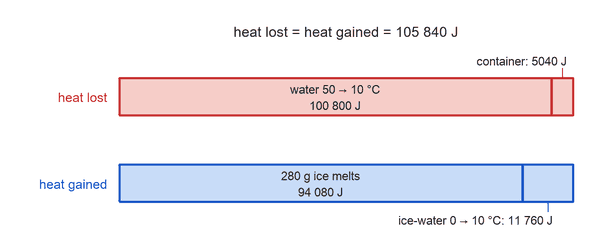
Watch out: The container is on the heat-LOST side with the water; it starts at 50 °C, not at 0 °C.
Therefore, the specific heat capacity of the metal container is 0.42 J g⁻¹ K⁻¹ (420 J kg⁻¹ K⁻¹).