
Question 391 markMCQAsked 2024Easy
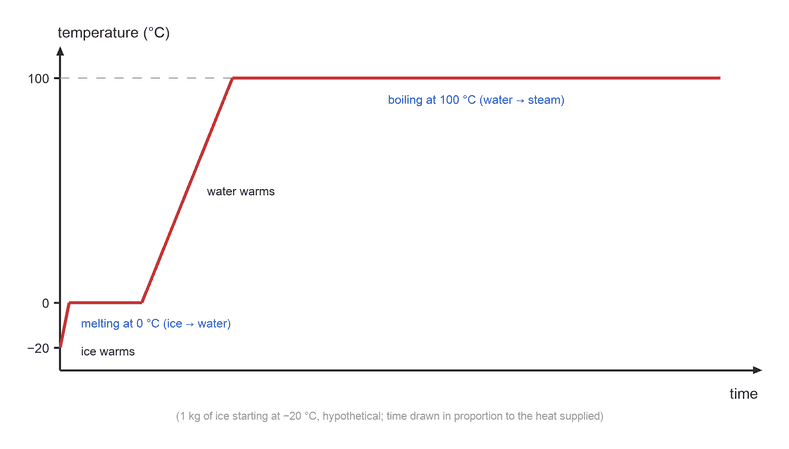
During melting of ice at 0°C the :
Confirming your payment
Sign up now and get 250 free tokens.
Previous Year Questions · Question 39 of 67
During melting of ice at 0°C the :
(A) energy is released and temperature remains constant.
(B) energy is absorbed and temperature remains constant.
(C) energy is released and temperature decreases.
(D) energy is absorbed and temperature increases.
Answer: (B) energy is absorbed and temperature remains constant.
Concept: During a change of phase (melting, freezing, boiling, condensation) the temperature stays constant. The heat taken in or given out then is the latent heat, Q = m × L, where L is the specific latent heat. For ice, L = 336 J g⁻¹ (336000 J kg⁻¹, or 80 cal g⁻¹).
Step 1 — Energy during melting.
To melt, ice absorbs latent heat of fusion, 336 J for each gram.
Step 2 — Temperature during melting.
This heat increases the potential energy of the molecules (separating them), not their kinetic energy, so the temperature stays at 0 °C until all the ice has melted.
Watch out: Melting ABSORBS energy; freezing releases it.
Why the other options are wrong:
Therefore, during melting energy is absorbed and the temperature remains constant, option (B).