Solution:
Concept: Principle of method of mixtures (principle of calorimetry): when a hot body and a cold body are mixed and no heat is lost to the surroundings, heat flows from the hot body to the cold body until both reach the same final temperature, and heat lost by the hot body = heat gained by the cold body. The heat taken in (or given out) by a body of mass m, made of a substance of specific heat capacity c, when its temperature rises (or falls) by Δt is Q = m × c × Δt.
Given: Metal 420 g at 80 °C; water 80 g and calorimeter 84 g at 20 °C; final temperature 30 °C; c(water) = 4.2 J g⁻¹ °C⁻¹; c(calorimeter) = 200 J kg⁻¹ °C⁻¹.
Step 1 — Decide what each body does.
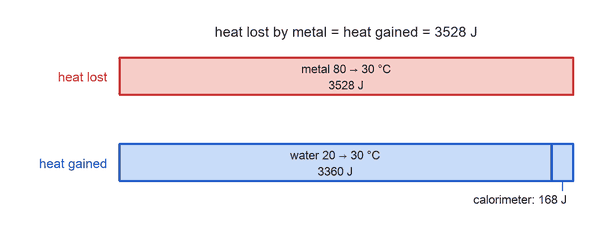
The metal cools from 80 °C to 30 °C (a fall of 50 °C). The water and the calorimeter both warm from 20 °C to 30 °C (a rise of 10 °C). The calorimeter's value per gram is 200 J kg⁻¹ °C⁻¹ = 0.2 J g⁻¹ °C⁻¹.
Step 2 — Heat gained by the water.
We use Q = m × c × Δt for the water.
Q1=80×4.2×10=3360 J
Step 3 — Heat gained by the calorimeter.
We use the same formula for the calorimeter.
Q2=84×0.2×10=168 J
Step 4 — Total heat gained.
We add the two amounts.
Q1+Q2=3360+168=3528 J
Step 5 — Heat lost by the metal.
Let the specific heat capacity of the metal be c (in J g⁻¹ °C⁻¹).
Q3=420×c×50=21000c
Step 6 — Equate heat lost and heat gained.
No heat is lost to the surroundings, so the two are equal.
21000c=3528
Step 7 — Solve for c.
We divide both sides by 21000.
c=210003528 J g−1∘C−1=0.168 J g−1∘C−1
In S.I. units this is 168 J kg⁻¹ °C⁻¹.
Watch out: Change 200 J kg⁻¹ °C⁻¹ to 0.2 J g⁻¹ °C⁻¹ before using it with masses in grams.
Therefore, the specific heat capacity of the metal is 0.168 J g⁻¹ °C⁻¹ (168 J kg⁻¹ °C⁻¹).
