
Question 334 marksAsked 2022Easy
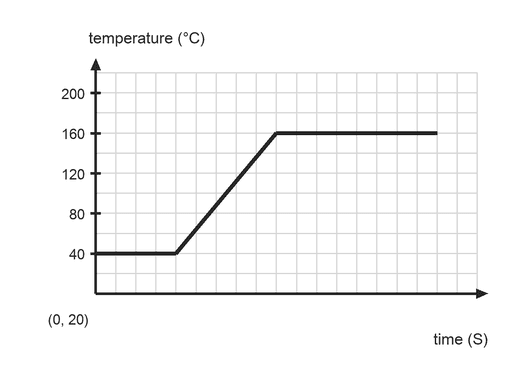
(a) From the graph of heating curve given below state the melting point and boiling point of the substance.
(b) Complete and rewrite the following nuclear reaction by filling in the blanks.
Confirming your payment
Sign up now and get 250 free tokens.
Previous Year Questions · Question 33 of 67
(a) From the graph of heating curve given below state the melting point and boiling point of the substance.
(b) Complete and rewrite the following nuclear reaction by filling in the blanks.
Solution:
Concept: On a heating curve the flat parts are changes of phase: the lower one is melting and the higher one is boiling. In a nuclear reaction the mass numbers (top) and the atomic numbers (bottom) balance on the two sides.
(a)
Step 1 — Read the first flat part.
The first flat part is at 40 °C, where the solid melts at a constant temperature. So the melting point is 40 °C.

Step 2 — Read the second flat part.
The second flat part is at 160 °C, where the liquid boils at a constant temperature. So the boiling point is 160 °C. (The origin of the printed graph is labelled (0, 20); the two readings come straight from the marked 40 and 160 lines, so this does not change them.)
(b)
Step 3 — Balance the atomic numbers.
The uranium nucleus gives out an alpha particle (a helium nucleus), so this is alpha decay. The bottom numbers must add up on the right.
Step 4 — Balance the mass numbers.
The top numbers must also balance.
Step 5 — Write the reaction.
Putting in both numbers gives the completed equation.
Therefore, (a) the melting point is 40 °C and the boiling point is 160 °C; (b) the blanks are 92 (atomic number of U) and 231 (mass number of Th).