
Question 423 marksAsked 2024Medium
85 g of water at 30°C is cooled to 5°C by adding certain mass of ice. Find the mass of ice required.
[Specific heat capacity of water = , Specific latent heat of fusion = ]
Confirming your payment
Sign up now and get 250 free tokens.
Previous Year Questions · Question 42 of 67
85 g of water at 30°C is cooled to 5°C by adding certain mass of ice. Find the mass of ice required.
[Specific heat capacity of water = , Specific latent heat of fusion = ]
Solution:
Concept: Principle of method of mixtures (principle of calorimetry): when a hot body and a cold body are mixed and no heat is lost to the surroundings, heat flows from the hot body to the cold body until both reach the same final temperature, and heat lost by the hot body = heat gained by the cold body. Ice at 0 °C takes in heat in two stages. First it melts at 0 °C, with no change in temperature, taking Q = m × L. Then the water formed from it warms from 0 °C to the final temperature, taking Q = m × c × Δt.
Given: Water 85 g at 30 °C, cooled to 5 °C; c(water) = 4.2 J g⁻¹ °C⁻¹; L = 336 J g⁻¹.
Step 1 — Decide what each body does.
The water cools from 30 °C to 5 °C (a fall of 25 °C). The ice is taken at 0 °C: it melts and then warms from 0 °C to 5 °C.
Step 2 — Heat lost by the water.
We use Q = m × c × Δt for the water.
Step 3 — Heat gained by the ice.
Let the mass of ice be m grams. It melts, and then the melted ice warms by 5 °C.
Step 4 — Equate heat gained and heat lost.
No heat is lost to the surroundings, so the two are equal.
Step 5 — Solve for m.
We divide both sides by 357.
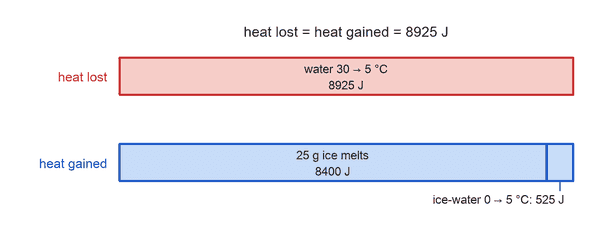
Watch out: The melted ice must also warm from 0 °C to 5 °C; leaving out the 21m term gives about 26.6 g.
Therefore, the mass of ice required is 25 g.