Solution:
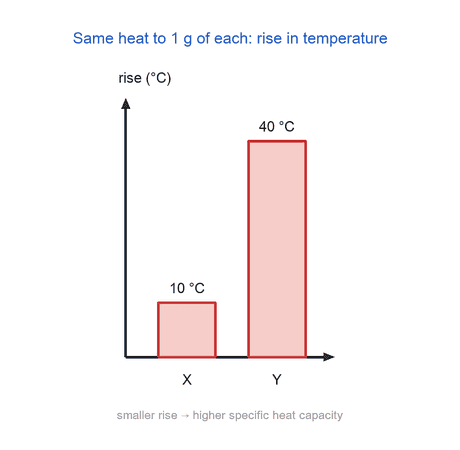
Concept: For the same heat and the same mass, c = Q ÷ (m Δt): the smaller the rise in temperature, the higher the specific heat capacity.
(a)
Step 1 — Compare the rises.
The same heat warms 1 g of X by 10 °C but 1 g of Y by 40 °C, so the specific heat capacities are in the inverse ratio of the rises.
cYcX=ΔtXΔtY=1040=4
Step 2 — Decide.
So X has the higher specific heat capacity, 4 times that of Y.
(b)
Step 3 — Choose for a calorimeter.
A calorimeter should take very little heat from its contents, so it needs a material of low specific heat capacity. That is material Y.
(c)
Step 4 — Judge the statement.
The specific heat capacity changes with the state: ice has about 2100 J kg⁻¹ K⁻¹ while water has about 4200 J kg⁻¹ K⁻¹. So the statement is false.
Therefore, (a) X has the higher specific heat capacity; (b) Y would be selected for a calorimeter; (c) False.
