Solution:
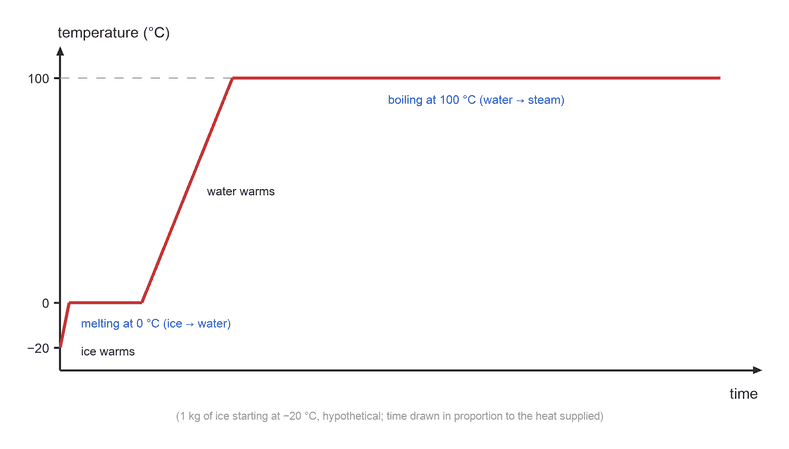
Concept: Temperature measures the average kinetic energy of the molecules. When heat raises the temperature, it increases their average kinetic energy; during a change of phase the temperature is constant, so the heat (latent heat) goes into increasing their potential energy instead, by separating them against their attraction.
(i)
Step 1 — Name the change.
The change of a solid into a liquid on heating is called melting (fusion).
(ii)
Step 2 — Look at the temperature.
Melting takes place at a constant temperature (the melting point). Temperature measures the average kinetic energy of the molecules, so this does not increase.
Step 3 — Where the heat goes.
The heat supplied increases the potential energy of the molecules instead, by moving them farther apart against their attraction.
(iii)
Step 4 — Name the energy.
The energy absorbed during the change of phase is called the latent heat, here the latent heat of fusion. 'Latent' means hidden: it does not show up as a rise in temperature.
Watch out: During a change of phase the heat goes into potential energy, not kinetic energy.
Therefore, (i) the change is melting (fusion); (ii) no, the average kinetic energy does not increase; (iii) the energy absorbed is the latent heat (of fusion).
