
Question 12 marksAsked 2016Easy
Calculate the mass of ice required to lower the temperature of 300 g of water at 40°C to water at 0°C. (Specific latent heat of ice = 336 , Specific heat capacity of water = 4.2 )
Confirming your payment
Sign up now and get 250 free tokens.
Previous Year Questions · Question 1 of 67
Calculate the mass of ice required to lower the temperature of 300 g of water at 40°C to water at 0°C. (Specific latent heat of ice = 336 , Specific heat capacity of water = 4.2 )
Solution:
Concept: Principle of method of mixtures (principle of calorimetry): when a hot body and a cold body are mixed and no heat is lost to the surroundings, heat flows from the hot body to the cold body until both reach the same final temperature, and heat lost by the hot body = heat gained by the cold body. During a change of phase (melting, freezing, boiling, condensation) the temperature stays constant. The heat taken in or given out then is the latent heat, Q = m × L, where L is the specific latent heat. For ice, L = 336 J g⁻¹ (336000 J kg⁻¹, or 80 cal g⁻¹).
Given: Water 300 g at 40 °C, cooled to 0 °C; L = 336 J g⁻¹; c(water) = 4.2 J g⁻¹ °C⁻¹.
Step 1 — Decide what each body does.
The water cools from 40 °C to 0 °C and gives out heat. The final temperature is 0 °C, so the ice (taken at 0 °C) only melts: the water formed from it does not warm up at all.
Step 2 — Heat lost by the water.
We use Q = m × c × Δt; the water falls from 40 °C to 0 °C, a fall of 40 °C.
Step 3 — Heat gained by the ice.
Let the mass of ice be m grams. It only melts, so it takes the latent heat.
Step 4 — Equate heat lost and heat gained.
No heat is lost to the surroundings, so the two amounts are equal.
Step 5 — Solve for m.
We divide both sides by 336.
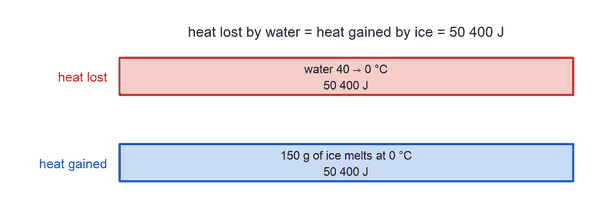
Watch out: Since the final temperature is 0 °C, do not add a term for the melted ice warming up.
Therefore, the mass of ice required is 150 g.