Solution:
Concept: During a change of phase (melting, freezing, boiling, condensation) the temperature stays constant. The heat taken in or given out then is the latent heat, Q = m × L, where L is the specific latent heat. For ice, L = 336 J g⁻¹ (336000 J kg⁻¹, or 80 cal g⁻¹). At a constant rate of heating, the temperature rises while one phase warms up, and stays constant during each change of phase.
Step 1 — Ice warms.
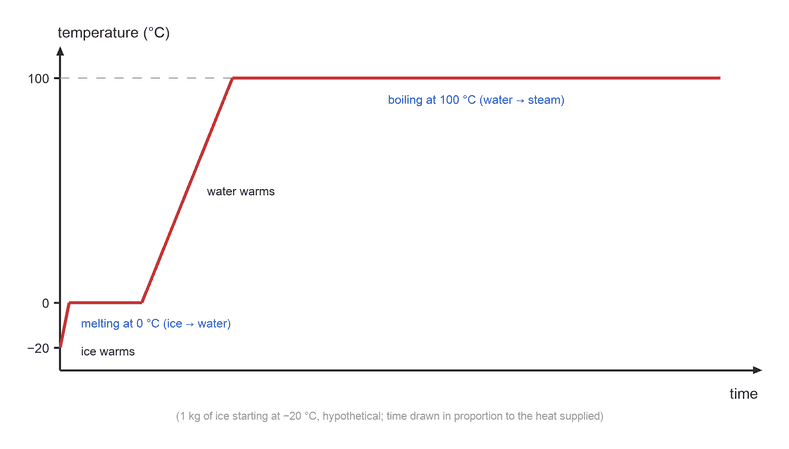
If the ice starts below 0 °C, its temperature first rises to 0 °C, so the graph slopes upwards.
Step 2 — First phase change: melting at 0 °C.
The temperature stays at 0 °C while the ice changes into water, so the graph is flat. The heat taken in is the latent heat of fusion (336 J for each gram).
Step 3 — Water warms.
Once all the ice has melted, the temperature of the water rises steadily from 0 °C to 100 °C.
Step 4 — Second phase change: boiling at 100 °C.
The temperature stays at 100 °C while the water changes into steam, so the graph is flat again. The heat taken in is the latent heat of vaporisation (about 2260 J for each gram).
Step 5 — Compare the lengths.
At a constant rate of heating, time is proportional to heat. Boiling needs about 2260 J g⁻¹, far more than melting (336 J g⁻¹) or warming the water through 100 °C (420 J g⁻¹), so the flat part at 100 °C is the longest. The ice part is steeper than the water part, because ice has about half the specific heat capacity of water (2100 against 4200 J kg⁻¹ K⁻¹).
Watch out: The two flat parts must be labelled as the phase changes (melting at 0 °C, boiling at 100 °C); a sloping line straight from 0 °C to 100 °C misses them.
Therefore, the graph rises to 0 °C, stays flat at 0 °C (melting), rises to 100 °C, and stays flat at 100 °C (boiling); the two flat parts are the two phase changes.
