Solution:
Concept: Principle of method of mixtures (principle of calorimetry): when a hot body and a cold body are mixed and no heat is lost to the surroundings, heat flows from the hot body to the cold body until both reach the same final temperature, and heat lost by the hot body = heat gained by the cold body. Ice at 0 °C takes in heat in two stages. First it melts at 0 °C, with no change in temperature, taking Q = m × L. Then the water formed from it warms from 0 °C to the final temperature, taking Q = m × c × Δt.
Given: Ice 280 g at 0 °C; water 600 g at 50 °C in a metal container of 300 g; final temperature 10 °C; L = 336 J g⁻¹; c(water) = 4.2 J g⁻¹ K⁻¹.
Step 1 — Decide what each body does.
The water and the metal container both cool from 50 °C to 10 °C (a fall of 40 K). The ice at 0 °C melts and then warms from 0 °C to 10 °C (a rise of 10 K).
Step 2 — Heat gained by the ice.
It takes latent heat to melt, and then the melted ice warms by 10 K.
Q1=280×336+280×4.2×10=94080+11760=105840 J
Step 3 — Heat lost by the water.
We use Q = m × c × Δt for the water.
Q2=600×4.2×40=100800 J
Step 4 — Heat lost by the container.
Let the specific heat capacity of the container be c (in J g⁻¹ K⁻¹).
Q3=300×c×40=12000c
Step 5 — Equate heat lost and heat gained.
No heat is lost to the atmosphere, so the heat lost by the water and the container equals the heat gained by the ice.
100800+12000c=105840
Step 6 — Solve for c.
We take 100800 from both sides, then divide by 12000.
12000c=5040
c=120005040 J g−1K−1=0.42 J g−1K−1
In S.I. units this is 420 J kg⁻¹ K⁻¹.
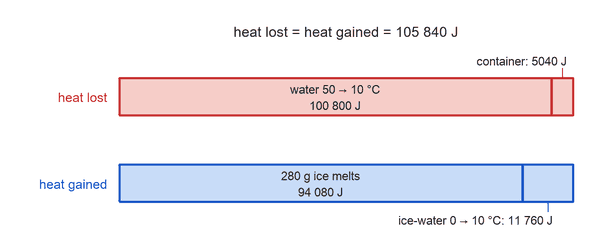
Watch out: The container is on the heat-LOST side with the water; it starts at 50 °C, not at 0 °C.
Therefore, the specific heat capacity of the metal container is 0.42 J g⁻¹ K⁻¹ (420 J kg⁻¹ K⁻¹).
