Solution:
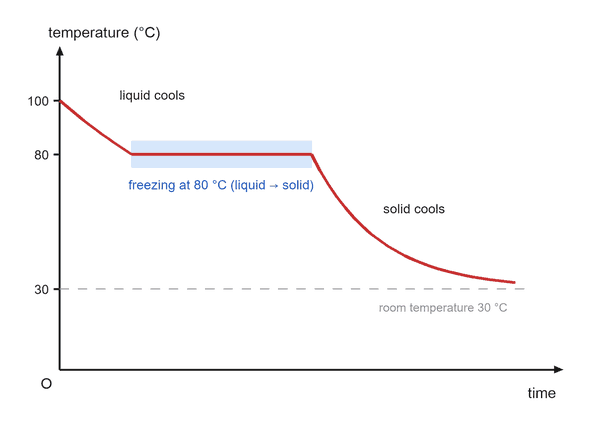
Concept: A liquid cools until it reaches its freezing point, which equals its melting point (80 °C for naphthalene). The temperature then stays constant while it freezes, because the latent heat given out makes up for the heat lost to the room. After it has all frozen, the solid cools to room temperature.
Step 1 — Liquid cools.
The liquid naphthalene cools from 100 °C to 80 °C, so the graph falls.
Step 2 — Freezing (the marked region).
At 80 °C the liquid changes into solid at a constant temperature, giving out its latent heat of fusion. This flat part of the graph is the freezing process.
Step 3 — Solid cools.
The solid then cools from 80 °C, quickly at first and then more slowly, and levels off at the room temperature of 30 °C.
Watch out: The graph never goes below the room temperature, 30 °C; a body cannot cool below its surroundings.
Therefore, the graph falls from 100 °C to 80 °C, stays flat at 80 °C (the freezing region), and then falls more and more slowly to 30 °C.
