Solution:
Concept: A cooling liquid gets colder until it reaches its freezing point. It then stays at that temperature while it freezes, because the latent heat it gives out makes up for the heat it loses. After that the solid cools towards room temperature.
Step 1 — Liquid cools.
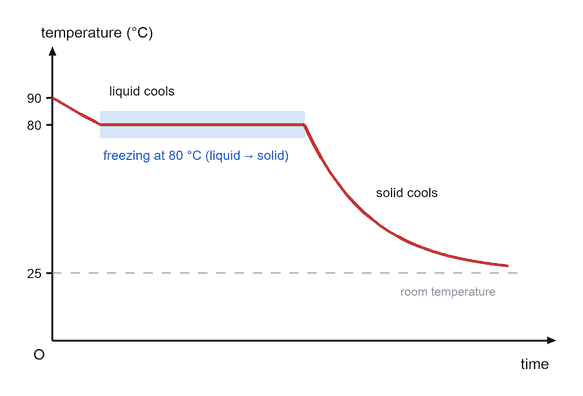
The liquid naphthalene cools from 90 °C to 80 °C, so the graph falls.
Step 2 — Freezing.
At 80 °C it starts to freeze. The temperature stays constant at 80 °C until all the liquid has become solid, because the latent heat given out makes up for the heat lost to the surroundings. This flat part (shaded) is the freezing region.
Step 3 — Solid cools.
The solid naphthalene then cools from 80 °C towards the room temperature of 25 °C. It cools quickly at first, then more slowly as its temperature gets close to that of the room, so the curve flattens out just above 25 °C.
Step 4 — Why 80 °C.
The melting point and the freezing point of a pure substance are the same, so naphthalene freezes at its melting point, 80 °C.
Watch out: The graph never goes below the room temperature, 25 °C.
Note: the spelling “napthalene” in the printed question has been corrected to “naphthalene”.
Therefore, the graph falls from 90 °C to 80 °C, stays flat at 80 °C while the naphthalene freezes (the freezing region), and then falls slowly towards 25 °C.
