
Question 563 marksMedium
The temperature of 600 g of cold water rises by 15°C when 300 g of hot water at 50°C is added to it. What was the initial temperature of the cold water?
Confirming your payment
Sign up now and get 250 free tokens.
Calorimetry · Question 56 of 108
The temperature of 600 g of cold water rises by 15°C when 300 g of hot water at 50°C is added to it. What was the initial temperature of the cold water?
Solution:
Concept: Principle of method of mixtures (principle of calorimetry): when a hot body and a cold body are mixed and no heat is lost to the surroundings, heat flows from the hot body to the cold body until both reach the same final temperature, and heat lost by the hot body = heat gained by the cold body. Both liquids are water, so c cancels.
Given: Cold water: 600 g, rises by 15 °C; hot water: 300 g at 50 °C.
Step 1 — Name the unknown.
Let the cold water start at T °C. It rises by 15 °C, so the final temperature of the mixture is (T + 15) °C, which the hot water also reaches.
Step 2 — Equate heat gained and heat lost.
The cold water (600 g) rises by 15 °C; the hot water (300 g) falls from 50 °C to (T + 15) °C.
Step 3 — Cancel c and simplify.
Divide both sides by c and work out the bracket.
Step 4 — Divide by 300.
This leaves a simple equation in T.
Step 5 — Solve for T.
Subtract to find T.
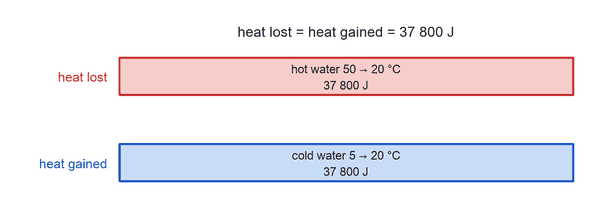
Check: The final temperature is 20 °C; the hot water falls 30 °C and the cold water rises 15 °C. The hot water has half the mass, so its fall must be twice the rise, as it is (each side is 37800 J with c = 4.2 J g⁻¹ K⁻¹).
Watch out: The 15 °C is the cold water's RISE, not its final temperature.
Therefore, the initial temperature of the cold water was 5 °C.