
Question 631 markMCQEasy
Heat energy supplied during the melting of a substance is utilised in :
Confirming your payment
Sign up now and get 250 free tokens.
Calorimetry · Question 63 of 108
Heat energy supplied during the melting of a substance is utilised in :
(A) increasing the kinetic energy of molecules
(B) decreasing the potential energy of molecules
(C) increasing the potential energy of molecules
(D) decreasing the kinetic energy of molecules
Answer: (C) increasing the potential energy of molecules
Concept: Temperature measures the average kinetic energy of the molecules. When heat raises the temperature, it increases their average kinetic energy; during a change of phase the temperature is constant, so the heat (latent heat) goes into increasing their potential energy instead, by separating them against their attraction.
Step 1 — Kinetic energy during melting.
The temperature stays constant while a substance melts, so the average kinetic energy of its molecules does not change.
Step 2 — Where the heat goes.
The heat supplied (the latent heat) is used to pull the molecules apart against their attractive forces. This increases their potential energy.
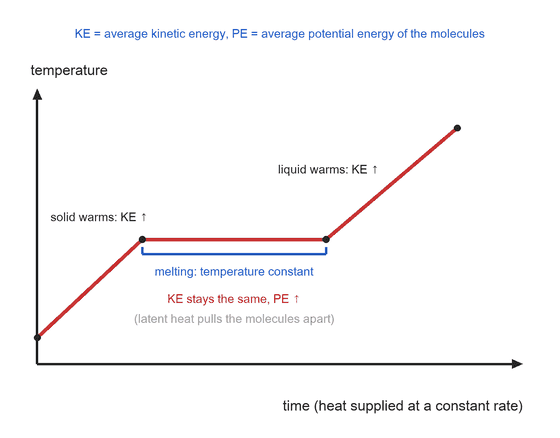
Watch out: A constant temperature means constant kinetic energy, not 'no change in energy'.
Why the other options are wrong:
Therefore, the heat supplied during melting increases the potential energy of the molecules, option (C).