Solution:
Concept: Principle of method of mixtures (principle of calorimetry): when a hot body and a cold body are mixed and no heat is lost to the surroundings, heat flows from the hot body to the cold body until both reach the same final temperature, and heat lost by the hot body = heat gained by the cold body. Here the calorimeter and the water both cool from 32 °C to 5 °C; the ice (taken to be at 0 °C) melts and then warms from 0 °C to 5 °C.
Given: Calorimeter: 50 g, c = 0.4 J g⁻¹ °C⁻¹; water: 150 g, c = 4.2 J g⁻¹ °C⁻¹; both at 32 °C; final temperature 5 °C; L = 330 J g⁻¹.
Step 1 — Read the data.
The question's “latent heat capacity of ice” means its specific latent heat of fusion, L = 330 J g⁻¹. Both the calorimeter and the water fall by 32−5=27 °C.
Step 2 — Heat lost by the calorimeter.
Use its mass and specific heat capacity.
Q1=50×0.4×27 J=540 J
Step 3 — Heat lost by the water.
Use the water's mass and specific heat capacity.
Q2=150×4.2×27 J=17010 J
Step 4 — Heat gained by the ice.
Let the mass of ice be m grams. It melts, then the water formed warms by 5 °C.
Q3=m×330+m×4.2×5=351m
Step 5 — Equate them.
Heat gained by the ice = heat lost by the calorimeter and the water.
351m=540+17010=17550
Step 6 — Solve for m.
Divide by 351.
m=35117550 g=50 g
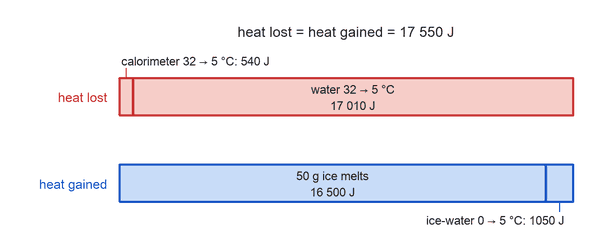
Watch out: Include the heat given out by the calorimeter as well as the water; here L is 330 J g⁻¹ as given, not 336.
Therefore, the mass of ice needed is 50 g.
