Solution:
Concept: Principle of method of mixtures (principle of calorimetry): when a hot body and a cold body are mixed and no heat is lost to the surroundings, heat flows from the hot body to the cold body until both reach the same final temperature, and heat lost by the hot body = heat gained by the cold body. All the ice melts, so the final temperature t is above 0 °C: the ice melts at 0 °C and then the water formed warms from 0 °C to t.
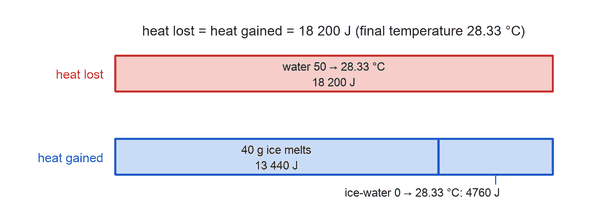
Given: Ice: 40 g at 0 °C; water: 200 g at 50 °C; c = 4200 J kg⁻¹ K⁻¹; L = 336 × 10³ J kg⁻¹.
Step 1 — Change to per-gram values.
Working in grams, c = 4.2 J g⁻¹ K⁻¹ and L = 336 J g⁻¹ (from 4200 J kg⁻¹ K⁻¹ and 336 × 10³ J kg⁻¹).
Step 2 — Heat gained by the ice.
The 40 g of ice melts, then warms from 0 °C to t.
Q1=40×336+40×4.2×t=13440+168t
Step 3 — Heat lost by the water.
The 200 g of water cools from 50 °C to t.
Q2=200×4.2×(50−t)=42000−840t
Step 4 — Equate them.
With no heat lost, heat gained = heat lost.
13440+168t=42000−840t
Step 5 — Collect the terms.
Add 840t and subtract 13440 on both sides.
1008t=28560
Step 6 — Solve for t.
Divide by 1008.
t=100828560≈28.33 ∘C
Watch out: The melted ice also warms up to t; include its 168t term.
Therefore, the final temperature of the water is about 28.33 °C.
